There was an awkward silence before I spoke today. Then I launched into the lines from The Princess Bride, “Mawage. Mawage is wot bwings us togeder tooday. Mawage, that bwessed awangment, that dweam wifin a dweam… And wuv, tru wuv, will fowow you foweva… So tweasure your wuv.” It was just some silliness for April Fool’s Day, but I have been thinking about what it means to be a fool or wise. Some memories are colored by foolishness and wisdom.
When I was student in my undergraduate studies I roomed with Tim Morgan and Ian Morris.

From left: Tim Morgan, Ian Morris, and Peter Worrall ‘celebrating’ the day that the first President Bush invaded Iraq – foolish.
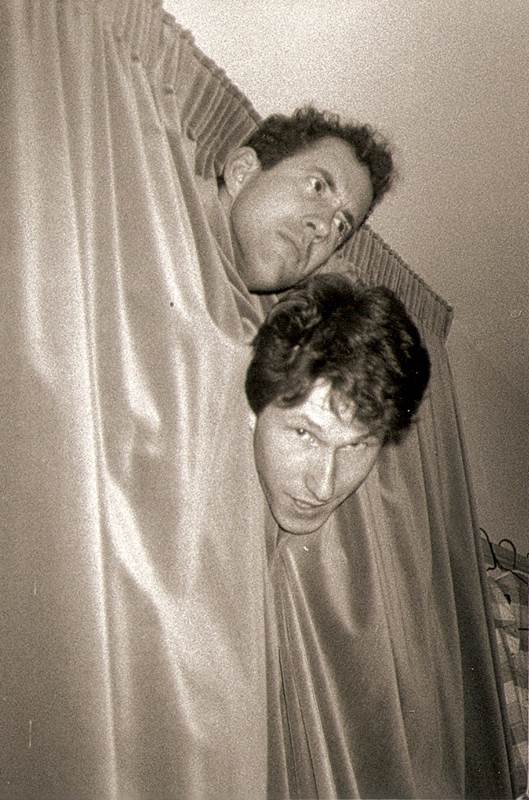
They were lovers of practical jokes and I was on the receiving end of many of them. One day I found all my underwear frozen in the freezer; another day I went to use the shower only to have them throw back the curtain and shout, “Surprise!” When I had a date they kept spying on us through my door with a 6 foot cardboard tube. I wrote her a poem about how we would soar on wings like eagles. Rather than an eagle motif, I found they had whited out the word eagle and replaced it with chicken. They filled my bed with cornflakes. They even locked me out of the house when I had stepped outside in nothing but a towel. Every day was April Fool’s Day when I lived in Looseleigh Lane!
Most people become wiser as they grow older. Some more noticeably than others. When I was in my twenties I did some foolish things. Some of those foolish activities have left marks, other foolery has been covered by God’s grace.
In Cornwall, England in the middle of the night my friends and I would drive to the beach and go swimming in the Atlantic Ocean.

Trebarwith Strand, Cornwall
In Japan, in the early hours of the morning my friends and I would race up the outside of Kochi Castle and then race back down again.

Kochi Castle, Japan
In Pakistan I walked a mile across the Batura Glacier in the middle of the night looking for a friend called Troy. What made it worse is that I was calling out his name as I went.

Batura Glacier, Northern Pakistan
I married a woman who wasn’t entirely wise in her twenties.

Kelli Kolesar (now Worrall) in her twenties.
My wife did some foolish things in her twenties too. On her blog, thisoddhouse.org, she has also taken time to write down the wisdom she has learned since her twenties. Relevant Magazine picked up the article 20 Things I Might Have Told My 20-something Self. Here are some of her pearls of wisdom:
http://thisoddhouse.org/2014/01/28/20-things-i-might-have-told-my-20-something-self/
How does one grow from foolishness into wisdom? Firstly one lets the wise hear and increase their learning. Secondly one fears the Lord.
If we look for wisdom in the Bible we often go to the wisdom literature and arguably the most famous book of wisdom is the Book of Proverbs. Proverbs does not always seem accessible. My friend Marcus once said that Proverbs is like an explosion in a fortune cookie factory. However, there is order to the book. The first nine chapters of Proverbs provide context for what follows. The first chapter of Proverbs provides an introduction to the whole book. To answer how one grows from foolishness to wisdom, we’ll focus on this introduction. Verses 1-7 of chapter one open the book like this:
The proverbs of Solomon, son of David, king of Israel:
2 To know wisdom and instruction,
to understand words of insight,
3 to receive instruction in wise dealing,
in righteousness, justice, and equity;
4 to give prudence to the simple,
knowledge and discretion to the youth—
5 Let the wise hear and increase in learning,
and the one who understands obtain guidance,
6 to understand a proverb and a saying,
the words of the wise and their riddles.
7 The fear of the LORD is the beginning of knowledge;
fools despise wisdom and instruction.
The first verse serves as an introduction to the book. The Proverbs are said to be of Solomon. However, Solomon wrote 3000 proverbs, and there are many less in the book of Proverbs. This can not be all of his Proverbs. Also, particularly toward the end of the book, we see that not all the Proverbs are generated by Solomon. The book of Proverbs is an anthology which is comprised mostly of a selection from Solomon.
At this point, it is good to remember who Solomon was. His success was that he asked for wisdom when God offered him fame, wealth, or wisdom. However, despite his wisdom he became a fool. His foolishness was reflected in how he married many women and divided his loyalty between the God of his father and the gods of his wives. However, Solomon as a name is associated with wisdom. If one was collecting words of wisdom from the time, to form a collection around Solomon would be wise. However, we can assume that those who compiled the book included a number of sources. Solomon’s name acts as both an endorsement and a warning. Solomon shows us that if we know the ways of God and we do not live in them, ultimately we will be a fool.
Nations surrounding Israel also valued wisdom. Sumerians and Egyptians both had strong wisdom traditions. The Egyptian wisdom tradition most closely resembles that of the Jewish people. Maybe the style or form was influenced by the Israelite time in captivity. However, Israelite wisdom literature is distinct in a number of ways. Perhaps the most distinctive way is the centrality of theology to the Proverbs of Israel. Jewish wisdom literature did not know any domain that was secular.
Proverbs, in general, talk about life. They work differently than the wisdom of Greece or Rome. Using parallelism they smash together two different perspectives on the same issue. We have probably studied similar, contrasting, and continuing parallelism. Hebrew poetry uses parallelism to craft artistic sentences. Similar parallelism puts two perspectives in a couplet that states the same basic idea in each line. Contrasting parallelism creates a couplet where ideas that are opposite or images that contradict are jar the reader’s equilibrium. Continuing parallelism extends the concept in the first line through a second line. However, wisdom literature uses the structure of Hebrew poetry to compare, contrast, or extend familiar life situations.
The word translated proverbs in the first verse of proverbs has a broader meaning than its English equivalent. The Hebrew word also includes riddles and parables. However, the function is the same. Life situations are condensed into similarities, contrasts, and extensions. The first listening does not always clearly communicate the intended meaning. Wisdom requires deep internalization of information to the point that it becomes personally meaningful. The disciplined student is separated from the undisciplined. The fool is more and more distinguished from the wise. The fool chooses ease and comfort, but the wise person seeks out the teacher and questions them further until they truly live out the words that the teacher communicated.
Proverbs and the wisdom tradition are not just an Old Testament form that was lost with the coming of the Messiah and the New Testament. Jesus is a sage in the ancient Jewish traditions of wisdom. Of course, he uses parables, which are extended proverbs. He hints after telling story that it is more than a pretty picture of life, but he says, “He who has ears to hear, let them hear.” Then he walks away. It is only to the disciples who follow him that he reveals the fuller extent of his communication. Jesus throws out statements that are proverbial in their structure, “Foxes have holes and birds of the air have their nests, but the Son of Man has nowhere to lay his head.” So, those who wish to serve Jesus would do well to brush up on their understanding of Proverbs and Wisdom literature. A deeper understanding of the genre opens us up to Jesus’ teaching in a whole new way. Jesus was the perfect Rabbi, but he walked in a tradition of Rabbis which went back for centuries.
The Book of Proverbs itself has great educational value. It is a book for parents who were teaching their children. However, the way that it teaches and the principles that it teaches should be embedded in all formal, semi-formal, and informal education. The goal of teaching is not to pass tests and get good grades. The goal of education is not economic success or self-sufficiency. Proverbs 1:1-7 gives us a foundation for all education and Proverbs also teaches us its goal.
To move us from foolishness to wisdom the opening statements of Proverbs give us two pieces of advice. Proverbs 1:1-7 gives us one command and one principle. The command is found in verse 5 and the principle is in verse 7.
The Command in Verse Five
Starting with verse 5 we see the same command stated twice in parallel structure.
Let the wise hear and increase in learning,
and the one who understands obtain guidance
The word let is an interesting command for the writer to give to the student. It sounds passive to our active 21st Century ears. We are used to wisdom being down to the individual. The word obtain sits with us a little more easily. Starting with let, sounds like an invitation to sit on our behinds. It sounds like an invitation to the kind of laziness that Proverbs in other places speaks strongly against. However, the word let takes the mind back to the creation account of Genesis 1. In each day of Creation God commands creation to let new creation come. God is the source of all things of worth in the world and beyond it. God is the source of wisdom but there is a certain releasing that must occur for wisdom to have its full affect. I must release the ideas that I am the source of wisdom, that mankind is the primary generator of knowledge, or that wisdom is secular or godless. When the wise hear, they are letting sages order creation for them in the right way. The attentive student sees the Creator God speaking through his creation in ways that help him or her live in harmony with its systems. In letting wisdom happen, the wise child becomes an agent of God who lives life the way it was designed to be lived.
Obtain, though contrasts the word let. The let side of the coin is a surrender to wiser, more godly persons. The obtain side of the coin is that one goes on a quest. Not all people are equally godly and wise. Not all places are conducive to learning. The young learner must navigate stormy seas and walk through wilderness experiences to find the lessons that God wants to teach them. To abandon oneself to the tempest or surrender oneself to the drought is fatal. The believer must work in harmony with the work that God is already doing. One actively paddles down the stream that God has provided to move toward learning and guidance.
The wise and the one who understands are one in the same person. Wisdom brings a deep comprehension of the world in which we live. The wise person can discern the way the world really is. Hearing and increasing in learning is equivalent to guidance. When one is given direct instruction from a wiser individual one must hear. There are many obstructions to hearing. Some are the result of living in a fallen world. Some do not hear because they are in deprived circumstances, they may be abused by their family, they may not have access to good schooling. In the context of the passage, the ones who are teaching are to be the parents. The Israelite youth could choose whether to listen to their parents or to ignore them. Choices were as authentic in the ancient world as they are today. We know that Solomon’s son Rehoboam had a problem accepting advice from those who were older than himself. He chose to listen to his peers to the ruin of Israel.
Also, increasing learning can be hard work. There are so many things in life to be experienced. There are so many distractions to satiate the senses. Why would one expend energy on boring stuff like learning from parents, or the older wiser sections of society? Proverbs seeks to answer that argument. It is important to gain guidance. Some choices are fairly innocuous, like whether to drive or take the train to work. However, there are choices where seeking to rely on our own intuition is dangerous and foolish. It is wise to let God instruct through those who know him.
To persuade the young person to walk the path of wisdom and not foolishness, the rewards of wisdom are outlined with the recurrence of the word to. In the parallel lines of the verse two, one knows wisdom and instruction and understands words of insight. One creates a body of knowledge that can be applied to life. The information that one has are not only comprehended, but they give the one who has them the inside scoop. Many mistakes are made in life because someone does not have inside information. A boy who doesn’t know how to tell if a bear is living in a cave might make a fatal mistake when choosing shelter on a wilderness expedition. The girl who doesn’t know how to spot a compulsive cheat and liar may make a series of terrible decisions in her dating relationships. Life is qualitatively better for those who know enough facts to make good decisions. Is it better to be the one who ‘gets it’ or the one who is shrugging their shoulders and saying, “You lost me?” Proverbs assumes it is better to be in the know and provides a path to get there.
The second couplet which explains the benefits lists four: wise-dealing, righteousness, justice and equity. We can see the judicial overtones here. One does not only judge their own decisions well, but they can judge whether others have made wise and fair decisions. Some people may be turned off here by the idea of being judgmental. It is true that a follower of Jesus is not to be judgmental. We are not to condemn other people. To judge can mean to condemn, but it can also mean to discern. In the meaning of discern the Christian is to have good judgment or discernment. Since life is shaped by our choices in many ways, there are good choices and there are mediocre choices and there are downright awful choices. To judge that someone standing in front of a freight train is bad, and to push them out of the way, is not a decision that condemns a person – ironically they are saved because of your judgment. If we want to know what values are right and which ones are wrong we must obtain wisdom. To be righteous is not to be snooty or condemning. It is to walk on a path that is right. To be righteous is to walk in a way of life which straightens itself out and makes rough terrain smooth. It is to make decisions that are best for everyone in the long run.
Social justice and wisdom are connected. Social reform can not happen if a person believes that there are no moral or ethical guidelines in life. The more we know the way the poor are to be liberated, how the hungry can be fed, or the disenfranchised are to be empowered, the more we can liberate them in ways that will be truly freeing. So often we leave people in the appalling conditions we find them because we lack wisdom, judgment, discernment.
Equity is not the same as equality. Equality means that everyone gets the same thing. Equity means that everyone gets what they need. Solomon, as king of Israel, would not have given all of his subjects swords and armour. That would be equal, but only soldiers need military equipment. Solomon, as a wise king, would not provide state assistance for everyone. He would release funds and resources to those who need them.
In some ways, the simple of verse 4 may be confused with the stupid. However, the simple refers more to the undeveloped because they are children or youth according to the context. Children do the silliest things because they lack insight. It is good to maintain a child-like innocence with regard to evil, but there is something sad about a childishness that refuses to grow up. We see in life that those who keep company with wise people often have a wisdom beyond their years. Those who read books and apply them to life are more likely to do well at life.
A young man or woman in ancient Israel became wise through the pedagogy, or the teaching technique of using parables, riddles, and proverbs. Each of these modes of teaching deliberately obscures the meaning. Each of these modes of learning makes life hard for the learner. In some way, though. This activates the brain and teaches lessons on a deeper level.
My Uncle Den took me under his wing rather like a sage. He called himself the Angry Old Man and he encouraged me to be angry. Angry about injustice. When I was a missionary he addressed his letters to the Angry Young Man and they were frequently in the form of poems. Even the address he put on his letters was more obscure than a normal address. He wrote the address as an absolute location in degrees, minutes and seconds. A letter from my Uncle could not be just read once. It had multiple levels of meaning and had more value as you delved into it. When I came back to England from Japan once, we sat on the rocky cliffs of Bovisand as the sun set. He would test me with questions and we would talk about biblical truths, poverty in Kenya, international politics, and family relationships. He lived out the principles that he espoused. He was a leader in his church, he traveled the world donating time and funds to those in lesser circumstances than himself. My Uncle also tried to be holistic in his living. He lived out the life of God in keeping physically, mentally, and spiritually fit.
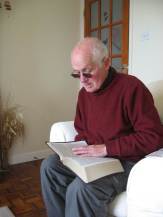
Uncle Den, the last time we met.
When I was doing life with someone like my uncle who sets such high standards for themselves, I could have given up or chosen to pursue the standards that he set himself. I had to make a choice whether to dialogue with him or whether to disengage. He would ask hard questions and he would speak hard truths. I remember the time when he asked if I had joy in my faith. It cut quite deeply because I knew it was lacking. However, the more I spent time with him and the more I listened to him, the more I became fit in mind, body and spirit.
When applying this passage to our lives, we can apply it as the teacher or the learner. As the teacher we can ask ourselves what we bring to the student through our teaching. My first application for the teacher is to ask, do we present a wisdom that truly makes life better? Some of us work with those who live in difficult neighborhoods. We want to help them to be wise because it will change their chances in life. We must look into their environment and study books like Dr. Fuder’s Heart for the City to see what opportunities there are to make the neighborhoods a better place. When we see a path to hope in the world, we can pass that on to those who do not have hope.
The second application I make for the teacher is to develop trust and relationship with the student. A potential block to a student receiving instruction in wise dealing, righteousness, justice and equity is that the student may come from an environment that has been unjust and corrupt. They have learned patterns of mistrust and crookedness. Before demanding a student receive the truths that their way is not the best way, the teacher must show them that they have the student’s best interests at heart. Righteousness will result from a faithful teacher walking alongside a hurting student. However, this will only occur if the student feels safe and secure and unconditionally accepted. Christ models this by showing God’s path of wisdom. It was whilst we were still sinners that Jesus died for us. He accepted us in unrighteousness so that he could lead us on the path to righteousness. Writing someone off before they have been given a chance does not extend the grace we have received. Leaving someone in the hateful condition that you find them is not to walk in the way of love.
A third point to consider as a teacher is whether to make access to wisdom easy? MIT have done studies in motivation and they have found that people are not actually motivated by ease and comfort. They do not achieve anything of significance if you increase financial rewards for anything but the most mindless tasks. MIT found that the pedagogy of Proverbs works. If you give people trust and a challenge, it is found that people perform best. Teachers need to assess what their students are capable of and then give them some of the tools to achieve God’s goals in their lives. Then it is best not to spoon feed students, but have them work out the problems for themselves. In so doing the student both learns and owns the information and it transitions from knowledge to wisdom.
What about the lessons to be learned from this passage as a student? Firstly we need to see that we both let and obtain. We let the natural laws of God’s creation, the truths of scripture, and the experiences of godly mentors soak into our lives. It is so easy once someone has hurt or betrayed us to shut down in some way. It is too hard to keep learning and growing once we have felt stupid or belittled by a throw away comment from a professor or a peer. Life’s hard knocks can work against wisdom sometimes, but to cease taking in the truths that God communicates through many avenues is to cease to grow. Some youths are stunted or have died, even though their body is still living.
A second application of verses 1-6 for the learner is applying the word obtain: there must be some pursuit on the part of the learner. We can not passively sit by and expect all things to come to us. As a professor, I struggle to teach both those who are shut down and those who are not advocates for their own learning. The one often implies the other. A student who is shut down and is not letting the wisdom of God reach them is often apathetic and inactive with regard to the pursuit of wisdom. It requires bravery sometimes to ask a professor to explain once again an assignment that wasn’t understood. It requires courage to keep reading the third explanation of a theological principle that baffled you through the first two readings. It is uncomfortable to ask an older man or woman to take time to be a mentor. The Bible doesn’t always make sense. In education we talk about internal and external locus of control. Those who see that they have no control over their own lives, who think that control is external, show evidence of underachieving. They whine and they complain about how someone else should take care of them, and as much as they allow that to happen, they do not grow up and take care of themselves. Those who persevere and see understanding as a challenge get their reward.
It is good, as a student, to evaluate what is really important in life. As part of that assessment, it is good to think whether we have the tools to achieve. Proverbs teach us that wisdom and understanding are attained through the acquisition of knowledge. We must study and work hard to become righteous and discerning in life. There must be an exercising of the mind.
A final application for the student is to deal with times when God is hidden. The fool in those times stamps their feet and possibly insists that God does not exist. However, God teaches us pursuit by hiding himself. God moves us by moving. As he disappears over the horizon, the wise person perspires and keeps moving to the last place they saw God. The fool judges everything by their own perception. They think riddles are stupid. They think the Bible should be easy to understand. They lack faith. They wither and fall away. Those who examine spiritual formation talk of a wall or a long dark night of the soul. In this time, Sunday School answers no longer satisfy. People who quote Bible verses and promise quick solutions become annoying. The solution comes as they surrender to the God they can not see or understand. Then they find that though there may be pain in the night, joy comes in the morning. I have found the popular quotation by Oliver Wendell Holmes Junior very encouraging: “I would not give a fig for the simplicity this side of complexity, but I would give my life for the complexity on the other side of simplicity.” In our naïve state we spout biblical truths without a deep grasp of what they mean. However, once we have experienced the nature of God’s reality, and the harsh truths that come from living in a fallen world, the simple truths we rattled off in our immaturity become immeasurably more profound.
So we have examined the command in verse five and the rewards that the command brings. We are to obtain wisdom, but what is the foundational principle in the pursuit of wisdom. How does one start?
The Foundational Principle of Wisdom in Verse Seven
The Bible gives both the foundational principle for wisdom and foolishness in verse seven:
The fear of the LORD is the beginning of knowledge; fools despise wisdom and instruction.
To get the negative out of the way, to ruin life, according to this verse, is to despise wisdom and instruction. This is not so much an emotional hatred as much as to turn away. One becomes a fool by becoming unteachable. People become unteachable when they think they know all that there is to be known, or people are fools when the learning process causes them discomfort in ways that they are not willing to address. An arrogant person, like me as a teenager, becomes unteachable when they lose trust in others’ ability to teach them. We may have had that science teacher who couldn’t solve the simple physics equation. We may have had the parent who kept telling us what to do, but they went through a divorce and we suspect they have problems telling the truth. However, shutting ourselves off to truth is only possible when we see the source of truth as being an untrustworthy source. God is the eternal source of knowledge and truth. Some people have learned only to depend on themselves and this makes them unteachable.
Others have been hurt or believe that it is unsafe to be imperfect. In the home some siblings destroy each other in a competitive family by playing general knowledge quizzes. In other homes, parents shame children about their lack of insight, so a child soon learns to say, “I know, I know,” when in fact they don’t know. They can’t possibly know because they have shut down the learning process. A popular TED talk addresses how people feel when we know we are wrong. It then talks about how we are all incomplete and wrong about many issues. If we can accept being wrong, we can address our deficiencies. We can learn. However, many people can not be wrong and when that happens they become fools.
 The foundation for true knowledge and wisdom is the fear of the Lord. When I first encountered this term the-fear-of-the-Lord, I broke it down into its component parts. I embraced the idea that I should be petrified and that the object of my constant petrification should be God. However, I have since found that the fear of the Lord should be understood as a concept which can’t be broken down into its composite parts. I found the Moody Commentary very helpful when looking for a definition of the fear of the Lord. David Finkbeiner cites Wetke when he writes, “The fear of the Lord is a reverential awe toward Him. It involves taking Him seriously; both fearing his judgment and holding him in the highest respect and love. The term likely has both rational and relational aspects. Rationally, it refers to knowledge of the Lord’s special revelation. Relationally, it involves the wise man’s worship of the Lord, a worship that entails reverent fear, love, and trust (Rydelnik & Vanlanningham 2014) .” Another definition I have found was one by Eugene Peterson in his book Christ Plays in Ten Thousand Places. I am a lover of Lewis and Tolkien, so the fact that he draws on the mythological to explain the fear of the Lord really appeals to me. He explains that “a world has been opened up to us by divine revelation in which we find ourselves walking on holy ground and living in sacred time. The moment we realize, we feel shy, cautious. We slow down and look around , ears and eyes alert. Like lost children happening on a clearing in the woods and finding elves and fairies singing and dancing in a circle around a prancing two-foot high unicorn, we stop in awed silence to accommodate to this wonderful but unguessed-at revelation. But for us it isn’t a unicorn and elves; it is Sinai and Tabor and Golgotha (Peterson 2005, 41).”
I teach a class called Faith and Learning at Moody. In this class we eliminate the concept of the secular. This is because each inch of creation belongs to God. Even evil is the corruption of God’s stuff, it is not the creation of anything new. That is why evil is abhorrent. When we realize the enormity of God and accept that in him we live and move and have our being, life can never be the same again. Creation is much bigger than we perceive. When we walk around our cities we see manmade structures and we believe that God is absent in the cold reality of concrete and steel. However, even the most grotesque sculptures or the most hideous songs are shaped or sung with resources given by God. The doctrine of the immensity of God says that because God is infinite with regard to time and space, he fills all of reality. Mankind through education, habit, and blindness ceases to see God in every aspect of living. In so doing we become fools.
The wise person learns about creation in such a way that God fills all of it. The awe of the mountaintop experience has the observer burst out in worship. The ripple of the brook is a delicate creation of an imaginative God. Hymns like, How Great Thou Art give testimony to an appropriate response to the natural world. However, the pinnacle of God’s creation is mankind whose true nature would cause us to be tempted to worship each other as gods, says C.S. Lewis. The fact of the matter is that the fear of God is not cultivated in our times because we do not see the God of creation beyond creation. We are awed by the expanse of the universe, by the majesty of a super nova, or by the energy of the sun. However, in capturing something in the words of science, we have lost everything in losing our theology.
The Proverbs know nothing outside of the reality of God. The inability to escape from God and the constant understanding that God is sustaining the largest and smallest aspect of living, causes a reverent fear to break out that fills life itself. The wise man sees God through every subject in the curriculum. The fool sees no such thing. This should shape how we approach schooling. In intertestamental times Jewish children were educated in the House of the Book associated with the local synagogue. We can not state with confidence how Jewish children were educated during the Israelite monarchy or before. If it was like later patterns, the child would go to the temple in the morning and then would come home in the afternoon. In the morning Torah was memorized and in the afternoon the child would learn housekeeping if she was a girl and a trade if he was a boy. However in the whole process there was no division into sacred and secular. One learned one’s theology in the morning and then applied it in the afternoon.
Hele’s School in Plympton, England was where I studied when I was a youth. The subjects of Mathematics, English, History, Geography, German, Physics, Chemistry, and Physical Education were my focus until age sixteen. Then I narrowed it down to Physics, Chemistry and Mathematics until I graduated from the sixth form in 1988. It was a school with a reasonable reputation, but it secularized my thinking. My belief in God was not belittled in the classroom, though in the hallways and home room I was mocked for my beliefs. The secularization came about because God was never mentioned. God was silent in Mathematics, God showed no interest in Geography, God had nothing to do with language acquisition. However, a godly student lays God as the foundation and walks with God through their studies. The content itself is the stuff of God, not just the behavior of the instructor or the students. My mind was indoctrinated into secular-humanism, but I was unaware of it. It was an unquestioned presupposition, a blind assumption, that the objective perspective to study the world’s knowledge was not the perspective of the God who created it, but the limited perspective of the man who consumed it. Education was not an act of worship walking in the fear of the Lord, it was an act of drudgery memorizing impersonal facts which had to be reproduced for no higher calling than to work in a bank or get into a college to further one’s own personal calling.

So, this begs the question, how are we studying now? How are we gaining wisdom? Are we foolish or wise? Fools despise wisdom for many reasons. One reason is that their relationship with God may be broken. There are many in the church who pay lip service to a healthy relationship with God but who in their hearts despise him or run from him. One can not find true wisdom whilst estranged from its source. The epistemology of true wisdom is personal. If our personal relationship with God is tortured or broken, our ability to see the way the world truly is becomes compromised. The first step to perceiving reality correctly is to be authentic about God and with God. The first step to walking in truth is to know the Truth. Christians sometimes flounder after conversion. In fact, it is problematic if Christians do not flounder. Authentic relationships are hard and maintaining a relationship between a finite, mortal being and an infinite, immortal being is no exception. He is holy, completely distinct, and so understanding him is not as simple as understanding any aspect of his creation. A wise person finds that the sermons from the pulpit, systematic theology, or words of encouragement from a Christian friend, do not always satisfy. Our attempts to bring God into the realities of our daily living fall short in capturing all of who he is. Sometimes we want to control God, feel safe with him, and feel accepted by him. When that doesn’t happen in ways that we anticipate, we walk away from him. This is foolish, but it makes sense in a broken world which hides God in the rubble of sin and depravity. However, if we will sit before him in submission and wait upon him for wisdom, wisdom will flow from a restored relationship.
Mostly, fools despise wisdom, it would seem, not because they have intentionally given up on God, but because of flaws that eliminate the possibility of spending time with God. In other words, our response to sin leads to foolish living. We are enticed by sin, it sucks us in and it changes the pattern of our minds. For example, many people buy into the myth that a busy schedule means importance. My worth is measured by the number of tasks I complete, or the number of appointments in my diary. They may acknowledge that they should free up time for God, but the tyranny of the urgent keeps them from thinking on any level deeper than simple problem solving. There in itself is a problem. Wisdom requires thinking beyond the completion of tasks. Wisdom requires thinking whether the task itself is valid. Is this the best use of time and resources? The ultimate questions which point to wisdom are, “Is this task what God wants me to do?” and “How does God want me to address this task?” However, many people live in misery because they are just completing task after task without seeing whether the task serves a higher person or whether it is what God would have them do. Although, to many, this state of afairs seems neutral but sad, it is sin. It falls short of the standards that God has for living. The God ordained life is mindful of God. To quote brother Lawrence, it practices the presence of God. In a peculiar sense, dishes done thoughtfully for the Kingdom of God are infinitely more valuable than dishes done quickly with the mind on the next task at hand. This is where many people live. Their minds are not on the present, but they are always living in tomorrow. However, Jesus in his wisdom told us not to worry about tomorrow because tomorrow would bring enough worries of its own.
Guilt and shame shut people down. In a conversation, when a person a triggered, they might say, “You just hate me!” or “I’m done with this!” or “Yes, of course, it’s my fault! It’s always my fault!” When these words come out of the mouth, the conversation is usually over. The shame or guilt that the person felt before the conversation has risen to the surface. Often they will blame the conversation, the one they are talking with, or presenting circumstances for this wellspring of negative emotion. However, if they could just stop and realize that the present circumstances do not explain the depth and breadth of guilt, they would see that the problem goes much deeper. Wise people face into their own shame and guilt and look to God to give them strength and healing. However, the fool justifies their inaction by appealing to the magnitude of their pain. They dismiss truth and wisdom because it comes from those who just ‘wouldn’t understand.’ Fools can not heal.
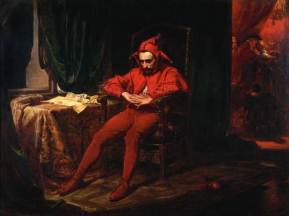
Another enticement that leads to despising wisdom is the pursuit of pleasure. Pleasure is a byproduct of a life of worship, but it is not its aim or focus. Advertising and entertainment assault the senses in our consumerist capitalist society. It is the quickest route to consumption. We often bypass the mind by our appeal to the senses. For example, Coca-cola promises popularity, happiness, and sunshine through the consumption of a syrupy liquid that contains who knows what. Cars are advertised as sexual stimulants that will either bring an attractive woman with them or arouse you in ways that cars have no business doing. However, we are led astray by our desires and reconstruct the consumer myth of happiness through ownership and consumption in our minds. An example of sensual pleasures run amok is the sexual content of media. Sexual practices in the west have not been shaped by sound research, biblical truth, or wise discussion. They have been shaped by subjective tales of pleasure where the consequences of promiscuity, sexual-experimentation, or gender confusion are recast as steps in healthy self-exploration on a journey to self-actualization. In these subjective tales, God is sidelined or sacrificed on the altar to self. The sin of the Garden of Eden is repeated because many people believe that faith in God limits personal freedoms, represses and withholds. We need to open up our minds to an education that sees self as a player in the narrative of God and other. We need to educate away from narcissism and toward submission and sacrifice. The cross does not sound like wisdom to those who worship comfort and ease. We should therefore not be surprised when the results of our foolishness come back to haunt us. If we acknowledge our own guilt and short sightedness we may find the path to wisdom.
As there are many ways for the fool to despise wisdom, but they all melt down to one – sin – so there are many ways to fulfil the precept that the fear of the Lord is the beginning of wisdom. Submitting oneself to the truth is a great place to start. God is Truth, but where is God to be found? He has revealed himself in both special and general revelation. He has spoken through the Bible and the created order. The created order is more difficult to discern, unless one has read how we are to approach it. This means that wisdom needs a steady diet of truth as communicated through scripture. Daily Bible study is not a chore done to fend off an angry God, it is a means to obtain truth. Truth allows one to see the way the world truly is. This in turn is a foundation for wisdom and the fear of the Lord. How is a habit like daily Bible study maintained? One has to have a vision for what will be obtained. Proverbs promises rewards, daily Bible study delivers them. Proverbs speaks of the rewards of discipline; thoughtful meditation on the truths of scripture is a foundational discipline. I find, though, that many Christians are not reading the Bible. Many have ceased to see anything new, some have not got accountability, and others lack time. Those who do not see anything new might push themselves through formal study or a commentary. Enrolling in courses where professors or pastors delve into God’s word can open one up to the riches one has not seen before. Courses are provided at local churches, on-line, or in colleges and universities like Moody. Also, a person who wants to hear a wiser voice can read commentaries or listen to the radio at home. To develop accountability I started posting my daily devotions on my blog at http://theplymothian.me The posts are not polished, but they are not for the public at large. They were originally posted for my small group. I sometimes use them for teaching at Moody, but ultimately now I have got into the habit of posting them as an act of worship to God. Those who lack the time would do well to put devotional Bible study on their day planner as a priority. If someone asks for the time that is scheduled for Bible study, it is legitimate to say that we have something important scheduled at that time.
Another way one would embrace the fear of the Lord is through reading books by those who seem to understand it. Aslan is a great illustration in children’s literature. He is wild, untamed and powerful – however, at the same time he is perfectly good. However, to see God in creation Eugene Peterson’s Christ Plays in Ten Thousand Places would be a good place to start. Authors like Amy Sherman and Tim Keller have written books about seeing God in our vocation. Cornelius Plantinga has written Engaging God’s World which looks at the biblical narrative from a perspective which includes all of creation and not just an anthropocentric perspective. Books like J. P. Moreland’s Love Your God With All Your Mind and Bartholemew and Goheen’s Living at the Crossroads look at how the church can develop the mind and engage with those who have different worldviews. We take in a lot of information from sources which are antagonistic to our faith. It is good to look to sources that can bolster it.
To cultivate the fear of the Lord is to cultivate a healthy prayer life. Personally, I found this one hard. The disciples had to ask Jesus how to pray and in my faith tradition it was sort of assumed that people could just make up prayers as they went along. However, there are certain practices in prayer that cultivate a fear of God. One is taking a Psalm each day and praying it through. Another is the examen prayer which asks God to examine our hearts and reveal to us any places that need transformation. I read Philip Yancey’s and Richard Foster’s books on prayer and found that they opened up to me ways to pray that I hadn’t seen before. Prayer meetings for protestants are often one more chance to open the Bible and read it through. Although Bible study is good, our short attention spans in prayer are an indication of a lack of the fear of the Lord. I let my emotions be a start for prayer. As I feel them shift, I tell the Lord how I feel. The way forward will vary for each individual. Wisdom and the fear of the Lord, though, are found by keeping up a communicative relationship with him.
It is important, then, to find wisdom since we are born naïve and need to mature. With the rewards God has in mind for us, we need to let God’s creation and his word inform us about the nature of reality as it truly is.
Finally, I would like to address the idea of schooling. Our theology has at times informed our education, but too often it falls short of addressing schooling. In the Book of Proverbs we see an education that starts with God, walks with God, and leads to God. This is a model for all education. The content and the system within any educational system must be cognicent that all knowledge has God as its author. Rightly understood, the examination of God’s creation leads us to him. If, like Proverbs, we care about children and their instruction we must invest in a schooling that is godly in its structure. We can not stand by and watch as our children are educated into a secular mindset by the state school system. We need to form a strategy to bring schooling back to God. I obviously think this is important because I have trained up elementary school teachers who do not teach like other teachers. Moody Bible Institute trains teachers who see that God is the foundation of all reality and permeates it at every point. Hopefully they are reforming the schools where they teach all over the world. I pray that their students will grow up to be wise and will gain insight and understanding.
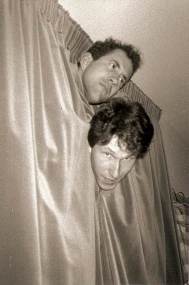

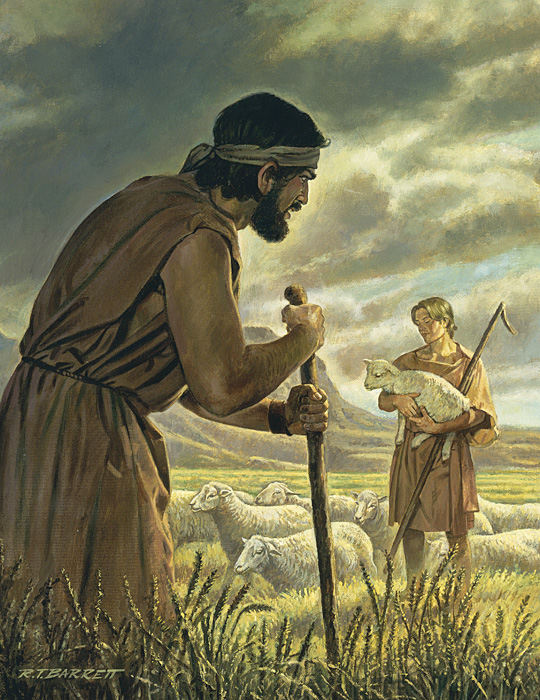









/images/scan0012.jpg)


 Plymothian