Acts 6:8-15 An Angel in Hell

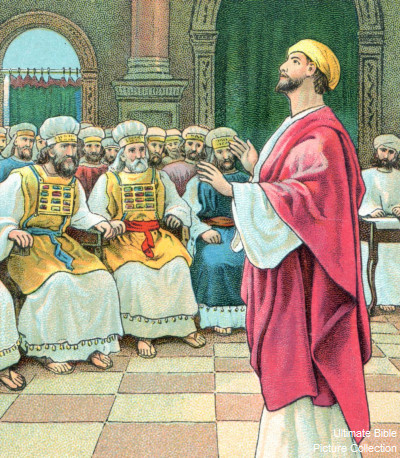
And Stephen, full of grace and power, was doing great wonders and signs among the people. Then some of those who belonged to the synagogue of the Freedmen (as it was called), and of the Cyrenians, and of the Alexandrians, and of those from Cilicia and Asia, rose up and disputed with Stephen. 10 But they could not withstand the wisdom and the Spirit with which he was speaking.11 Then they secretly instigated men who said, “We have heard him speak blasphemous words against Moses and God.” 12 And they stirred up the people and the elders and the scribes, and they came upon him and seized him and brought him before the council, 13 and they set up false witnesses who said, “This man never ceases to speak words against this holy place and the law,14 for we have heard him say that this Jesus of Nazareth will destroy this place and will change the customs that Moses delivered to us.” 15 And gazing at him, all who sat in the council saw that his face was like the face of an angel.

An Angel in Hell

If Stephen’s face shone like an angel, what was that like?  We know that, in the West, the idea of a person being like an angel has a nuance of innocence and simplicity.  That’s not what would be in the mind of the author.  Angels are the messengers of God who are met with fear.  The righteous purity of Stephen would have been apparent.  He is filled with a power that provokes those who surround him with a desire to murder.  However, he is unafraid.

We need wisdom like Stephen’s today.  I am told that more and more graduates of Moody Bible Institute are taking to social media to tear down the institute and the professors that have invested in them.  Maybe they think they are doing it for righteousness’ sake?  They accuse us of racism and of being out of date in our opinions on sexuality.  However, these broad strokes, painted by both sides, forget that we are human.  We become an institution called Moody, full of clones called Moodies.  We become enemies who graduated and now are heretic champions of heresay.  In movies like V for Vendetta the masses move for reform in an impersonal crowd.  In Christianity we all have stories.  We all have faces.  But none of our faces are those of an angel.

I fear for the future amidst the falsehoods.  I fear that Moody will be destroyed from without or within.  I fear that Christians may become divided over sexuality and progressives will feel they have done a service to God when they take away my profession and my income.  I fear that conservatives will become angry, ugly, and offensive and will castigate those who struggle.  I fear a great schism that will divide and conquer the faithful – the faithful who are divided on issues but don’t know how to have a civil conversation.

We have spewed our dysfunction all over the media.  We have fought each other in the law courts.  We are making Jesus a laughing stock.  Some of us.

Some of us are silent, some of us are outraged, some of us are scared.

However, I don’t want to fight my brothers and sisters when I do so from such fear.  I don’t want to have victory over those who disagree with me.  I want to embrace the heretic and understand why they are hurting so badly.  I want to console the conservative and know why they despair or fight so hard.

The Sanhedrin acted as one, but it was composed of many.  Nicodemus found Jesus and broke ranks.  They were not of one mind, although they made decisions that were horrific.  So, we can not come together in unity when we dehumanize one another and trigger shame.  Our discussions show that wherever we stand on race, sexuality, worship, or family values many of us are not yet aware that we are already free.  Discussion among free people, in my opinion, would be more productive.

Prayer

Jesus, you have set us free.  I give in to fears that I do not have to hold.  I want what is right.  Eradicate fears of groups that are not like me.  Deal with my heart toward individuals who do not share my views.  Let my fears decrease and the freedom to grow and to discuss increase.  For your glory.
Questions

For the context of my posting above read the news article about Moody at The Chicago Tribune:  http://www.chicagotribune.com/news/local/ct-moody-institute-white-privilege-forum-met-20150309-story.html

  1. Why was Stephen brought to trial?
  2. How is he a model for public discourse?
  3. How is his countenance described?  What does that mean in the original context?
  4. What public debates involve Christians today?
  5. How might God use the current hot topics around Christianity in powerful ways like God used Stephen?
Leave a comment

Acts 6:1-7 Church Admin

Now in these days when the disciples were increasing in number, a complaint by the Hellenists arose against the Hebrews because their widows were being neglected in the daily distribution. And the twelve summoned the full number of the disciples and said, “It is not right that we should give up preaching the word of God to serve tables. Therefore, brothers, pick out from among you seven men of good repute, full of the Spirit and of wisdom, whom we will appoint to this duty. But we will devote ourselves to prayer and to the ministry of the word.” And what they said pleased the whole gathering, and they chose Stephen, a man full of faith and of the Holy Spirit, and Philip, and Prochorus, and Nicanor, and Timon, and Parmenas, and Nicolaus, a proselyte of Antioch. These they set before the apostles, and they prayed and laid their hands on them.

And the word of God continued to increase, and the number of the disciples multiplied greatly in Jerusalem, and a great many of the priests became obedient to the faith.

Church Admin

The followers of Jesus were growing so that it became impossible to administrate the group efficiently.  Those who had started in leadership had gifts which were ample for a few thousand, but now the church had grown to a size beyond even that.  The apostles had a particular responsibility to talk of all that they had been taught and had seen.  Not everyone could do that job, but now they were able to teach and witness less because of the day-to-day administration of the daily needs of the church.

As usual, those who are struggling attribute blame and the accusation was that there was an unjust favouritism toward the Jews from Israel.  Those Jews who were culturally Greek were feeling that they had been overlooked when they became Christians.  The apostles commissioned 7 leaders to serve as administrators.  We are given Greek, Hellenistic, names for them which shows a welcoming of Greek culture.  The seven might have had Jewish names, but those are not given so that a sense of unity is communicated with those who are suffering.

Some might see a two-tier priesthood here.  The idea may be that the apostles are a class above other people.  Their function was important, but they were not better people because of their role.  There was no cause for feelings or thoughts of superiority.   However, although everyone is equal, not everyone is the same.

We have many different roles that need filling in the church.  Each person has a gift and the gifts need to come together to form a cohesive whole.  A senior pastor can not meet every member of a church and understand them all equally.  We need those who are gifted in preaching, visitation, and administration.  Those who administrate might need to be full time and should be shown great respect.  Some churches focus on preaching as if that is why the church exists.  Other churches might focus on singing or Bible studies.  The question is whether the church is operating in such a way to meet the real needs of its members and to mobilize them all in ministry.  Most churches fall short.  The solution is not to blame some distant person of power at the top of the church ladder.  The solution is to have real conversations with people who share the same values and to motivate each other to action.  We may begin to see how we can take care of some of the church’s issues ourselves.

Prayer

Your church has so many spectators looking on passively.  Help us to both identify the needs and to identify our gifts so that we can take care of those needs.  You have equipped us but we have become lazy consumers in many cases.  We look for a motivated pastor to sort us all out, but we have been gifted in ways that could take care of our own needs.

Questions

  1. What was the blessing in the passage above which put strain on the church?
  2. How was the problem addressed?
  3. What are the cultural implications of the passages above?
  4. What administrative issues strain churches today?
  5. How can they be addressed?
Leave a comment

Acts 5:17-42 The Security of God’s Plan

But the high priest rose up, and all who were with him (that is, the party of the Sadducees), and filled with jealousy 18 they arrested the apostles and put them in the public prison. 19 But during the night an angel of the Lord opened the prison doors and brought them out, and said, 20 “Go and stand in the temple and speak to the people all the words of this Life.” 21 And when they heard this, they entered the temple at daybreak and began to teach.

Now when the high priest came, and those who were with him, they called together the council and all the senate of the people of Israel and sent to the prison to have them brought. 22 But when the officers came, they did not find them in the prison, so they returned and reported, 23 “We found the prison securely locked and the guards standing at the doors, but when we opened them we found no one inside.” 24 Now when the captain of the temple and the chief priests heard these words, they were greatly perplexed about them, wondering what this would come to. 25 And someone came and told them, “Look! The men whom you put in prison are standing in the temple and teaching the people.” 26 Then the captain with the officers went and brought them, but not by force, for they were afraid of being stoned by the people.

27 And when they had brought them, they set them before the council. And the high priest questioned them, 28 saying, “We strictly charged you not to teach in this name, yet here you have filled Jerusalem with your teaching, and youintend to bring this man’s blood upon us.” 29 But Peter and the apostles answered, “We must obey God rather than men. 30 The God of our fathersraised Jesus, whom you killed by hanging him on a tree. 31 God exalted him at his right hand as Leader and Saviour, to give repentance to Israel andforgiveness of sins. 32 And we are witnesses to these things, and so is the Holy Spirit, whom God has given to those who obey him.”

33 When they heard this, they were enraged and wanted to kill them. 34 But a Pharisee in the council named Gamaliel, a teacher of the law held in honour by all the people, stood up and gave orders to put the men outside for a little while. 35 And he said to them, “Men of Israel, take care what you are about to do with these men. 36 For before these days Theudas rose up, claiming to be somebody, and a number of men, about four hundred, joined him. He was killed, and all who followed him were dispersed and came to nothing. 37 After him Judas the Galilean rose up in the days of the census and drew away some of the people after him. He too perished, and all who followed him were scattered. 38 So in the present case I tell you, keep away from these men and let them alone, for if this plan or this undertaking is of man, it will fail; 39 but if it is of God, you will not be able to overthrow them. You might even be found opposing God!” So they took his advice, 40 and when they had called in the apostles, they beat them and charged them not to speak in the name of Jesus, and let them go. 41 Then they left the presence of the council, rejoicing that they were counted worthy to suffer dishonour for the name. 42 And every day,in the temple and from house to house, they did not cease teaching andpreaching Jesus as the Christ.

The Security of God’s Plan

I am fatigued since having my sinus infection.  I am not bouncing back well.  I wonder some days, “Why bother?”  These would be despairing days if I did not believe there was a God.  However, I sincerely believe that God is working out his story through the years of history and we are each playing our part.  In the time of the Acts, Gamaliel knew the futility of standing in the way of God’s plan.  Of course, we also cause heresies to flourish if we do not act.  However, the principle that standing against the work of God is futile is a sound one.  God will accomplish his goals.

So in my tired and weakened state, I do not despair.  I know that in my weakness God is working to do something which will bring him glory.  If his plan is to show his strength in restoring my body, then he is glorified.  If his plan is to show his strength in growing me through a time of physical fatigue, then he is also glorified.  The truth is that, whether through strength or weakness, God is glorified.  I find hope in that.  God’s plan works for his good, but it also works for the good of those who love him.

Prayer

Father, in spite of our weakness, do your work.  Please tell your story and push aside the opposition.  Let us be bold when wisdom dictates that we act.  Help us to be wise when we should take a step back.

Questions

  1. What led to the apostles’ trouble?
  2. What was Gamaliel’s point?
  3. Was he correct in his assumptions?
  4. How is God moving in the world today?
  5. How does God want you to move powerfully as his witness?
1 Comment

Acts 5:12-16 Challenged by Power

Now many signs and wonders were regularly done among the people by the hands of the apostles. And they were all together in Solomon’s Portico. 13 None of the rest dared join them, but the people held them in high esteem. 14 Andmore than ever believers were added to the Lord, multitudes of both men and women, 15 so that they even carried out the sick into the streets and laid them on cots and mats, that as Peter came by at least his shadow might fall on some of them. 16 The people also gathered from the towns round Jerusalem, bringing the sick and those afflicted with unclean spirits, and they were all healed.

Challenged by Power

There seems to be a power at work in society to diminish the faith and undermine believers.  We grow weary in doing good and we are constantly pressured from within and without to give up on serving others and to take care of ourselves.  These last few weeks I have been sick twice, had my computer malfunction, and had my house flood ($11K worth of structural damage).  I could just look at all of these things as coincidence, but I think that they are meant to discourage me.  Following God seems a little like walking through treacle at the moment.  I know that it is good, but I feel unnatural resistance to reading my Bible and when I pray I do not sense the nearness of God in the refreshing way that I did a month ago.

The apostles faced opposition which must have let them wondering how they would ever proceed.  They must have wondered why they were persecuted and whether the message they had been given would ever prevail.  Kelli and I are writing a book to encourage Christians which, we believe, could be the kind of support many twentysomethings need as they feel disillusioned with God and his church.  The faculty at Moody are alarmed at some of the hypocrisy in the student body, and we have been forced to start by examining our own lives and crying out to God that he would work powerfully for his name’s sake.  In these times of resistance and darkness we are seeing lightning bolts of God’s power.  the Spirit is stirring in our midst.  We are challenged  by our own shortcomings and the darkness of this age of diluted truth and foundationless living to pursue God more fervently.  Maybe when we are desperate for him, he will show up with the same power that he does in Acts.

Prayer

Oh God, we are weak and the world seems so confusing and overwhelming.  Opposition to universals and to dogmatic belief are pushing the ‘nice’ people in your church into hiding.  Some are fearful and some are hateful.  Let us be a people who are loving and kind and bold.  Show us the path to work through.  Break the resistance to your Kingdom with the power of your Spirit.  Give us the wisdom that we lack and the eloquence to communicate.  Oh, God, for your name’s sake comfort the hurting and raise up the downcast.

Questions

  1. What factors were working against the gospel in the time of acts?
  2. What support did the people of God have in order to prevail?
  3. Why were people afraid to join the followers of Jesus?
  4. What factors oppose us in the spreading of the gospel and living in the light?
  5. What resources does God give us in order to prevail?
1 Comment

Acts 5:1-11 God Kills A Dishonest Giver

But a man named Ananias, with his wife Sapphira, sold a piece of property,and with his wife’s knowledge he kept back for himself some of the proceeds and brought only a part of it and laid it at the apostles’ feet. But Peter said, “Ananias, why has Satan filled your heart to lie to the Holy Spirit and to keep back for yourself part of the proceeds of the land? While it remained unsold, did it not remain your own? And after it was sold, was it not at your disposal? Why is it that you have contrived this deed in your heart? You have not lied to men but to God.” When Ananias heard these words, he fell down and breathed his last. And great fear came upon all who heard of it. The young men rose and wrapped him up and carried him out and buried him.

After an interval of about three hours his wife came in, not knowing what had happened. And Peter said to her, “Tell me whether you sold the land for so much.” And she said, “Yes, for so much.” But Peter said to her, “How is it that you have agreed together to test the Spirit of the Lord? Behold, the feet of those who have buried your husband are at the door, and they will carry you out.” 10 Immediately she fell down at his feet and breathed her last. When the young men came in they found her dead, and they carried her out and buried her beside her husband. 11 And great fear came upon the whole church and upon all who heard of these things.

God Kills a Dishonest Giver

I know that people are dishonest with their money.  I know that people are not generous with God.  However, the story of God killing a dishonest giver causes me consternation.  What happened is that Ananias and Sapphira sold land and held back part of it for themselves.  When they only gave part of it to God, he killed them.  He doesn’t do that today, as far as I have experienced, so why does Acts include such a story.  One solution is that the story is just plain fiction, composed to create more faithful givers.  This is not an option for me.  I believe it happened.  However, I believe that it stands in much the same way as the story of Achan stands near the beginning of the story of the creation of Israel.

Achan’s death stood as a warning that people could not mess with God.  It was a strong enough shock that the message became clear to all of Egypt that a righteous God does not side with deception.  Lying is a serious crime against community.  In the early days of the church a similar fear is established.  People need to know that the God who is love and provides grace will not allow community to be destroyed by lying and deception.

So, although I don’t like the story, it has its desired affects on me.  I don’t want to mess with a God who takes deception and lying this seriously.  That’s the truth.

Prayer

Father cure the church of deception.  Let us not try fooling people into thinking that we are better tan we are.  Let me be honest in my dealings with the church.  Let my heart be more true.

Questions

  1. What did Ananias do?
  2. Why was he killed?
  3. Why wasn’t Peter killed for lying about knowing Jesus?
  4. How does deception hurt the church today?
  5. How might this story address corruption, lying, and deception in the modern church?
1 Comment

Acts 4:32-37 Are Christians Communists?

32 Now the full number of those who believed were of one heart and soul, and no one said that any of the things that belonged to him was his own, but they had everything in common. 33 And with great power the apostles were giving their testimony to the resurrection of the Lord Jesus, and great grace was upon them all. 34 There was not a needy person among them, for as many as were owners of lands or houses sold them and brought the proceeds of what was sold 35 and laid it at the apostles’ feet, and it was distributed to each as any had need. 36 Thus Joseph, who was also called by the apostles Barnabas (which means son of encouragement), a Levite, a native of Cyprus, 37 sold a field that belonged to him and brought the money and laid it at the apostles’ feet.

Are Christians Communists?

At first glance it looks like Karl Marx drew his Manifesto from verses like these.  The redistribution of wealth is a central tenet of Marxism and wealth is clearly redistributed in this passage.  Those who want to marry Christianity with Capitalism defend themselves by saying that this passage reports an experiment that failed.  In fact, this course of action led to poverty which meant that Paul had to take funds from other churches to prop up the naive and destitute church of Jerusalem.  Of course, this reads the bias of the commentators into the text.  It is quite possible that the early church was always struggling with poverty and it wasn’t brought about by sharing possessions.

A key difference in Christian redistribution of wealth and Communist redistribution of wealth is that the Christian version is voluntary.  It may be justifiable for the state to take from the rich to give to the poor, but the church does not ‘take’ it ‘receives’.  If the church is to manage God’s resources it must have a God-honouring plan.  The church seeks to better people’s lives, so it must reinvest money it administrates sensibly and to eliminate poverty.  We know that many times the lack of wealth within a group is due to ignorance about wealth management or how to utilize resources the group possesses.  The church must become familiar with what really changes the condition of poverty for the long haul and not short-term.

A second point that comes from this passage is that the money was given to a central administrating agency.  The church administrated the gifts of its members to God.  This is descriptive and not prescriptive.  The principle, in my opinion, is that the people of God give at least a tenth of all their money to the service of God.  I do not give a tenth to a church organisation, I give my first tenth to a Christian School.  This is because my church does not give to the school and I think the school is essential in the fight to stop the church sliding into wrong thinking about knowledge and truth.  It is my own belief that every church in the area should support this particular Christian school and understand more fully how to adopt it as one of their ministries.  So, I give, but I do not give directly to the church.  I support God’s work by directly supporting a Christian ministry which, in my opinion, the church neglects.  However, there is something amiss if someone is not freely giving a portion of their wealth to further God’s work in the community.

Prayer

God, we are challenged by the Marxist ideals of helping the poor by redistributing wealth.  We often resent the government taking our money and using it for schemes that we find immoral or wasteful.  However, the people in the churches have not stepped up and given from their wealth to support alternative schemes and to support those who struggle in their own community.  May that change.  Please challenge each of us regarding the stewardship of our money.  Let us give freely rather than build temporary kingdoms that will die with us.

Questions

  1. How did the early church respond to poverty?
  2. Was their response descriptive or prescriptive?
  3. Who administrated the giving?
  4. In your opinion should the church or the state be setting the example of how to redistribute wealth?
  5. How does your wealth become redistributed among God’s people?
3 Comments

Acts 4:23-31 God the Despot?

When they were released, they went to their friends and reported what the chief priests and the elders had said to them. 24 And when they heard it, they lifted their voices together to God and said, “Sovereign Lord, who made the heaven and the earth and the sea and everything in them, 25 who through the mouth of our father David, your servant,said by the Holy Spirit,

“‘Why did the Gentiles rage,
    and the peoples plot in vain?
26 The kings of the earth set themselves,
    and the rulers were gathered together,
    against the Lord and against his Anointed’—

27 for truly in this city there were gathered together against your holy servant Jesus, whom you anointed, both Herod and Pontius Pilate, along with the Gentiles and the peoples of Israel, 28 to do whatever your hand and your plan had predestined to take place. 29 And now, Lord, look upon their threats and grant to your servants to continue to speak your word with all boldness,30 while you stretch out your hand to heal, and signs and wonders are performed through the name of your holy servant Jesus.” 31 And when they had prayed, the place in which they were gathered together was shaken, and they were all filled with the Holy Spirit and continued to speak the word of God with boldness.

God the Despot?

A despot is someone who has a lot of power over another person or exercises absolute authority.  It is very similar to a dictator.  When you think of a dictator who comes to mind?  Mussolini?  Hitler? Pol Pot?  In times of trouble the population of a country often turns to an individual who seems to have good ideas but then grasps power as a result.  In Germany after World War I there were harsh conditions because of the sanctions from The Treaty of Versailles.  The economy tanked and it was shameful to be part of a weak Germany.  Then a national leader came who promised strength and unity.  He advocated national pride and saved the economy.  Of course, that person was Hitler.  He looked like he was bringing good but in the shadows of the halls of power he was actually perpetrating profound evil.

In the past many kings have ruled with absolute power.  Some of them have acted benevolently toward their people and sacrificed themselves in selfless rule.  Many of the kings have taken resources from their own people, lived in the lap of luxury and engaged in unlimited vice.

The word sovereign at the beginning of the prayer above comes from the Greek word that is the root of our word despot.  God has no rival and rules as an absolute dictator.  To the early apostles they sought his will above all else and submitted to it as a slave submits to his master.  In their prayers they align themselves with a God who dictates.  In seeking God, they harmonize their story with God’s story – they receive power and boldness.  This is in contrast with the disciples of God today.

Who is the despot that we submit to?  Some may be in abusive relationship with a spouse or a parent where their will is crushed.  That is not most of us.  Most of us are chained to a much more subtle tyranny.  We are slaves to ourselves.  Our first thought in the day is to get what we want.  We seek to arrange our lives around the ideals of our own dreams.  We share power with a spouse only as long as they meet our needs and work toward the same goals.  However, the false self that we serve is a cruel master.  We even become Christians without deposing the self.  We take on a false version of God who is not sovereign, he is not almighty, he is not Lord.  We expect God to facilitate our own dreams and we pray in order to align his will with ours, not the other way around.

The apostles are afraid of the power and authority of the Sanhedrin.  However, they know the absolute power and authority of the God they serve.  Their own authority has been trumped by the historical power structure of Ancient Israel.  They appeal to the highest authority that exists.  They align themselves with God’s desire that the gospel be preached.  This does not make them super-human or invulnerable.  They still become instruments in the hands of a dictator.  However, they are aligned with the side of right.  They are going to stand up for the one who is good.

Today we see people changing their allegiance away from God and his church.  Some people call The West post-Christian.  Those who are progressive think that we have moved away from hierarchical tyranny and embraced a new freedom.  However, the West is weakening its ability to survive.  We have seen this change before.  As each member of an empire becomes too self-important, they begin to do more and more of what they believe is right in their own eyes.  We have become our own gods.  We ignore the facts that our minds are too small and our wills are corrupt.  We do not know that we are blind because we have redefined the darkness as light.

We will bend the knee to someone.  We will obey other humans, some god or other, or our own desires.  Let’s bow the knee to the life-giver who will lead us into the way the world was designed to be.  Like the early apostles, let’s align ourselves with God and walk in his power.

Prayer

God, to relinquish our own power is scary.  We are told so often to be true to our own hearts, but our hearts are corrupted.  We do not choose what is ultimately good and selfless.  Let us submit our own will to your will.  Let us align our own self with you.  May you speak with absolute authority to your church and may she obey.  For your glory.

Questions

  1. What drives the apostles to prayer?
  2. How do the apostles view God?
  3. What does God do for the apostles?
  4. What drives us to prayer in the church today?
  5. Do we serve God or does God serve us?
Leave a comment

Acts 4:1-22 Exclusive Gospel

And as they were speaking to the people, the priests and the captain of the temple and the Sadducees came upon them, greatly annoyed because they were teaching the people and proclaiming in Jesus the resurrection from the dead. And they arrested them and put them in custody until the next day, for it was already evening. But many of those who had heard the word believed, and the number of the men came to about five thousand.

On the next day their rulers and elders and scribes gathered together in Jerusalem, with Annas the high priest and Caiaphas and John and Alexander, and all who were of the high-priestly family. And when they had set them in the midst, they enquired, “By what power or by what name did you do this?”Then Peter, filled with the Holy Spirit, said to them, “Rulers of the people and elders, if we are being examined today concerning a good deed done to a crippled man, by what means this man has been healed, 10 let it be known to all of you and to all the people of Israel that by the name of Jesus Christ of Nazareth, whom you crucified, whom God raised from the dead—by him this man is standing before you well. 11 This Jesus is the stone that was rejected by you, the builders, which has become the cornerstone. 12 And there is salvation in no one else, for there is no other name under heaven given among men by which we must be saved.”

13 Now when they saw the boldness of Peter and John, and perceived that they were uneducated, common men, they were astonished. And they recognized that they had been with Jesus. 14 But seeing the man who was healed standing beside them, they had nothing to say in opposition. 15 But when they had commanded them to leave the council, they conferred with one another,16 saying, “What shall we do with these men? For that a notable sign has been performed through them is evident to all the inhabitants of Jerusalem, and we cannot deny it. 17 But in order that it may spread no further among the people, let us warn them to speak no more to anyone in this name.” 18 So they called them and charged them not to speak or teach at all in the name of Jesus. 19 But Peter and John answered them, “Whether it is right in the sight of God to listen to you rather than to God, you must judge, 20 for we cannot but speak of whatwe have seen and heard.” 21 And when they had further threatened them, they let them go, finding no way to punish them, because of the people, for all were praising God for what had happened. 22 For the man on whom this sign of healing was performed was more than forty years old.

Exclusive Gospel

Peter in front of the Sanhedrin could have made a case for religious pluralism.  He could have said that there are many ways to the one true God.  However, he was more confrontational than that.  He drew dividing lines and expressed the differences between traditional Jewish belief and the beliefs of the apostles.  The Holy Spirit led them to speak in such a way.  It wasn’t nice.  It wasn’t conciliatory.  It wasn’t about to make any friends.  However, it was true.  There is no other name on heaven or earth by which we may be saved.

This is becoming an increasingly offensive message to a world that wants us all to agree.  However, if we all agree we have to empty ourselves of anything that is distinctive.  In many cases this is a harmless agreement on the trivial.  However, to insist that Jews, Christians, Muslims, Hindus and Buddhists are all just saying the same thing at their core –  you gotta have faith – is to empty the religions of what their founders have believed.  In fact, to believe that all the faiths are equal is to create a new faith.  Ironically such a new faith is then established as being superior to all the old faiths.  A seemingly fair dismissal of all faiths asserts that an atheistic position is superior to all others.

Christians have historically insisted upon the superiority of their position and have recently been lambasted for their privilege and arrogance.  However, those who have torn down Christianity have set up a faith of their own and they insist that others adhere to it.

I am afraid to be counted among Jesus’ followers because I do not know what my family will need to sacrifice in years to come.  However, I still believe that Jesus is the historical man written about in the gospel.  I believe he is still working through his church.  I believe that Jesus is the only name through which a person will be saved.  Maybe the haters will hate us, and we will love the world through uncompromising truth.

Prayer

Father, you know that we need your Spirit.  Our clever schemes and our megachurches have watered down the truth and created a sick version of the faith.  Those living in the darkness do not see your light.  May we know what you want to do and may we stand firm.

Questions

  1. How did Peter and John use the opportunity of their testimony to share the gospel?
  2. Why were the Sanhedrin angry?
  3. Why did Peter and John choose civil disobedience?
  4. How does your testimony allow you to share the gospel?
  5. How do you stand for Jesus in the face of people who want to water down the faith or dismiss it as just another man-made religion?
Leave a comment

Acts 3:11-26 Teamwork

11 While he clung to Peter and John, all the people, utterly astounded, ran together to them in the portico called Solomon’s. 12 And when Peter saw it he addressed the people: “Men of Israel, why do you wonder at this, or why do you stare at us, as though by our own power or piety we have made him walk?13 The God of Abraham, the God of Isaac, and the God of Jacob, the God of our fathers, glorified his servant[b] Jesus, whom you delivered over and denied in the presence of Pilate, when he had decided to release him. 14 But you deniedthe Holy and Righteous One, and asked for a murderer to be granted to you,15 and you killed the Author of life, whom God raised from the dead. To this we are witnesses. 16 And his name—by faith in his name—has made this man strong whom you see and know, and the faith that is through Jesus[c] has given the man this perfect health in the presence of you all.

17 “And now, brothers, I know that you acted in ignorance, as did also your rulers. 18 But what God foretold by the mouth of all the prophets, that his Christ would suffer, he thus fulfilled. 19 Repent therefore, and turn again, that your sins may be blotted out, 20 that times of refreshing may come from the presence of the Lord, and that he may send the Christ appointed for you, Jesus, 21 whom heaven must receive until the time for restoring all the things about which God spoke by the mouth of his holy prophets long ago. 22 Moses said, ‘The Lord God will raise up for you a prophet like me from your brothers. You shall listen to him in whatever he tells you. 23 And it shall be that every soul who does not listen to that prophet shall be destroyed from the people.’24 And all the prophets who have spoken, from Samuel and those who came after him, also proclaimed these days. 25 You are the sons of the prophets and of the covenant that God made with your fathers, saying to Abraham, ‘And in your offspring shall all the families of the earth be blessed.’ 26 God, having raised up his servant, sent him to you first, to bless you by turning every one of you from your wickedness.”

At first glance the existence of John in this story seems almost pointless.  He doesn’t seem to say or do anything.  However, what we can know from his presence is that early in the life of the church, life was done in community.  This would include ministry. Peter acted with John present.  They were a team.  There are lots of lone wolf ministers in the church today.  People in the Protestant tradition start up churches and form ministries that rely very heavily on one person.  However, the church in the Book of Acts got along with each other.  There was unity.  The church in the west needs to know how to focus on the work of the Spirit without so quickly seeing the need to divide.

Although the power of the miracle draws a crowd, the response of Peter is thoughtful and reasoned.  He appeals to the body of knowledge which all of his listeners knew.  We too should be reliant on the Spirit but smart.  Many Christians don’t know their Bibles well today and don’t know how to engage with current thought or culture.

In talking with my friend Bill from church today, my heart is stirred to pray that God would move in us powerfully.  Our churches are crippled and struggling and our culture is aggressive against our faith.  It is time to admit that, like Peter and John, we may lack material resources, but we do have the power of the Spirit.

Prayer

Oh God, let us have opportunity to speak lovingly and powerfully to the lost.  They assert that we have no truth, but your truth heals and sets free.  We are crippled Christians limping toward heaven.  Show us ways to move in power so that your love and wisdom may be known.

Questions

  1. How would you outline what Peter said?
  2. What is John’s role?
  3. Where does such boldness of speech lead?
  4. What opportunities do we have in our world to share our faith?
  5. How can we copy Peter’s style?
1 Comment

Acts 3:1-10 Lame

Now Peter and John were going up to the temple at the hour of prayer, the ninth hour.And a man lame from birth was being carried, whom they laid daily at the gate of the temple that is called the Beautiful Gate to ask alms of those entering the temple. Seeing Peter and John about to go into the temple, he asked to receive alms. And Peter directed his gaze at him, as did John, and said, “Look at us.” And he fixed his attention on them, expecting to receive something from them. But Peter said, “I have no silver and gold, but what I do have I give to you. In the name of Jesus Christ of Nazareth, rise up and walk!” And he took him by the right hand and raised him up, and immediately his feet and ankles were made strong. And leaping up he stood and began to walk, and entered the temple with them, walking and leaping and praising God.And all the people saw him walking and praising God, 10 and recognized him as the one who sat at the Beautiful Gate of the temple, asking for alms. And they were filled with wonder and amazement at what had happened to him.

Lame

Peter and John did not break with their Jewish roots.  They kept the regular customs and celebrations.  One of the customs was to give alms to the poor and the crippled.  With very little in the way of social welfare, people who were disabled would have to rely on the kindness of both family and strangers.  The family might place a crippled member of the family on the street. The person in today’s story was lame from birth.  It sounds as if the man was suffering from cerebral palsy.  I am no doctor and not a great biblical scholar, but I have lived with someone who had CP and the description fits.  A lack of oxygen to the brain at birth causes brain damage.  It can be mild or severe, CP has a sliding scale.  That the man is able to communicate clearly would be in line with a milder CP.  However, in an agrarian society, someone who has spastic CP would be seen as a liability.  We need to read more in the text than a purely physical ailment.  This man has experienced shame from birth.  He would have been the son who constantly disappointed.  He would have been the child no-one wanted.  God values people with illness or disease, but society commits limited time to them.  In fact, because the western world is becoming more materialistic, I can see a push for killing children born with disability.  Although Peter Singer seemed radical for his insistence that children with disabilities that prevent them from making decisions are not persons, our society has moved into a godless corner where killing each other seems less crazy.  Peter and John come from an outdated and flawed tradition according to people like Peter Singer, but Peter and John react to the dignity of all human life.  Thinking that people are created in God’s image leads to a more human approach than thinking that humans are just one animal among many.  We should be acting on this principle ourselves.

Peter Singer at Oxford University

Prayer

Dear God, please let our compassion for the lame speak of the truth of our views.  The position that there is no God leads to so many atrocities – may those who are disabled be protected.

Questions

  1. What did the lame man ask for?
  2. What did he receive?
  3. What did this show about God?
  4. What does Peter Singer advocate?
  5. How would you counter Peter Singer?
Leave a comment