Acts 12:20-25 Struck Down for His Remarks

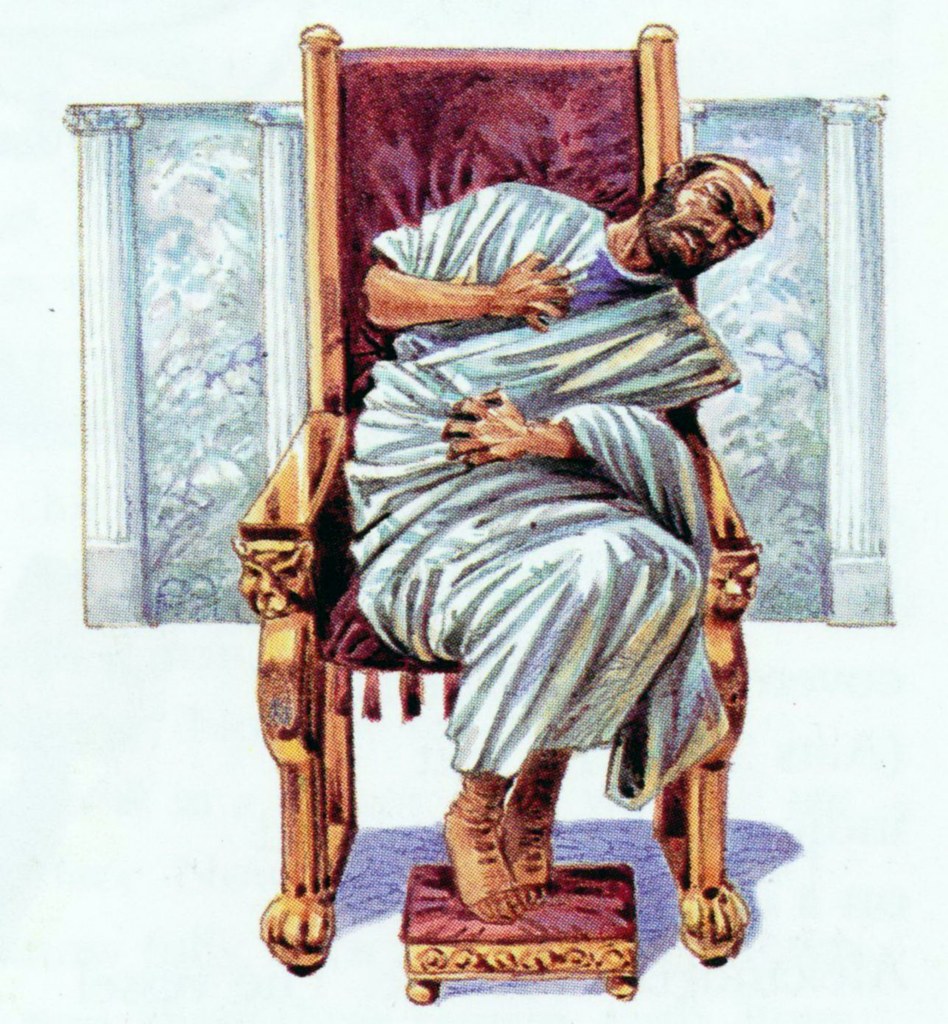
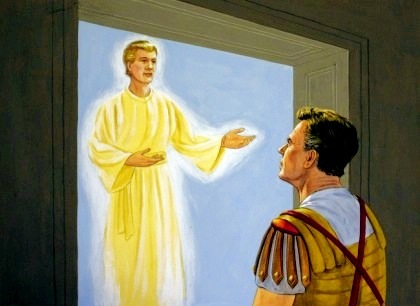
Now Herod was angry with the people of Tyre and Sidon, and they came to him with one accord, and having persuaded Blastus, the king’s chamberlain, they asked for peace, because their country depended on the king’s country for food. 21 On an appointed day Herod put on his royal robes, took his seat upon the throne, and delivered an oration to them. 22 And the people were shouting, “The voice of a god, and not of a man!” 23 Immediately an angel of the Lord struck him down, because he did not give God the glory, and he was eaten by worms and breathed his last.

24 But the word of God increased and multiplied.

25 And Barnabas and Saul returned from Jerusalem when they had completed their service, bringing with them John, whose other name was Mark.

Struck Down for His Remarks

Oratory skill was much prized in the ancient world.  In fact schooling was often broken into Grammar, Logic, and Rhetoric stages.  The grammar stage is where one learns and absorbs content.  In the logic stage one learns what makes a good argument.  The rhetoric stage pulls all the skills together so that a prospective world changer can deliver communication that will carry the day.  Classical Christian schooling movements have adopted this model as a means to regain the kind of minds that Plato, Aristotle, Marcus Aurelius and The Apostle Paul had.  However, before we go too far with this, Herod was also a skilled orator.  Hitler was able to move the masses with his powerful oration.  Historically it has been agreed that pathos, ethos, and logos make up a god speech.  Pathos is the passion with which the speech is delivered.  Ethos is the life behind the speech.  Logos is the content, literally the words, of the speech.  Although Herod, in the passage above, delivered a great speech where Pathos and Logos may have been covered, his ethos was missing.  Herod’s heart was rotten and was devoted to himself.  The people of the region were possibly flattering him when they sang his praises.  However, Herod had ultimately set himself up against what God was doing through his people.  He had killed faithful followers of Jesus and he had imprisoned others.

I can’t imagine what it is like to be eaten from the inside out.  However, the one who looked so good on the outside was disgusting on the inside.  His heart was corrupted and his organs were infested.

Delivering a great speech is a great skill.  However, the passion, and the words must be backed up by a righteous life.  The righteous life will permeate the words that a godly person speaks.  God will bring justice on those who speak falsehoods.  He will ultimately raise up those who speak truth.

Prayer

Father, help us to know what it is to follow you.  Help us to live out our lives with devotion and thanksgiving.  May our lips speak in line with your wisdom.

Questions

  1. How have God and Herod been in opposition?
  2. What is Herod’s problem?
  3. How can God be good and afflict someone in this way?
  4. What powerful people oppose God in our world?
  5. What might be their fate?

Leave a comment

Acts 12:6-19 God Protects (Sometimes)

Now when Herod was about to bring him out, on that very night, Peter was sleeping between two soldiers, bound with two chains, and sentries before the door were guarding the prison. And behold, an angel of the Lord stood next to him, and a light shone in the cell. He struck Peter on the side and woke him, saying, “Get up quickly.” And the chains fell off his hands. And the angel said to him, “Dress yourself and put on your sandals.” And he did so. And he said to him, “Wrap your cloak round you and follow me.” And he went out and followed him. He did not know that what was being done by the angel was real, but thought he was seeing a vision. 10 When they had passed the first and the second guard, they came to the iron gate leading into the city. It opened for them of its own accord, and they went out and went along one street, and immediately the angel left him. 11 When Peter came to himself, he said, “Now I am sure that the Lord has sent his angel and rescued me from the hand of Herod and from all that the Jewish people were expecting.”

12 When he realized this, he went to the house of Mary, the mother of John whose other name was Mark, where many were gathered together and were praying. 13 And when he knocked at the door of the gateway, a servant girl named Rhoda came to answer. 14 Recognizing Peter’s voice, in her joy she did not open the gate but ran in and reported that Peter was standing at the gate.15 They said to her, “You are out of your mind.” But she kept insisting that it was so, and they kept saying, “It is his angel!” 16 But Peter continued knocking, and when they opened, they saw him and were amazed. 17 But motioning to them with his hand to be silent, he described to them how the Lord had brought him out of the prison. And he said, “Tell these things to James and to the brothers.” Then he departed and went to another place.

18 Now when day came, there was no little disturbance among the soldiers over what had become of Peter. 19 And after Herod searched for him and did not find him, he examined the sentries and ordered that they should be put to death. Then he went down from Judea to Caesarea and spent time there.

God Protects (Sometimes)

God is about God’s work and we are his creation.  To keep Peter alive was beneficial for his work, but only for the time being.  Peter, so we hear, was crucified upside down in Rome eventually.  Before this passage James was executed.  God does not rescue people from harm all the time.  He does not always keep his followers safe.  However, in some instances he decides to rescue his followers because it is in the best interests of all involved.

Peter’s story is less about Peter and his friends and more about what God is able to do when he mobilizes his power.  God is not compelled by the moral imperatives that we construct.  We believe that it is right and good that no-one should suffer.  We believe that all god people should be free to live and go about their lives as they choose.  God sees a greater god that sometimes comes through suffering and he sees a greater good that sometimes comes through imprisonment.

Peter’s release shows how important the message was that Peter carried.  If all the disciples were dispatched to be with God in quick succession, who would communicate their eye-witness account of the death and resurrection of Jesus.  God wants the story to be told and so he releases Peter to keep spreading the good news.  Peter is glad to serve God and is surrendered to God’s will.  If by living or dying a disciple serves God, they are open to either option.  Paul puts it well in Philippians when he writes that ‘to live is Christ and to die is gain.’  In this way of thinking James may have had the better end of the deal when he died by the sword and was ushered into the presence of God.

We do not have a faith that thinks in these terms.  We have a faith that chooses ease and comfort.  We miss on seeing God work powerfully because we live in ignorance and cowardice.  Stories like this open us up to possibilities we have forgotten.

Prayer

Lord, we were created for your pleasure.  Use us in life or death in ways that you see fit.

Question

  1. What happened to James?
  2. What happened to Peter?
  3. How have you processed the difference?
  4. Why do we solve for comfort in our world?
  5. What would God do if we were open to both miracle and death?
Leave a comment

Acts 12:1-5 An Apostle Is Killed

About that time Herod the king laid violent hands on some who belonged to the church. He killed James the brother of John with the sword, and when he saw that it pleased the Jews, he proceeded to arrest Peter also. This was during the days of Unleavened Bread. And when he had seized him, he put him in prison, delivering him over to four squads of soldiers to guard him, intending after the Passover to bring him out to the people. So Peter was kept in prison, but earnest prayer for him was made to God by the church.

An Apostle Is Killed

I am not quite why Herod had the authority to kill James.  I thought that the Romans had to sanction that kind of thing like they did with Jesus.  However, a year has passed since Jesus’ death and Christianity has spread and developed a name for itself.  It is causing division among the Jewish people.  The result of the tensions is that Herod not only imprisons a disciple but has him killed.

Herod, whose life was ruled by political posturing, saw that this increased his popularity with the populace and so he arrested Peter with the idea of killing him also.  The security that Herod placed around Peter is given in great detail.  Things looked dire for Peter.

However, before we move on to the story about Peter’s deliverance, let’s remember that James was executed.  We often share a gospel with our friends in the 21st century promising them a better life.  We say that if you have Jesus you will find happiness.  Doesn’t that sound like a lie when we look at the life of James.  He was killed with a sword.  I don’t know if he was stabbed or decapitated, I would assume the latter.

We may think of this as an ancient experience at the hands of kings and queen long since forgotten.  However, in this day and age Christians are again imprisoned and decapitated for their faith.  In America, to be a Christian is no longer to enjoy the privileged position of power it once was.  Christians are often talked about as a problem and movies mock the way that the church has conducted itself.  To be a Christian means to be an outcast or worse.

The question is, if choosing Jesus meant standing up against a wooden post and having a person cut off your head, would you still choose Jesus?

Symbol associated with Christians in Syria

Prayer

In these days when owning You does not mean a life of ease and comfort, give us the strength to be faithful to you.  Be everything to us so that martyrdom makes sense.  Help us to choose you each day in every decision so that when the difficult days come we still choose you.

Questions

  1. What happened to James?
  2. What happened to Peter?
  3. Why did God let these things happen?
  4. Who is being killed for their faith today?
  5. How does that change how we communicate about our faith?
Leave a comment

Acts 11:19-30 Persecution Spreads Faith

19 Now those who were scattered because of the persecution that arose over Stephen travelled as far as Phoenicia and Cyprus and Antioch, speaking the word to no one except Jews. 20 But there were some of them, men of Cyprus and Cyrene, who on coming to Antioch spoke to the Hellenists also, preaching the Lord Jesus. 21 And the hand of the Lord was with them, and a great number who believed turned to the Lord. 22 The report of this came to the ears of the church in Jerusalem, and they sent Barnabas to Antioch. 23 When he came and saw the grace of God, he was glad, and he exhorted them all to remain faithful to the Lord with steadfast purpose, 24 for he was a good man, full of the Holy Spirit and of faith. And a great many people were added to the Lord. 25 So Barnabas went to Tarsus to look for Saul, 26 and when he had found him, he brought him to Antioch. For a whole year they met with the church and taught a great many people. And in Antioch the disciples were first called Christians.

27 Now in these days prophets came down from Jerusalem to Antioch. 28 And one of them named Agabus stood up and foretold by the Spirit that there would be a great famine over all the world (this took place in the days of Claudius).29 So the disciples determined, everyone according to his ability, to send relief to the brothers living in Judea. 30 And they did so, sending it to the elders by the hand of Barnabas and Saul.

Persecution Spreads Faith

The stoning of Stephen scattered the fledgling church and people started traveling back to their own countries.  One such group had to pass through Antioch on their way to Cyprus.  Also people from North Africa were in the city.  Antioch was one of the great Metropolises of the ancient world.  It was named after the Greek rulers of the region, but was a town of much diversity.  That such a city would be affected by the gospel was a huge step in the success of the church.  The central church government in Jerusalem needed to certify that this was not a cultic heresy, but that true, orthadox faith in Jesus was at work.

Barnabas was the man for the job.  He was encouraging and very practical.  Upon seeing that the faith of those in Antioch is genuine, he thinks about who can provide leadership in such a diverse setting.  Paul comes to mind undoubtedly because of his skills as a teacher and his education in Greek and Jewish culture.  It could not have hurt that Paul was raised outside of Jerusalem and was a Roman citizen.

Two major church centers are now set up, but they are in tandem with each other.  The mother church and its satellite work as one to evangelize the world.  The satellite will even mobilize its resources to support the struggling believers back in Jerusalem.

Churches that are embedded in the local culture but that are also connected with a central agency stand a better chance of survival.  They have both strong leadership and strong context.  If the central agency mobilizes its resources to support the work in a new location rather than control it, a symbiotic relationship can develop where everyone benefits.  New leaders can be grown and the satellite campus itself can develop autonomy and plant new churches.

Moody Bible Institute has satellite campuses in Michigan and Spokane.  My church, The Chapel, has campuses in multiple locations.  In each case a strong central team provides resources and leadership.  The multisite model seems to work well in most cases, but still requires some tweeks.

Prayer

Let us have a strategy to build new churches and new places of biblical learning that will advance the gospel and grow the church.  May we respond well to opportunities that come through current events like the people in the time of Acts did.

Questions

  1. What led to a group of believers meeting in Antioch?
  2. How did the church in Jerusalem respond?
  3. What was the role of Barnabas in the founding of a strong church?
  4. What current events might lead to Christians moving to new cities?
  5. How can churches be founded that have strong context and strong leadership?

Leave a comment

Acts 11:1-18 Missionary Report

Now the apostles and the brothers who were throughout Judea heard that the Gentiles also had received the word of God. So when Peter went up to Jerusalem, the circumcision party criticized him, saying, “You went to uncircumcised men and ate with them.” But Peter began and explained it to them in order: “I was in the city of Joppa praying, and in a trance I saw a vision, something like a great sheet descending, being let down from heaven by its four corners, and it came down to me. Looking at it closely, I observed animals and beasts of prey and reptiles and birds of the air. And I heard a voice saying to me, ‘Rise, Peter; kill and eat.’ But I said, ‘By no means, Lord; for nothing common or unclean has ever entered my mouth.’ But the voice answered a second time from heaven, ‘What God has made clean, do not call common.’ 10 This happened three times, and all was drawn up again into heaven. 11 And behold, at that very moment three men arrived at the house in which we were, sent to me from Caesarea. 12 And the Spirit told me to go with them, making no distinction. These six brothers also accompanied me, and we entered the man’s house. 13 And he told us how he had seen the angel stand in his house and say, ‘Send to Joppa and bring Simon who is called Peter; 14 he will declare to you a message by which you will be saved, you and all your household.’ 15 As I began to speak, the Holy Spirit fell on them just as on us at the beginning. 16 And I remembered the word of the Lord, how he said, ‘John baptized with water, but you will be baptized with the Holy Spirit.’ 17 If then God gave the same gift to them as he gave to us when we believed in the Lord Jesus Christ, who was I that I could stand in God’s way?” 18 When they heard these things they fell silent. And they glorified God, saying, “Then to the Gentiles also God has granted repentance that leads to life.”

Missionary Report

Early Jewish Christians would have wanted to hear why Peter was spending time among Gentiles.  The Gentiles were unclean and even though Jewish people had found Christ their prejudice remained.  Peter replays the story of his own conversion from a person suspicious of Gentiles to one who calls them brother and sister.  The miraculous way in which God has transformed everyone involved lends to the credibility of God’s story and causes those back in Jerusalem to both accept the Gentiles and accept what God is doing through them.  In hearing, second hand, about what God is doing in the world, the hearts of the Christians in Jerusalem overflow in worship.

Some of the most exciting times I had in church growing up were when missionaries would come to the church and report what they had seen happening abroad.  I think that their stories emboldened me to talk about Jesus more in the state school that I attended.  I expected to see God work in similar power to the ways which they described.  Lines of communication need to be open between those who are seeing God work and those who need encouragement.  Powerful testimony to God’s working brings encouragement to the body of the church.

Prayer

May I be open with what You have been doing in my life and may I seek to hear what You are doing in the lives of others.  Let’s provide a platform for testimonies and let me know who should talk and when.

Questions

  1. To whom does Peter report?
  2. What does he tell them?
  3. Why do they need to know?
  4. Whose report of God’s work has encouraged you recently?
  5. To whom have you reported God’s work through you?
  6. Follow the link to see how you can pray for mission work and even think of joining TEAM https://team.org/

team_logo

Leave a comment

Acts 10:44-45 The Spirit Falls

While Peter was still saying these things, the Holy Spirit fell on all who heard the word. 45 And the believers from among the circumcised who had come with Peter were amazed, because the gift of the Holy Spirit was poured out even on the Gentiles. 46 For they were hearing them speaking in tongues and extolling God. Then Peter declared, 47 “Can anyone withhold water for baptizing these people, who have received the Holy Spirit just as we have?” 48 And he commanded them to be baptized in the name of Jesus Christ. Then they asked him to remain for some days.

The Spirit Falls

The passivity of being a follower of God comes through clearly in this passage.  The Spirit is active, but a person has to do very little to be fallen upon.  Those watching are amazed at the Spirit’s affects on the Gentiles who have found Jesus.  Again passivity is emphasized when the Holy Spirit is called a gift.  Of course, a person must receive what they are given but the initiative rests with the giver.  They hold the power in the interaction.

I crave for the Holy Spirit to descend upon me.  However, I think I am so active that I provide a moving target for Him to fall upon.  I am either motivated or guilted from moving from one project to another and find it hard to find the time or the motivation to sit still and let the Holy Spirit descend.  I sometimes blame it on having small children who need constant attention or a wife who takes on more than she can chew.  However, if I blame others for the problems in my life I will just continue life as normal.  I have created my own issues by my own choices.  I can choose to be still.  I can rearrange my day and my life.  In remaining both spiritually and physically rooted, the Spirit can descend on me and lead to more mindful and meaningful use of my time.

Prayer

Father, let me know the power of your Holy Spirit in my living today.  Heal my mind, body, and spirit and let me walk forward in wholeness.  I pray for those with whom I live.  may they receive your power communicated through these jars of clay.  I long for something more – I long for more of you.  I was created for this.

Questions

  1. What obstacles has Peter overcome?
  2. How is passive acceptance reinforced in this passage?
  3. Why might a person refuse a free gift which they only have to receive?
  4. When have you known the Holy Spirit to fall?
  5. Pray for a fresh outpouring of the Holy Spirit.
1 Comment

Acts 10:34-43 God Shows No Partiality

So Peter opened his mouth and said: “Truly I understand that God shows no partiality, 35 but in every nation anyone who fears him and does what is right is acceptable to him. 36 As for the word that he sent to Israel, preaching good news of peace through Jesus Christ (he is Lord of all), 37 you yourselves know what happened throughout all Judea, beginning from Galilee after the baptism that John proclaimed: 38 how God anointed Jesus of Nazareth with the Holy Spirit and with power. He went about doing good and healing all who were oppressed by the devil, for God was with him. 39 And we are witnesses of all that he did both in the country of the Jews and in Jerusalem. They put him to death by hanging him on a tree, 40 but God raised him on the third day and caused him to appear, 41 not to all the people but to us who had been chosen by God as witnesses, who ate and drank with him after he rose from the dead.42 And he commanded us to preach to the people and to testify that he is the one appointed by God to be judge of the living and the dead. 43 To him all the prophets bear witness that everyone who believes in him receives forgiveness of sins through his name.”

God Shows No Partiality

All who fear God and do what is right are acceptable to God, the passage above tells us.  It goes on to say that everyone who believes in Jesus receives forgiveness of sins.  These two verses must be taken together to form a whole.  There is an openness and a limitation to being acceptable to God.  People are limited in the sense that no-one is accepted by God who does not take action.  A person must fear God, do what is right, and believe in Jesus.  Believing in Jesus is explained elsewhere in the Bible.  It is not a mere mental assent.  It is not the acknowledgement that Jesus existed.  It isn’t even enough to believe that Jesus lived and died and rose again as just an historical fact.  What believing in means, in the context of receiving the forgiveness of sin, is that we throw ourselves on Jesus.  We trust him to save us.  We look to him.  So the ability to be right with God is limited to those people who make that step.  God provides the means of forgiveness of sin, but he does not force a response for all people.

However, he does make the forgiveness of sin available to all people regardless of race, gender, nationality, or age.  This was a hurdle that the Jewish people had to overcome, and it is one that I know in theory but fail to practice.  I am somewhat selective of which social groups I spend my time with.  I do not actively seek out Spanish-speaking and black friends.  I do not reject them, but I do not seek them.  When I visualize my friendships they are often with people who are culturally a lot like me.  I resonate more with people who share my perspectives rather than with those who challenge them.

In his offer of salvation, God shows no partiality.  The story of Jesus can be taken to any people and it can be communicated in the way Peter communicated to Cornelius.

Prayer

Father, let me be freed from prejudice.  Let me share the god news of your gospel with someone in this coming week.  Let me see if the opportunity is with someone vastly different from me or quite similar.  Remove my prejudice.

Questions

  1. To whom was Peter called to speak?
  2. Are all people who fear God and do good works saved?
  3. How does Peter practically lay out the gospel?
  4. To whom are you called to speak?
  5. How might God have you share the gospel with someone who is ethnically different to you?
1 Comment

Acts 10:9-33 Overcoming Prejudice

The next day, as they were on their journey and approaching the city, Peter went up on the housetop about the sixth hour to pray. 10 And he became hungry and wanted something to eat, but while they were preparing it, he fell into a trance 11 and saw the heavens opened and something like a great sheet descending, being let down by its four corners upon the earth. 12 In it were all kinds of animals and reptiles and birds of the air. 13 And there came a voice to him: “Rise, Peter; kill and eat.” 14 But Peter said, “By no means, Lord; for I have never eaten anything that is common or unclean.” 15 And the voice came to him again a second time, “What God has made clean, do not call common.”16 This happened three times, and the thing was taken up at once to heaven.

17 Now while Peter was inwardly perplexed as to what the vision that he had seen might mean, behold, the men who were sent by Cornelius, having made enquiry for Simon’s house, stood at the gate 18 and called out to ask whether Simon who was called Peter was lodging there. 19 And while Peter was pondering the vision, the Spirit said to him, “Behold, three men are looking for you. 20 Rise and go down and accompany them without hesitation, for I have sent them.” 21 And Peter went down to the men and said, “I am the one you are looking for. What is the reason for your coming?” 22 And they said, “Cornelius, a centurion, an upright and God-fearing man, who is well spoken of by the whole Jewish nation, was directed by a holy angel to send for you to come to his house and to hear what you have to say.” 23 So he invited them in to be his guests.

The next day he rose and went away with them, and some of the brothers from Joppa accompanied him. 24 And on the following day they entered Caesarea. Cornelius was expecting them and had called together his relatives and close friends. 25 When Peter entered, Cornelius met him and fell down at his feet and worshipped him. 26 But Peter lifted him up, saying, “Stand up; I too am a man.”27 And as he talked with him, he went in and found many persons gathered.28 And he said to them, “You yourselves know how unlawful it is for a Jew to associate with or to visit anyone of another nation, but God has shown me that I should not call any person common or unclean. 29 So when I was sent for, I came without objection. I ask then why you sent for me.”

30 And Cornelius said, “Four days ago, about this hour, I was praying in my house at the ninth hour, and behold, a man stood before me in bright clothing 31 and said, ‘Cornelius, your prayer has been heard and your alms have been remembered before God. 32 Send therefore to Joppa and ask for Simon who is called Peter. He is lodging in the house of Simon, a tanner, by the sea.’33 So I sent for you at once, and you have been kind enough to come. Now therefore we are all here in the presence of God to hear all that you have been commanded by the Lord.”

Overcoming Prejudice

I know that I struggle with prejudice.  I think that we all do to some extent.  Some people have racial prejudice, some people are prejudice with relation to class, some people are nationalistic, other people are prejudice against another gender.  For Peter, his prejudice was his cultural prejudice against Gentiles.  Jesus had started to push at his disciples’ misconceptions by feeding and healing Gentiles. Now Peter had to understand his prejudice more completely so that the gospel could be spread.

In McHenry, Illinois some men and women don’t look after themselves and their dress and their appearance.  I find myself imagining a home life for them which is far from peaceful.  The truth is I have no idea, but I do have prejudice.  I have to deal with my presuppositions and be open to those who do not dress or act like me, even in my own community.

Prayer

Father, I have preconceptions and prejudice toward people who are not like me.  I want you to lessen that so that I am not judgmental or condemning of anyone.  I want to be a conduit of grace to all your children.

Questions

  1. Against whom was Peter prejudiced?
  2. How did God address this?
  3. How was Peter then able to minister?
  4. Against whom are you prejudiced?
  5. How is God challenging that?
Leave a comment

Acts 10:1-8 Rewards for Good Works

At Caesarea there was a man named Cornelius, a centurion of what was known as the Italian Cohort, a devout man who feared God with all his household, gave alms generously to the people, and prayed continually to God.About the ninth hour of the day he saw clearly in a vision an angel of God come in and say to him, “Cornelius.” And he stared at him in terror and said, “What is it, Lord?” And he said to him, “Your prayers and your alms have ascended as a memorial before God. And now send men to Joppa and bring one Simon who is called Peter. He is lodging with one Simon, a tanner, whose house is by the sea.” When the angel who spoke to him had departed, he called two of his servants and a devout soldier from among those who attended him, and having related everything to them, he sent them to Joppa.

Rewards for Good Works

In some circles good works are seen as pointless.  We are saved by grace, we are told, so we shouldn’t worry about what we do.  In this passage, Cornelius’ acts of service and his fervent prayer are listed as having triggered a response from God.  That is the plain meaning of the text.  If we pray and give to the poor, it would seem, God responds.  However, Paul, a major player in the book of acts, puts a caveat on acts of service.  In 1 Corinthians 13, he says that if I serve God but have no love the service is useless.  So, what kind of good works receive a reward?  The first requirement of God is that we give him our heart.  The first commandment is that we love the Lord our God with all our heart, soul, mind and strength.  Cornelius doesn’t understand God well, but he is devoted to him.  He has understood a little about God and so he responds to him with love.  In the Bible love is not primarily an emotion akin to warm fuzziness.  In the Bible love is an orientation of the heart that maintains a commitment to someone through thick or thin.  Ruth is committed to Naomi in this way, David is committed to God in this way, and Jesus is committed to His Father and the world in this way.  The commitment that qualifies as love is sacrificial.  It doesn’t always feel good.  How do we know, then, if a person loves God?  It shows in their actions.  A person who loves God sticks to God through thick and thin.  They seek out what God wants and they serve him.  Cornelius was not ‘saved’, but he was on the right path.  He showed a genuine commitment to God and His ways through his actions.  God responded with grace and sent him a messenger of salvation.

I have heard some people say that the first prayer from a person that God hears is the sinner’s prayer of repentance.  That can not be the case.  Cornelius had not prayed that prayer, but God had heard the longing of his heart.  God was responding to Cornelius’ prayer and service before he was saved.

Many today who claim to be Christian show no fruit.  I think it is possible to be ‘saved’ but show no fruit, but there is no real security in asserting the fact of salvation without any evidence.  A heart that is inclined toward God – a heart that shows devoted acts of service to God – is a heart that is on the right path.  At some point on that path God saves.  He saves because of his sovereign choice.  The works that we do do not make God respond to us out of gratitude or obeisance.  However, the works that we do show that God is at work in fulfilling his purposes.  A person seeking God with all of their heart will find God.  Even in Muslim countries where the gospel is made illegal, Jesus shows up in the dreams of sincere seekers.  He starts hidden in our unbelief and sinful world, but if we pursue God with passion and sincerity, we will be found.

Prayer

Dear God, I am perplexed why many Christians live lives where they don’t give even a tenth of their income and their prayer lives are non-existent.  Here is a man who knew very little about you but was inspired to be open with you with his words and his finances.  You rewarded his authentic good works with a visit from an angel.  May we not seek angels, rewards, or material gain – may we seek You.  Change our hearts so that we are free to be generous with our material wealth and with our words.  Let us pray and give to the community.  May we at least do as many good works as those who do not know you yet.

Questions

  1. What good works did Cornelius do?
  2. What does the angel say about his good works?
  3. What role does devotion play in the passage?  What does it mean to be devout?
  4. Are your good works on a par with Cornelius?
  5. Do Christians in your church behave as well as unbelievers in your community?  What should be the difference?

https://www.youtube.com/watch?v=H3lHueRXvh0 Compare the story of this Muslim with the story of Cornelius.

1 Comment

Acts 9:36-43 Living With People Who Smell

Now there was in Joppa a disciple named Tabitha, which, translated, means Dorcas. She was full of good works and acts of charity. 37 In those days she became ill and died, and when they had washed her, they laid her in an upper room. 38 Since Lydda was near Joppa, the disciples, hearing that Peter was there, sent two men to him, urging him, “Please come to us without delay.”39 So Peter rose and went with them. And when he arrived, they took him tothe upper room. All the widows stood beside him weeping and showing tunics and other garments that Dorcas made while she was with them. 40 But Peter put them all outside, and knelt down and prayed; and turning to the body he said, “Tabitha, arise.” And she opened her eyes, and when she saw Peter she sat up. 41 And he gave her his hand and raised her up. Then calling the saints and widows, he presented her alive. 42 And it became known throughout all Joppa, and many believed in the Lord. 43 And he stayed in Joppa for many days with one Simon, a tanner.

Living With People Who Smell

I have put on weight in the time that it has taken for my wife and myself to write a book.  I weighed in at 160 lbs before we started and now weigh in at 172.  I have decided to work on it and lose the weight, partly because it is more healthy and glorifying to God, and partly because Amelia (my 3-year-old) keeps asking to smell my belly button.  This all started during a family cuddle when she saw my belly.  Daryl (my 6-year-old) exclaimed ‘Belly!’  Then just rolled into a rhythmic, “Daddy’s belly!  It’s big, and fat, and smelly!”  He moved on to something else, but the ideas stuck in Amelia’s head.  Daddy now has a fascinating, big, fat, smelly belly.  I know that it is grace, then, that allows me to have hugs and kisses from my two children.  I don’t deserve it because of my big, fat, smelliness.

On a more serious note, Dorcas and Simon would have smelled bad.  One because they were dead and the other because they were a tanner.  A tannery was often located outside a town because the process of tanning a hide was so unpleasant to smell.  Peter decides to stay with someone whose smell would have been really bad.

We often distance ourselves from people because of such superficial things like looks or smell.  We may not do so consciously, but we should assess the situation.  Are all my friends aware of how to take care of their bodies?  Anyone who commits to junior high ministry knows that students in junior high are at that age where sweat begins to stink.  You can go into a room full of junior high boys and sometimes smell them before you see them.  Some find this to be too unpleasant to cope with.  Others leap in.  Sometimes an elderly person may stop cleaning themselves effectively.  Do we complain to our friends or reach out in love?  Is there anyone who you know who doesn’t smell great?  Do you treat them like you do everyone else?

This line of thinking is probably not why these passages were written, but it is embedded.  A Christian loves all people no matter how they smell.

Prayer

Dear Father, let us associate with people who are unpleasant to be around.  Help us to acknowledge that there are times when we are difficult.  Let us not walk away from people in need because of dirt or disease or awkward behavior.

Questions

  1. Where was Peter located?
  2. Describe the people he met?
  3. How does Peter’s lack of prejudice open doors?
  4. How are you around people with poor hygiene?
  5. What kind of professions today lead to bad smells or dirt?  How do we view people who work in those jobs?
Leave a comment