Take Sin Seriously

The behaviors of Christians are similar to the behaviors of others.  We could blame the culture  for our loose morals, but we don’t really want to obey.  Being good takes all the fun out of life.  Also, because of the guilt associated with sin, we like to redefine evil as good.  Lies that seem to make people feel better are called ‘white lies’, eating or drinking too much is called ‘life’s little pleasures’.  Our perception of sin and evil is often razor sharp when we believe that we have been sinned against, but we rationalize our own behaviors.

The Bible teaches that the heart is wicked.  This does not mean that our feelings are wicked, though feelings are often that way, but ‘heart’ in the Bible is the part of us that makes choices.  Our natural inclination is to make poor choices.  Kelli and I are in the process of eliminating sugar, dairy and wheat flour from our diet.  It is shocking how much I am conditioned to choose ketchup, chocolate, and sweetened yoghurt.  My body works against my best interests, my thoughts move me away from God, and my eyes fix on pleasures that will only do me harm.

Sin has long term affects and moves us down a trail.  Each choice is like a paving slab that builds the pathway toward God or away.  The initial departure from God’s design shows us that we have the power to make our own choices.  It can be intoxicating.  We may never see, though, who we are becoming.  Too late, we may see the monster in the tears of a partner that we manipulate for our own pleasure; We may see death in the decay of our body when it starts shutting down far too early.  The fool has no thought for tomorrow.

Romans 1:18 to 2 describe the condition of mankind and the path that sin constructs.

18 For the wrath of God is revealed from heaven against all ungodliness and unrighteousness of men, who by their unrighteousness suppress the truth.19 For what can be known about God is plain to them, because God has shown it to them. 20 For his invisible attributes, namely, his eternal power and divine nature, have been clearly perceived, ever since the creation of the world, in the things that have been made. So they are without excuse. 21 For although they knew God, they did not honor him as God or give thanks to him, but they became futile in their thinking, and their foolish hearts were darkened.22 Claiming to be wise, they became fools, 23 and exchanged the glory of the immortal God for images resembling mortal man and birds and animals and creeping things.

24 Therefore God gave them up in the lusts of their hearts to impurity, to the dishonoring of their bodies among themselves, 25 because they exchanged the truth about God for a lie and worshiped and served the creature rather than the Creator, who is blessed forever! Amen.

26 For this reason God gave them up to dishonorable passions. For their women exchanged natural relations for those that are contrary to nature; 27 and the men likewise gave up natural relations with women and were consumed with passion for one another, men committing shameless acts with men and receiving in themselves the due penalty for their error.

28 And since they did not see fit to acknowledge God, God gave them up to a debased mind to do what ought not to be done. 29 They were filled with all manner of unrighteousness, evil, covetousness, malice. They are full of envy, murder, strife, deceit, maliciousness. They are gossips, 30 slanderers, haters of God, insolent, haughty, boastful, inventors of evil, disobedient to parents,31 foolish, faithless, heartless, ruthless. 32 Though they know God’s righteous decree that those who practice such things deserve to die, they not only do them but give approval to those who practice them.

Therefore you have no excuse, O man, every one of you who judges. For in passing judgment on another you condemn yourself, because you, the judge, practice the very same things. We know that the judgment of God rightly falls on those who practice such things. Do you suppose, O man—you who judge those who practice such things and yet do them yourself—that you will escape the judgment of God? Or do you presume on the riches of his kindness and forbearance and patience, not knowing that God’s kindness is meant to lead you to repentance? But because of your hard and impenitent heart you are storing up wrath for yourself on the day of wrath when God’s righteous judgment will be revealed.

He will render to each one according to his works: to those who by patience in well-doing seek for glory and honor and immortality, he will give eternal life;but for those who are self-seeking and do not obey the truth, but obey unrighteousness, there will be wrath and fury. There will be tribulation and distress for every human being who does evil, the Jew first and also the Greek,10 but glory and honor and peace for everyone who does good, the Jew first and also the Greek. 11 For God shows no partiality.

12 For all who have sinned without the law will also perish without the law, and all who have sinned under the law will be judged by the law. 13 For it is not the hearers of the law who are righteous before God, but the doers of the law who will be justified. 14 For when Gentiles, who do not have the law, by nature do what the law requires, they are a law to themselves, even though they do not have the law. 15 They show that the work of the law is written on their hearts, while their conscience also bears witness, and their conflicting thoughts accuse or even excuse them 16 on that day when, according to my gospel, God judges the secrets of men by Christ Jesus.

Reflections

Sin embraces untruth.  We tell ourselves that reality is other than it is.  We convince ourselves that our choices are only personal, they don’t hurt anyone else.  Morality is relative to other people’s feelings and so when I indulge in lust in my own bedroom the mutual exploitation and manipulation is acceptable because no-one is getting hurt.  Dig a little deeper and we begin to see the truth.  Porn does have its victims.  Selfish sex does not satisfy.  Sex is more than penetration.  Objectifying people diminishes humanity.  So we keep shallow.  We self-medicate and we lie to ourselves.  We lie and we lie until our conscience is silent and the path to depravity has its entrance gates blown off.

Paul deals with the decline in society.  He looks to how, in the beginning, God had revealed himself to humans.  Humans walked away.  The path they chose could embrace technology and progress, but they left behind the God who made technology and progress possible.  We have become gods in our own eyes.  We have fashioned so many religions after ourselves, that we believe that biblical faith is man made too.  We do not see the edifice of scientism rising in our marketplace.  We are too narcissistic to question whether  creating a world where complete trust in ourselves is valid.

While we have become obsessed with ourselves we have not let truth reign.  Either we believe there is no hope and we despair, or we believe that all things are permissible and we wonder at the way our lives don’t work.  We eat all we want and we marvel at our weight gain.  We desensitize ourselves to violence and then wonder at the increase in violence around us.  We glorify sexual immorality and wonder why relationships don’t endure through hard times.  When we do wake up to the destruction we blame Hollywood rather than our remote control.  We blame the high fructose corn syrup rather than our purchasing.  We point the finger at those who choose a member of their own sex as a life-partner rather than question our daily daydreams about the neighbour’s wife.  We can’t deal with the sin around us because we are avoiding the sin in our own lives.  We are hypocrites and charlatans.  We claim more knowledge than we possess, then we peddle it in a worldly subculture that is only different because we include Christian in the title.

God searches hearts.  He knows that we all fall short.  Many have redefined sin, but still more just wink at it.  No-one fools God, but the fool eradicates God as a man-made myth.  We may have created iPads, supersonic travel, space exploration, and treatments for disease.  We have not created a remedy for sin, depravity, corruption and evil.  We can’t.  Our technology will rust and our progress will cease when unchecked evil consumes us.

Elderberry — Original Sin Hard Cider

Questions

Answer the following observation questions

  1. What does unrighteousness suppress?
  2. What is plain to people?
  3. What did those who knew God fail to do?
  4. What does God do with those who walk away from him?
  5. When people are given over to a debased mind, what do they practice?
  6. Apart from doing sin, what is a common attitude (mind set) of those who sin?
  7. Why should the readers of Romans not pass judgment?
  8. On whom does God’s judgment rest?
  9. To what is God’s kindness meant to lead?
  10. What awaits those who pursue unrighteousness?
  11. Who will be justified according to verse 13?
  12. What does God judge by Jesus Christ?

Answer the following interpretation questions

  1. What is truth and why is it unhealthy to suppress it?
  2. Why suppress truth?
  3. If God’s creation makes him plain, why do many people ignore him?
  4. How does Romans 1 communicate a step by step decline?
  5. Why is homosexual behaviour singled out by Paul as an example of a decline in morality?
  6. What is the role of the mind in dealing with sin?
  7. How does James 1:12-15 support Romans 1?
  8. Why might the readers feel secure after reading Romans 1 and then insecure as they plunge into Romans 2?
  9. Romans 1 and 2 ask us to judge certain actions as wrong, but then it tells us not to judge.  Why is this not a contradiction?
  10. Is Romans 2 saying that you are saved by what you do?
  11. How can living a life that results in death feel so good?
  12. Are those who don’t have the Bible able to be saved by following the law written on their hearts?

Answer the following application questions

  1. How do people today justify ignoring the truth that nature and science reveal God?
  2. How do people today justify leaving biblical truth behind?
  3. How can the church influence people to walk away from God?
  4. How can Jesus’ followers influence people to walk toward God?
  5. Has America’s departure from religion led to an increase or decrease in sinful behaviors, in your opinion?
  6. How should the example of homosexual behavior in Romans 1 be communicated in a culture where same-sex-marriage is legalized?
  7. What kind of sin is approved of by society as a whole?
  8. What kind of sin does the church treat lightly?
  9. You tell a Christian friend that you love them and think they are making destructive choices.  They respond with, “Don’t judge me!”  How do you respond?
  10. How do movies promote the idea that if you don’t experience all the world has to offer you are missing out?
  11. Why do Christians engage in sexual immorality, gossip, greed, and materialism as much as other people?
  12. What motivates you to cut off the sin in your life and pursue God?
Leave a comment

Be Patient

Focus Treatment Centers – Patience Pays

Patience is not required in a life that is going to plan.  Our plans often involve good things coming to us with speed.  However, patience itself is a virtue.  It is a good.  In our consumer world we often forget that the good things in life are often hard to come by.  They take time and the immediate pressures of life cause us to leave character development and quality time on the shelf.

God has a different agenda.  He sometimes cares about us enough that he forces us to develop character or live in misery.  When we don’t pass a test and have to study hard to move forward it pains us but we either develop patience or despair.  When the right girl does not come along we become frustrated with the idea that God might have let us down.  When we want a child, but pregnancy is illusive we are enraged that the crack addict has a crack baby.  We do not always wait well.  Perhaps the goal in waiting is not to get the product that we want, but it is to find God in the waiting and let him develop patience in us.

Psalm 4o is a strong Bible passage to study about patience.

I waited patiently for the Lord;
    he inclined to me and heard my cry.
He drew me up from the pit of destruction,
    out of the miry bog,
and set my feet upon a rock,
    making my steps secure.
He put a new song in my mouth,
    a song of praise to our God.
Many will see and fear,
    and put their trust in the Lord.

Blessed is the man who makes
    the Lord his trust,
who does not turn to the proud,
    to those who go astray after a lie!
You have multiplied, O Lord my God,
    your wondrous deeds and your thoughts toward us;
    none can compare with you!
I will proclaim and tell of them,
    yet they are more than can be told.

In sacrifice and offering you have not delighted,
    but you have given me an open ear.
Burnt offering and sin offering
    you have not required.
Then I said, “Behold, I have come;
    in the scroll of the book it is written of me:
I delight to do your will, O my God;
    your law is within my heart.”

I have told the glad news of deliverance
    in the great congregation;
behold, I have not restrained my lips,
    as you know, O Lord.
10 I have not hidden your deliverance within my heart;
    I have spoken of your faithfulness and your salvation;
I have not concealed your steadfast love and your faithfulness
    from the great congregation.

11 As for you, O Lord, you will not restrain
    your mercy from me;
your steadfast love and your faithfulness will
    ever preserve me!
12 For evils have encompassed me
    beyond number;
my iniquities have overtaken me,
    and I cannot see;
they are more than the hairs of my head;
    my heart fails me.

13 Be pleased, O Lord, to deliver me!
    O Lord, make haste to help me!
14 Let those be put to shame and disappointed altogether
    who seek to snatch away my life;
let those be turned back and brought to dishonor
    who delight in my hurt!
15 Let those be appalled because of their shame
    who say to me, “Aha, Aha!”

16 But may all who seek you
    rejoice and be glad in you;
may those who love your salvation
    say continually, “Great is the Lord!”
17 As for me, I am poor and needy,
    but the Lord takes thought for me.
You are my help and my deliverer;
    do not delay, O my God!

Reflections

The psalmist, David, waits patiently.  His waiting has faith and lacks frenetic action.  He knows his own limits and he realises that if he tries to hurry things along it will be to no avail.  In some sense he is helpless.  He has no power to control the path to the future he so desires.  He is stuck fast in miry clay which pulls him away from freedom.

To deal with his present, David remembers his past.  In the past God has provided what he needed.  In the past things have a had a way of working out.  David concludes that the past shows evidence that God is steadfast in his love and faithful in his focus.  He can rely on God in the present circumstances, but God is working out a plan.  When he recalls the actions of God he finds a place of gratitude.  Gratitude lifts his spirits and feeds a focus away from himself.  Often in times of great stress and trial we obsess on ourselves and our needs.  David’s thought process works in an opposite direction.  He doesn’t implode but explodes with gratitude and dependence on God.

It is problematic in the West in our age to see retribution desired by David.  In our insulated and protected existence we forget the fury of living life under the threat of the sword.  It is easy to love enemies who call you names, it is harder to love enemies who murder your children.  In a harsh environment the scales tip from loving acceptance to a desire for justice.  Both are good.  Goodness in the Bible is akin to righteousness.  When the right thing happens it is good, however to be good does not always mean to be nice.  David is not nice, but what he requests is just.  If he received justice for what had been done to him, his enemies would suffer.  If they repented would he want grace for them?  We see in David’s treatment of Saul and his family in 2 Samuel that he does not seek the destruction of all who oppose him.  However, he wants liberation and justice because he is oppressed and has no freedom.

God does not delight in slave-like service.  God desires hearts to be turned toward him.  David shows that he is no concerned with offering empty sacrifices at the temple, he is primarily concerned with relationship.  In this time of patient waiting, David can reevaluate and reestablish his relationship with God. This character development and relationship building is of great worth.  We do not see the worth of the character developed as in correlation to the magnitude of the suffering or the length of our waiting.  In the economy of God, though, the great cost reflects the great worth.  This is why James, in his epistle, tells us to consider it pure joy.  When we would be inclined to punch someone who gave us James’ advice, biblical characters had a different value system.  Just as you can not buy love, so you can not buy patience.  Patience comes as a gift to those in the waiting room.

So, in summary, those who wait well are able to focus away from themselves and toward God.  God’s wisdom gives them insight into waiting and peace.  They develop character and godliness.  They grow.  The waiting itself does not become a dead-zone which is worthless and wasted.  It becomes a workshop where God is the potter and we are the clay.  Then, when the time is right and the piece is ready, the waiting is over and he reveals the work which he has wrought to the world.

Questions

Answer the following observation questions:

  1. How did the psalmist wait for the Lord?
  2. Which verb tense is used in verses 1-3?
  3. What words describe the psalmist’s condition before and after God’s salvation in verses 1-3?
  4. What are two possible outcomes in this psalm that can occur when patience is tested?
  5. In what has God not delighted?
  6. What words contrast slavish obedience with heart-felt relationship?
  7. In what verses does the psalmist sing of or tell the works of God?
  8. What is not concealed from the congregation?
  9. What is the verb tense in verse 11?
  10. What words are repeated throughout Psalm 40?
  11. What is the condition of the psalmist at the end of the psalm?
  12. On what thought does the psalmist end the psalm?

Answer the following interpretation questions:

  1. How would you describe patience in your own words?
  2. How does the psalmist remembering the past help him to endure the present?
  3. What kind of difficult circumstances did David, the author, endure (scan 1 & 2 Samuel)?
  4. What does turning to the proud and going after a lie look like?
  5. How was David saved by God from difficult situations in life?
  6. What is David’s motive for telling God multiple times that he will broadcast the news when God rescues him?  Is he trying to make a deal with God?  Does that work?
  7. If David is in such a difficult situation, why is there so much gratitude in the psalm?
  8. Why does David recount to God how well he has behaved?
  9. Was it alright for David to want bad things to happen to those who oppressed him?  Why?  Why not?
  10. Why are God’s steadfast love and faithfulness essential to patience?
  11. If the fruit of the Spirit includes patience, how is it developed in a Christian?
  12. Would you say the psalm focuses on God, David, or the oppressors?

Answer the following application questions:

  1. Would others describe you as a patient person?
  2. For what have you had to wait?
  3. How has God come through for you in years past?
  4. How does remembering God’s faithfulness and steadfast love for you help you to wait?
  5. For what are you grateful?
  6. Are you good at giving thanks to God when you don’t think you have what you want or need?
  7. What might prevent God from working more quickly in your life?
  8. How do you use times of waiting to remove obstacles to God’s blessing in your life?
  9. How does your life encourage others to wait well?
  10. What pressures 21st century Christians to seek immediate gratification?
  11. How do people cope best with pressures toward immediate gratification?
  12. Why is it often good to wait for marriage, children, healing, peace of mind, tasks to be completed?
Leave a comment

Learn to Rest

Kelli wrote:

Learn to rest. Though this could fall under “foster good habits,” for me, it deserves its own point. I am terrible at it. And I can trace this trouble back to my twenties—when I was single and lonesome and (more) insecure. And to distract myself, I filled my days and nights to overflowing. A bit fuller and more frenetic each year. So I would tell my 20-something self that busy is not better. And your worth is not measured by the length of your to-do list.

Brent Riggs - Designer, Author, Business Man - Hebrews 4:1-10 The ...

Kelli has struggled with rest, but many people in the big cities of America do.  We foster a lack of rest early by scheduling activity and busyness into our children’s lives.  Life is measured by achievement and so children who have more trophies on the shelf or letters after their name show that we have been successful as parents.  The truth is different.  I think that rest in the Bible is reflective.  It takes a break from the over-activity of life and presses the pause button.  Entertainment short-circuits real rest because it does not really refresh the mind.  I am reminded of my frustration with the word vacation compared to holiday.  To vacate something sounds like an emptying.  However, the idea of a holiday sounds like filling the time with special thoughts and celebrations.  I think that the latter is more akin to God’s rest.  We take a break from filling our lives with work and we fill our lives with family, friends, and, most importantly, faith.

Striving, turmoil and stress seem to be some of the antitheses of rest.  Rest has a connotation of peace.  We are at rest when we are at peace.  We are at peace when we remember that we are not God and that the world’s problems will not be resolved by me.

One of the most extensive passages about rest is Hebrews 3:7 to 4:13.

 Therefore, as the Holy Spirit says,

“Today, if you hear his voice,
do not harden your hearts as in the rebellion,
    on the day of testing in the wilderness,
where your fathers put me to the test
    and saw my works for forty years.
10 Therefore I was provoked with that generation,
and said, ‘They always go astray in their heart;
    they have not known my ways.’
11 As I swore in my wrath,
    ‘They shall not enter my rest.’”

12 Take care, brothers, lest there be in any of you an evil, unbelieving heart, leading you to fall away from the living God. 13 But exhort one another every day, as long as it is called “today,” that none of you may be hardened by the deceitfulness of sin. 14 For we have come to share in Christ, if indeed we hold our original confidence firm to the end. 15 As it is said,

“Today, if you hear his voice,
do not harden your hearts as in the rebellion.”

16 For who were those who heard and yet rebelled? Was it not all those who left Egypt led by Moses? 17 And with whom was he provoked for forty years? Was it not with those who sinned, whose bodies fell in the wilderness? 18 And to whom did he swear that they would not enter his rest, but to those who were disobedient? 19 So we see that they were unable to enter because of unbelief.

Therefore, while the promise of entering his rest still stands, let us fear lest any of you should seem to have failed to reach it. For good news came to us just as to them, but the message they heard did not benefit them, because they were not united by faith with those who listened. For we who have believed enter that rest, as he has said,

“As I swore in my wrath,
‘They shall not enter my rest,’”

although his works were finished from the foundation of the world. For he has somewhere spoken of the seventh day in this way: “And God rested on the seventh day from all his works.” And again in this passage he said,

“They shall not enter my rest.”

Since therefore it remains for some to enter it, and those who formerly received the good news failed to enter because of disobedience, again he appoints a certain day, “Today,” saying through David so long afterward, in the words already quoted,

“Today, if you hear his voice,
do not harden your hearts.”

For if Joshua had given them rest, God would not have spoken of another day later on. So then, there remains a Sabbath rest for the people of God,10 for whoever has entered God’s rest has also rested from his works as God did from his.

11 Let us therefore strive to enter that rest, so that no one may fall by the same sort of disobedience. 12 For the word of God is living and active, sharper than any two-edged sword, piercing to the division of soul and of spirit, of joints and of marrow, and discerning the thoughts and intentions of the heart. 13 And no creature is hidden from his sight, but all are naked and exposed to the eyes of him to whom we must give account.

Reflections

The Holy Spirit speaks directly into the lives of The Hebrews by applying the words of Psalm 95.  The Holy Spirit teaches The Hebrews by showing that salvation only really belongs to those who endure.  The role of works in this passage is clear.  The Christian strives, as a follower of Jesus, to live out evidence that they belong to him.  Those who cease to show good works have difficulty justifying any claims that  they will receive an eternal reward.  The eternal reward is the subject of our focus here because that reward is the ‘rest’ that God offers.  In the passage, the Christian strives or works for the duration of their life.  After their life’s work is done for God, they then rest.  We frequently today talk about death as a rest when we put RIP (Rest in Peace) on a gravestone, or we say that a person has entered into the Lord’s rest, or maybe that they are resting in the Lord now.

The toil from which death is a rest is related to the curse of Adam.  He had to work the ground with extra vigour because it would not only produce the kind of vegetation that would be god for food, but the twisted earth would produce twisted plants and extra cultivation would be needed.  When we retire we often cease from our labours.  We dream of the day when we can retire to Florida, play gold all day, and in the evenings sip lemonade by the pool.  This is a poor idea of ‘rest’ though because it is more akin to indolence.  Indolence is laziness or sloth.  It is sin.  The rest that the Bible provides is not the cessation of all activity, but it is activity which is at peace with God.  In restful activity there are no counter forces working to resist and slow down the work’s completion.  It is like a body which is in inertia.  In physics inertia is described as, ‘a property of matter by which something that is not moving remains still and something that is moving goes at the same speed and in the same direction until another thing or force affects it (Webster).’  So a thing can be active and moving, but it is not ‘toil’ or ‘work’ in order to do so.  The Lord’s rest is a divine state where we are in harmony with him and we move according to his will.  In this sinful world we are bogged down by many cares and time and circumstances often work against us.  Rest in a daily schedule means finding time without stress and opposition.  Rest on a Sabbath means seeking God until the peace of God permeates life.

In the passage, those who begin to seek God, but who give up easily, will not have rest.  They will be in constant opposition to God and God’s world will work against them.  They will stress about the little things in life because they will show them that everything is ultimately not okay.  God will not give them his presence and his conclusions to their tasks.  Hell will be like an eternity of unwashed dishes, unmown lawns, unfinished masterpieces, and unrealised dreams.  It is when all is concluded in God that all rest happens.  This is superbly illustrated in Tolkien’s story Leaf by Niggle.  Niggle strives all of his life to realise the perfection of a tree he has once seen.  He works on his art, but due to life’s distractions and the nagging responsibilities he has, his vision is never set down on canvas.  Finally, after the long journey of death, Niggle sees the whole tree and the landscape that surrounds it realised in the peace of heaven.  This peace is not for those who walk a path without God.  This peace is not for those who shun the opportunity which is given to them today to seek God.

The word of God, in particular Psalm 95, cuts the reader to the core and asks if we have truly made a decision to walk with God.  Those who ignore this life’s opportunity to seek God will never find rest.

Questions

Complete these observation questions:

  1. What does the Holy Spirit say?
  2. In what verses are parts of what the Holy Spirit says repeated?
  3. In what verses is ‘rest’ mentioned?
  4. Who is resting or not resting in those verses?
  5. What should be done with one another every day?
  6. What is the conditional clause related to coming and sharing with Christ?
  7. What phrase is repeated three times throughout the passage?
  8. What had those who failed to enter formerly received?
  9. Who failed to lead the people into rest?
  10. What should be done lest it should be shown that anyone has failed to reach God’s rest?
  11. In which verse are striving and resting contrasted?
  12. Why did the message not benefit those who received it?

Answer these interpretation questions:

  1. How does Psalm 95 form the foundation of this passage?
  2. Why is rest so often mentioned in a negative context?  In other words it frequently emphasizes that there is no rest for certain people.
  3. There is a contrast between the faithful and the unfaithful in the passage.  How would you describe the contrast in your own terms?
  4. What does exhorting another person look like?
  5. How does this passage relate to Jesus’ teaching about the vine and the branches in John 15?
  6. What is the ‘rest’ that is promised in the passage?
  7. Can a believer have an ‘evil, unbelieving heart’?
  8. What rest should Joshua have brought?  Why did Joshua’s rest not take affect?
  9. Does ‘striving’ mean that Christians need to work for their salvation?
  10. Does the passage teach that a person can lose their salvation if they do not strive until the end?
  11. How does the rest in this passage give us a picture of Sabbath rest?  How are they related?
  12. How does God rest when he is at every moment sustaining creation?

Answer these application questions:

  1. How does Psalm 95 apply to today?
  2. How do people’s hearts harden to continuing in the work for God?
  3. What work has God given you to do?
  4. What does rest from your work look like for you?
  5. Who models a good pattern of rest and work for you?
  6. Is retirement a good example of how God wants us to rest after our task of work is done?
  7. What will your retirement years look like?
  8. When have you felt a great sense of completion of a task?
  9. What work are you doing right now that could one day be completed in this life?
  10. Is there any work that you find restful?
  11. Is ministry something that you choose to do when you are resting or something that you need a rest from?
  12. This week, how will you build rest into your schedule?
Leave a comment

Foster Good Habits

40Proverbs-500x500.jpg

I am generally in the habit of not drinking caffeine.  So when I went by McDonald’s because the family was thirsty at 10:30 last night, I was shocked to find that I was drinking a caffeinated drink that I had not ordered.  Because I react strongly to caffeine, I thought that because I had drunk a little, I might just as well drink the whole thing.  True to form, I then did not sleep.  At least not until 5 a.m.  It reminded me of the days when I would caffeinate myself regularly in order to get more hours out of a day.  However, I could feel that my brain was not functioning in ways which I wanted it to.  I was beginning to get a headache.  Rather than lure me back into the habit of a morning cup of java, the experience confirmed my desire to be free from the false high which I have had in the past.

I desire to sleep well, spend time with the children, and eat regularly with my wife.  However, I have habits which get in the way.  Good habits lead to a general sense of well-being.  Poor habits lead to a shutting down of my system and poor reasoning and retrieval.  Why do we sabotage ourselves?  It’s usually because we have some kind of belief that is unhealthy and stands in opposition to our good habit.  For example, I believed that if I didn’t have caffeine I would miss out.  Not only would I miss out on the high of being caffeinated, but I would miss the fun of the extra hours spent playing computer games or partying with friends.

Habits are a pattern in life.  The book of Proverbs really helps us see what these patterns might look like in daily living.  They weave together to compose a way of life.  The way of wisdom has healthy patterns, but the way of the fool is marked by wrong decisions and wrong habits.

Let’s look at Proverbs 13 together.

Proverbs 13

Intelligent children listen to their parents;
    foolish children do their own thing.

The good acquire a taste for helpful conversation;
    bullies push and shove their way through life.

Careful words make for a careful life;
    careless talk may ruin everything.

Indolence wants it all and gets nothing;
    the energetic have something to show for their lives.

A good person hates false talk;
    a bad person wallows in gibberish.

A God-loyal life keeps you on track;
    sin dumps the wicked in the ditch.

A pretentious, showy life is an empty life;
    a plain and simple life is a full life.

The rich can be sued for everything they have,
    but the poor are free of such threats.

The lives of good people are brightly lit streets;
    the lives of the wicked are dark alleys.

10 Arrogant know-it-alls stir up discord,
    but wise men and women listen to each other’s counsel.

11 Easy come, easy go,
    but steady diligence pays off.

12 Unrelenting disappointment leaves you heartsick,
    but a sudden good break can turn life around.

13 Ignore the Word and suffer;
    honor God’s commands and grow rich.

14 The teaching of the wise is a fountain of life,
    so, no more drinking from death-tainted wells!

15 Sound thinking makes for gracious living,
    but liars walk a rough road.

16 A commonsense person lives good sense;
    fools litter the country with silliness.

17 Irresponsible talk makes a real mess of things,
    but a reliable reporter is a healing presence.

18 Refuse discipline and end up homeless;
    embrace correction and live an honored life.

19 Souls who follow their hearts thrive;
    fools bent on evil despise matters of soul.

20 Become wise by walking with the wise;
    hang out with fools and watch your life fall to pieces.

21 Disaster entraps sinners,
    but God-loyal people get a good life.

22 A good life gets passed on to the grandchildren;
    ill-gotten wealth ends up with good people.

23 Banks foreclose on the farms of the poor,
    or else the poor lose their shirts to crooked lawyers.

24 A refusal to correct is a refusal to love;
    love your children by disciplining them.

25 An appetite for good brings much satisfaction,
    but the belly of the wicked always wants more.

Reflections

When we are children we don’t think too much about the habits that we have unless our parents tell us.  “Don’t put your feet on the sofa!”  “Shut the door behind you!”  “Make sure you do your homework before you play!”  The most intelligent children pay attention to these healthy patterns, even when they sound like nagging.  However, many children have absent parents or abusive parents.  Does the passage above apply to them?  As an adoptive parent I am aware that parenting is more than bringing a child into the world.  Some people parent by just standing in the place that a parent has vacated or abused.  It is good for us all to have a parental influence in our lives, even if it is not a biological one.  Then we can learn patterns or habits from them.  Proverbs assumes this kind of relationship and motivates every person to develop a healthy pattern of living which becomes a way of life.

The patterns define people.  We see above what the bully does when compared to the good.  Good people are in the habit of helping others around them.  Bullies manipulate to get their own way.  They can bully by beating people down, or they can bully by strong emotional manipulation.  In many cases the bully and the good person will not know their habits and so they get exposed in honest conversation with a parent or friend. The earlier in life these conversations happen, the easier it is to accept changes.  However, an emotionally manipulative mother who bullies her adult children will find it hard to accept that their needs are best met elsewhere.  They will probably continue to make pleading phonecalls filled with guilt and shame rather than let their kids find freedom.  The contrast would be the mother who is available for her children and wishes for their best.  She sees clearly what might benefit the child, but she does not feel anger or inordinate sadness if her children do not follow the advice they have asked for.

The verses above show habits of thriving, commonsense, reliable, diligent people.  They also show the habits of arrogant liars.  The two roads in life are highlighted by two lines in each verse.  Many of the verses show the life of success lived with God in one line and the life of failure, living for self in the other line.  Jesus adopted this same dichotomy 1,000 years later.  People who I have been in conversation with recently think that this dichotomous morality is too simple.  They think that with sexuality in particular we see a plethora of choices because people are born with a spectrum of dispositions.  To be gay, to be bisexual, to be transgender, to be queer, to be straight, are all options for living.  Christianity, so they say, is out of date because it says that heterosexual attraction is the only one sanctioned by God, and so it creates two easy categories which exclude many people.  However, the Bible tends to be simple in its categories in one sense but it is very complex in its laying out of the details.  Although there are only two paths, one with God and one without God, there are many habitual ways to live within those paths.  If a person is born heterosexual or homosexual, or queer or bisexual in their orientation, the question is whether their habits show a desire to justify self or a desire to pursue God.  A lot of the fighting on both sides of the issue seeks to justify self rather than pursue God.  The first habit, which is actually pulled from the passage above, is to try and be helpful in our conversations rather than bully others through berating them or shaming them because they think differently.  No-one is going to hell because they are gay, for example.  Just like a hell-bound heterosexual, people go to hell because it is the natural continuation of the path they have chosen.  They have chosen alienation from God in this life and that pattern will continue.

The book of Proverbs acts like a spiritual health check.  It shows us the habits that we have developed and we can see where we are in life.  When we see ten proverbs, for example, we can see how the righteous live and how the wicked live in each of those ten proverbs.  Let’s then say that we are living out 7 of the 10 directives for the righteous. Then we can say based on those proverbs we have scored 7/10 on a measure of our path toward righteous living.  There are more proverbs than 10 and many of the principles are repeated.  Also, the proverbs do not make us righteous, Jesus does.  Our 7/10 is not based on our own work, so there is no room for pride or boasting.  The 7/10 shows how we are doing in living out the righteousness that Jesus has purchased for us.

Although the righteous  behaviours and rewards are clearly laid out in Proverbs, they are not prescriptive or promises.  What I mean is that they are to be thought about and applied carefully to life.  Not all the proverbs are applicable in every case.  For example in one proverb it says to answer a fool according to their folly and in another proverb it says not to answer a fool.  The aim of Proverbs is not to tell you exactly how to answer in each case, it is to get you to think how you answer the fool.  The habit with regards to the fool is to think whether it is wise to answer.  Also, when Proverbs encourages the habit of training and disciplining your children it indicates that they will not depart from the life of the wise when they get old.  This is not a promise, it is just a generalisation.  In general, if you are in the habit of disciplining and teaching your children, they will turn out better.  There is also the very slight possibility they will reject the path of God and sell themselves into prostitution for drugs.  We don’t get to dictate the future by our habits, we just live life in line with the way God intended.  Then the probability of sin ruining the system is diminished.

Healthy habits include reading the Bible regularly.  This is not a machine-like devotional time that gets checked off in the morning.  It is an intimate time of reading a love-letter from your Creator.  It is the habit of spending time with God so that our lives are continuously transformed.  I know I hit a wall with Bible study in my late teens where I wasn’t getting much from it.  In my late twenties this was reinvigorated by reading commentaries where wise people showed me the insights and the questions raised by the Bible I was otherwise missing.  I went to Israel and gained some geographical context.  I look up terms in a Bible dictionary and see the richness in the word choices.  If you are not reading the Bible regularly, you are doing life wrongly.  If you are bored reading the Bible, there is something wrong too.  If you never read the Bible with a group of people, you are missing out.  The Bible transforms our minds and in so doing it shapes our lives. It patterns us after God.

Dallas Willard says that we must have VIM to change our habits.  The V stands for Vision.  If we just want to quit a bad habit, we will lack power unless we see clearly what quitting the pattern will bring for us.  A person who sees the benefits of a healthy diet clearly will be more likely to eat well.  A person who sees the vision of a stable relationship is more likely to cease the habit of one-night-stands.  The I stands for Intent.  The person may see the vision, but they may not be motivated.  An unmotivated person will not change.  We have to be honest about how we are motivated and then cultivate a desire for change.  Sometimes we need to heal from our sources of apathy before we can engage in the passion of the pursuit of a life of wisdom.  Finally, the M is the Means.  Do we have the means to pursue the new habits?  If I believe that I should eat more organically, but I don’t have the budget to buy the foods I may have to downgrade my vision for now.  Alternatively I may need to incorporate a bigger income into the vision.

We all have habits, like cleaning our teeth, which are good for us and we do without thinking.  Before condemning ourselves for our bad habits, it is good to recall all of the things that we do well.  We might get up at a regular time to read the Bible, we may attend church regularly, we may compliment our friends.  These are all wise ways of living in the Kingdom of God.  The bad things that we do like our addiction to sugar, our excessive playing of computer games, or our constant surfing of social media can be dealt with.  We just need to bring those habits into the light.  We need to agree with God that we are still making consistent choices for wrong and we need to expect him to work out the good in us like he has in other areas.  It is then that we need to identify why we do the habits.  What benefits do we think the bad habits bring to us?  What are our assumptions that the habit that harms us is based on?  By challenging those assumptions habits change.  By challenging those assumptions we walk into the light.

Questions

Complete the following observation questions:

  1. What do intelligent children do?
  2. What do bullies do?
  3. What do careful words achieve over time?
  4. What habit pays off in the end?
  5. What happens to those who ignore the word?
  6. What is contrasted with a reliable reporter?
  7. What does a good life bring?
  8. What happens to those who refuse discipline?
  9. What is equivalent to a refusal to love?
  10. Which verses have two lines which express the same idea in different words?
  11. Which verses have two lines which show a contrasting idea or outcome?
  12. Which verses have two lines, the second of which just continues where the first one left off?

Complete the following interpretation questions:

  1. Proverbs is written as poetry.  In Hebrew poetry two lines are put together in parallel.  Using your answers to 10-11 in the previous section describe how lines of Hebrew poetry differ from the poetry that is popular in the West.
  2. Which verses describe a pattern of living and which verses just express something that is generally true about life?
  3. What kind of habits did ancient people think were wise?  How are they the same or different to today?
  4. Would a wicked person practice all the bad patterns of living or just some of them?
  5. Can a righteous person practice wicked habits?
  6. Marcus LeShock once described Proverbs as an explosion in a fortune cookie factory.  Why do you think some people see Proverbs that way?
  7. How should the book of Proverbs be read so that it makes sense?
  8. Are Proverbs promises from God?  How would a person who expected life to be controlled by living the Proverbs be disappointed?
  9. How do the Proverbs develop healthy habits?
  10. How do the Proverbs identify bad habits?
  11. If we are saved by grace through faith and not by works, why bother working on changing bad habits?
  12. How are good habits related to God’s creation?  How do they connect with the world God made before it fell?

Complete the following application questions:

  1. How would you rate your love of poetry (1-10)?
  2. Do you have a habit of using a commentary or Bible dictionary when reading the Bible?  Why?  Why not?
  3. Why do you think that many Christians have given up regular Bible study?
  4. How would you describe the consistency of prayer in your life?
  5. How do you deal with pain and conflict?  Do they lead to healthy habits or to bad ones?
  6. How would you describe the way that you regularly talk with others?
  7. Are you in the habit of accepting correction?  Is there someone who responds well to correction from you?
  8. How well have you done in keeping a good habit going for a long time?
  9. Do your habits primarily serve you, others, or God?
  10. How do you think new habits are formed?  Have you watched anyone with a strong habit, like smoking, change that habit?
  11. Dallas Willard writes that we need to have a clear vision, we need intention, and we need the means to follow through on our intention.  This is called VIM.  Do you understand what this means?  Do you have VIM for change?
  12. Identify a habit that you have which is good for you.  Identify a habit that you think God would want to work on.  How would you embrace more wisdom by changing your habits.
Leave a comment

Feed Yourself

America has a reputation for feeding itself well.  Perhaps, though, we should emphasize the need for nourishment, not just ingestion.  According to the Center for Disease Control and Prevention 78.6 million Americans are obese.  That is more people than the population of England.  So, the problem in the country in which I live is not scarcity of food, but what is being eaten.  Americans are consuming unhealthy food or unhealthy amounts of good food.  Of course, there are those who consume too little and see themselves as overweight when in fact they are malnourished.  This is equally tragic.

What is true of physical well-being is also true of spiritual well-being.  In this summer period there is a lot of feast and famine in the spiritual walk.  People attend retreats and drink deeply of God, but then they return home and the stresses of life and the cares of the world lead them back into starvation.  The lack of a schedule tends to create the tyranny of the urgent, or a lack of discipline which results in just doing whatever comes to hand.  Christians do not practice a healthy way of life with regular spiritual nutrition, but they stop now and again for a sermon of quick-fix parenting, instant marriage solutions, and self-serving spirituality.  Christians want a drive-through religion on their journey to self-actualization.  Some Christians don’t want to stop for anything as they race from experience to experience on the road to nowhere.  The Bible wants us to feed ourselves.  It wants us to learn patterns of healthy living.  It wants us to feed on the Bread of Life and to embrace a holistic wellness because God has given us bodies, minds, and spirits over which we are stewards until we return home.

1 Timothy 4 has the Apostle Paul talking with Timothy about the way in which he and those around him should live.

1 Timothy 4

Now the Spirit expressly says that in later times some will depart from the faith by devoting themselves to deceitful spirits and teachings of demons,through the insincerity of liars whose consciences are seared, who forbid marriage and require abstinence from foods that God created to be received with thanksgiving by those who believe and know the truth. For everything created by God is good, and nothing is to be rejected if it is received with thanksgiving, for it is made holy by the word of God and prayer.

If you put these things before the brothers, you will be a good servant of Christ Jesus, being trained in the words of the faith and of the good doctrine that you have followed. Have nothing to do with irreverent, silly myths. Rather train yourself for godliness; for while bodily training is of some value, godliness is of value in every way, as it holds promise for the present life and also for the life to come. The saying is trustworthy and deserving of full acceptance. 10 For to this end we toil and strive, because we have our hope set on the living God, who is the Saviour of all people, especially of those who believe.

11 Command and teach these things. 12 Let no one despise you for your youth, but set the believers an example in speech, in conduct, in love, in faith, in purity. 13 Until I come, devote yourself to the public reading of Scripture, to exhortation, to teaching. 14 Do not neglect the gift you have, which was given you by prophecy when the council of elders laid their hands on you. 15 Practise these things, immerse yourself in them, so that all may see your progress.16 Keep a close watch on yourself and on the teaching. Persist in this, for by so doing you will save both yourself and your hearers.

Reflections

The Holy Spirit has revealed to the church that people will walk away from the faith.  A lot of people do walk away from the faith because of their spiritual diet.  The people who departed from the faith in this passage were devouring the teaching of the age.  It seems that the prevalent teaching in Ephesus was a legalistic and mystic hodgepodge.  Stringent rules concerning diet were mixed with mystic stories that probably explained secret rites and rituals.  The emphasis on food is interesting both literally and as an analogy.  The Ephesians were in error about how they fed their stomach and their minds.  This meant that they were probably neither physically or spiritually as healthy as they could be.  In particular regard to the food, Paul appeals to creation.  If God created all the things that people can eat and has now declared them as good, it is not for man to be guilt-ridden over diet as if it makes a difference to God.  God does not accept or reject his people based on what they eat.  We are free to choose what is healthy without worrying whether God will reject us based on our grocery list.

Timothy, in contrast to those who are trying to behave their way to God, is to pursue godliness.  Godliness is a character which mirrors God himself.  This is cultivated, not through prescribed actions, but through proximity.  We spend time with God and we become like God.  Feeding ourselves on rules and regulations does not lead to God but to a stifling legalism.  Feeding ourselves on God leads to a different kind of living, but it is an outworking of a relationship which is ours unconditionally.  The relationship motivates a person to train.  God has given us a body to be steward of, so looking after it well is of some value.  However, God has also given us an eternal spirit.  Feeding ourselves spiritually nourishes us for eternity.

Like all training, a person is properly motivated when they have a goal.  Hope is firmly set in a vision of what might be.  For Timothy and for the Christian the hope is set on the living God and on his character.  When we focus on God our lives are conformed to his will and our actions are transformed by his desire.  This personal transformation then becomes an example to those around us.  People notice a godly person, especially when the culture around is losing its anchor and drifting toward the rocks.  A person who wants to grow will focus on the reading of Scripture, exhortation, and teaching.  The centrality of the mind is key here.  We do not live differently unless we think differently.  We do not walk a different path unless we learn a different way.  We find the truth by feeding on the Word of God.  We know God by how he has revealed himself.  When we develop and enthusiasm for the pursuit of God, we see it as our highest value.  Like any enthusiast we express passionately the value that we have found in God and we want it for others.  We encourage them in their walk with God and we challenge them to grow.  Each person has received spiritual gifts from God and God uses those gifts to build us up and to build up those around us.  Do you know what your gift is?  How do people around you flourish because of your pursuit of God?

Pursuing God helps us have a better idea of self.  We see that the heart is deceitfully wicked above all things.  We see that our mind tends to want to feed itself with quick-fixes and sedatives.  However, God leads us through pain to the development of the true self – the self that he has recreated in us from the blueprint of Jesus.

In the last two hundred years public education has devoted itself to developing the mind.  However, embedded in the education system is a godlessness and humanistic mindset that we have become devoted to in the West.  Mankind has dropped the notion of a God who is to be pursued outside of the self and has set up billions of little gods who are to find their own truth by looking within.  Few stories fascinate people as much as their own narrative and so we live isolated self-obsessed lives.  the goal of life, we think, is to be happy and contented.  We find that through consuming.  We consume ideas about ourselves in our media, we vote selfishly in our politics, and we fall in love and choose a spouse based on how similar they are to our own selves. Narcissism is explained by our scientists as self-preservation.  Egocentricity is defended by our philosophers as inevitable because our own perspective is all that we can know.  Our diet of secularism and consumerism has made us sick.  The cure, according to Paul, is a steady diet of God and his word.

God has given us a body and he has given us multiple food sources.  It is good to take care of the physical body that we have.  A membership in a gym can be an act of worship and the eating of greens and less fatty meats can be a godly action.  However, this is not because eating and exercising will make God happier with us.  It is not because what we eat and drink brings about salvation, or jeopardizes it.  It is a response to God not a placating of him.

God has given us a soul and he has made the spirit of the Christian alive.  That spirit is born at conversion. As an infant it needs proper feeding so that it will grow.  The life we were saved to live does not flourish on passivity.  We do not mature well by starving ourselves or feeding ourselves junk.  In any relationship feeding yourselves lies and misinformation is going to lead to trouble.  We do not have to go looking for misinformation about God because it is all around us.  We do not have to teach ourselves to starve ourselves of spiritual nutrition because the culture is often silent about God.  In public life God is not so much maligned as not talked about at all.  This starves us of God’s perspective in public life and leads to godless policies and evil actions.

A way to become consistent in spiritual growth and feeding yourself is to look to communicate well with others.  Weightwatchers uses this principle for weightloss.  They form community and talk regularly about what they are eating.  Those who do well motivate those who are struggling.  We would do well to talk as openly about what we are feeding ourselves spiritually as we talk about daily diet in Weightwatchers.  Who are you talking to about how you feed yourself?

Questions

Answer these observation questions:

  1. What does the Spirit expressly say?
  2. To what did those who departed from the faith devote themselves?
  3. What did those who departed from the faith require others to eat?
  4. How are things created by God described?
  5. In what two things is Timothy to be trained?
  6. Of what value is bodily training?
  7. Of what value is spiritual training?
  8. On what is Paul’s and Timothy’s hope set?
  9. In what things should Timothy set an example?
  10. To what should Timothy be devoted?
  11. What should not be neglected?
  12. Over what should Timothy keep a close watch?

Answer these interpretation questions:

  1. What problems do you think Timothy had to face in his church?
  2. How does 1 Timothy 3 set the context for 1 Timothy 4?
  3. What did those who left the faith in Timothy’s day feed themselves?
  4. How does food connect to spirituality in Timothy’s day?
  5. Is Paul saying that everything and everyone is good deep down, if you just look hard enough?  Why?  Why not?
  6. How is Timothy to feed himself?
  7. Is Paul saying to ignore physical training?  Do you think Paul was an athlete or was he opposed to athletics?
  8. If Paul and Timothy had to make out a schedule, how much time do you think they would devote to feeding themselves intellectually, spiritually, and physically?
  9. What is ‘hope’ in the Bible?  Wishful thinking?  Something else?
  10. How does Timothy feeding himself well possibly lead to his church feeding themselves well?
  11. Why might a person neglect their spiritual gifts?  How did people in Timothy’s day identify and receive spiritual gifts?
  12. Isn’t it selfish to keep a close watch on yourself?  Why? Why not?

Answer these application questions

  1. How do things like The Theory of Evolution, other religions, and the images from our songs and movies create false ideas of what faith in God should be?
  2. How does time spent reflecting on who God is help us address false teaching in the church or lies from the culture?
  3. What do some Christians feed on which prevents them from growing and actually leads them away from the faith?
  4. What do you think God would have you eat?  How do you think God would have you feed and look after your body?
  5. What do you think God would have you read and listen to?  How do you think you would feed and look after your mind?
  6. How do you feed yourself spiritually?  What does a well-nourished spiritual life look like?
  7. How does the way Paul told Timothy to feed himself encourage or challenge you?
  8. How do you think the culture today regards athletes?  How should a Christian regard athletics?
  9. How do you think churches, Christian camps, Christian schools and Christian homes could work to help people develop a healthy spiritual diet?
  10. Who is feeding themselves better because of your example?
  11. Have you received a spiritual gift?  What is it?  How do you use it?
  12. How might the principles of Weight Watchers help us learn how to feed ourselves well spiritually?
Leave a comment

Choose Your Community Carefully

On my Facebook page I recently posted:

When my friends pop up next to my wall I see lots of rainbows. I am happy about the diversity in my friends list. I am glad when people of diverse opinions are friends.

This was in response to a few conversations about same-sex marriage and the fact that the supreme court had used an open definition of marriage in its rulings on the 14th Amendment last week.  I sincerely meant what I wrote.  However, there is a difference between the kinds of friends that one has on a friends-list and the kind that one truly does life with.  The closer a friend the closer the shared values tend to be.  Some of my Christian friends are quite distant and I have shared little of my life with them.  One or two of my atheist or agnostic friends have been quite close.  For very different reasons we have shared the same values and pursued the same goals.  However, the closest possible friends that a person can have will share the essential beliefs of a person and pull toward the same goal.  In some parts of the Bible this is explained by describing a yoke on two oxen.  The oxen are joined together as they pull the plough.  However, if one ox pulls in one direction and one in another, the plough will go nowhere (or at best in circles).  When two people of varying beliefs become yoke-fellows the Bible warns against unequal yoking.  So, we should choose our community carefully.  We should choose wisely who we give access to our lives in ever-deepening ways.  As Psalm 1 explains, if we allow people with godless goals to shape how we spend our time and energy, we will find that we stop moving toward Jesus and our life goes in circles or stops moving at all.

Psalm 1

Blessed is the man
    who walks not in the counsel of the wicked,
nor stands in the way of sinners,
    nor sits in the seat of scoffers;
but his delight is in the law of the Lord,
    and on his law he meditates day and night.
He is like a tree
    planted by streams of water
that yields its fruit in its season,
    and its leaf does not wither.
In all that he does, he prospers.
The wicked are not so,
    but are like chaff that the wind drives away.
Therefore the wicked will not stand in the judgement,
    nor sinners in the congregation of the righteous;
for the Lord knows the way of the righteous,
    but the way of the wicked will perish.

Reflections

The man in the passage is described as walking, standing, and then finally sitting.  He goes from being an active person to one who is sedentary.  He has stalled in life.  The overall psalm is framed by images of walking in a ‘way’ of life.  This is how wisdom literature is composed.  There are two ways that a person can live.  There is a way that leads toward God and a way that leads away.  Jesus tells us in The Sermon on the Mount that the way to destruction is broad.  Most people are not pursuing God and are therefore unwise by biblical standards.  However, the Bible does not present these two ways of living as equal choices, this passage makes that abundantly clear.  In wisdom literature the way of folly, sin, wickedness and unrighteousness are all the same.  The Bible presents a high view of God.  The Bible insists that the greatest commandment is a singular focus on God which results in a lifelong pursuit of him.  To pursue anything else is wicked.  God is the only good aim in life.  Now we can see how those who disagree would scoff.  They would make fun of those whose whole life is centered around God as fanatical, judgmental, and even dangerous.  This was true in ancient times and it is true now.  Verse one restates the kind of life the blessed man rejects in three parallel ways.  This is how Hebrew poetry is constructed.  However, the use of more sedentary verbs makes the parallelism ‘continuing parallelism’ and the restatement of the character of the bad friends is ‘similar parallelism’.  This kind of restatement, three times, shows the completeness of the wayward path which the blessed man avoids.

To understand wisdom, the psalmist says that the blessed man will focus on God’s laws.  This is not for slavish obedience, but for something that leads to delight.  An ancient person would have been aware that there are spiritual components to life, but would often have seen the actions of nature and life as arbitrary and confusing.  Although bad company will lead a man to lose his focus, a godly person first of all seeks to see how God has made the world.  The law tells us how the world was designed to operate.  It even outlines how the world fails to operate and why.  The biblical worldview creates wisdom because it promises to give a complete picture of the way the world is.  A wise person doesn’t seek community first, they seek God and his wisdom first and that informs them how to find the best community.

The person who starts their community with intimacy with God finds strength and resilience.  This is represented in the passage by a tree.  A tree planted by water has a constant source of water and nutrients.  This illustrates the constant source of refreshment and health the godly person receives from reading scripture deeply and repetitively.  This kind of tree responds well to the changes in the environment and produces what it was meant to produce.  The fruit will lead to reproduction and the growth of similar trees planted in a similar position of strength.

In contrast, those who conform to the majority opinion that moves away from God are compared to chaff.  Chaff is contrasted to the tree.  Where the tree is solid and firm the chaff is light and blown by the wind.  The chaff is unstable and finds itself in places which are determined by circumstance.  The chaff is the casing of the seed.  It is not the seed itself.  Therefore, although it looks like it should bear fruit it is barren.  It might look like it will produce something healthy and wholesome, however it does not.  It is fed to cattle, ploughed back into the soil, or burnt.  Having the chaff burned away is often a sign of judgment.  That which is not eternal lacks substance and is burned up in judgment.

C.S. Lewis in the Great Divorce has those who are on a day trip to Heaven from Hell lack substance.  Those who dwell in heaven have a permanence or stability about their form.  Those who choose a way other than God become less than the people they were created to be.  When life is evaluated for how it was spent, those who have focused their lives on the pursuit of God stand strong and tall.  Those who have focused on self and pleasure will cower away.  Jesus frequently reminded the religious that among their number were those who looked like they had been living well, but in the end their lives were chaff or weeds.  Their lives were a waste that would be burned up on the compost heap.  No-one fools God and God knows what each person is doing with the life they are given.  the overall evaluation in the psalm is about a way of life and not a single decision.  Many people deceive themselves into believing that they have led a decent life and that if there is a God, they will stand tall before him based on the good that they have done.  However, since their acts are not mindful of God, none of the good that we do apart from God is the good that God is looking for.

In today’s world there are many Christians who try and walk two paths.  They are mindful of God on Sundays or during a devotional, but the rest of their lives lack the weight and stability of being rooted in God.  As a community we do not see God and so we walk mindlessly with those who also do not have a thought for God.  We make a stand in the public sphere without connecting our stance with God.  We sit in front of the T.V. and soak in a spectrum of evil and godlessness without thought for how the images in our minds will lead our coming weeks.  We can not remove ourselves from the evil around us, but the question is whether we are conformed to the pattern of living that is held up by those who have no thought for God.  I know that my thoughts are influenced by those by whom I desperately want to be accepted.  I know I have adopted godless patterns of thought by walking through life with an agnostic father and an imperfect mother.  I know I have desired forbidden fruit during some of my times in the nightclubs and the bars of England and Japan.  I have sometimes become more and more like the self-righteous in church because we celebrated the fact that we didn’t practice certain sin, rather than mourn over the sin that still had hold of us.

Psalm 1 stands in line with the wisdom that we have learned from watching those whose lives were ruined by the friends that they made.  I have family members who chose close friendships with those who self-medicated with drugs and alcohol.  One of them was found dead at the bottom of a stairwell.  His body was destroyed by the coping mechanism that he had learned from those who knew no better.  I have had friends choose close friendships with those who are cynical about biblical faith whilst cultivating no friendships with those who held to the God of the Bible.  It is no surprise that many of them saw things more and more differently than the Bible teaches.  Some of them now look with contempt on those who believe the Bible is true.  However, the friendships that they made coupled with the friendships they left behind cultivated the stance they now have.

Why would people choose friends whose life choices lead them to where God does not want them to go?  A simple answer is the basic desire for acceptance.  Many people do not feel accepted by God’s people and they feel more accepted by those who are cynical about God.  In a godless community, there may be a code of conduct, but they would not really go so far as to call it holiness or righteousness.  Holiness and righteousness are unattainable goals in this life, but they are the life-pursuit of the Christian none-the-less.  If these are divorced from a core relationship with Jesus, as they often are, the Christian community becomes a scary group of enforcers in God’s Gestapo.  I have been policed, so I know the pain that would cause a person to want to escape.  But the escape can lead to another slavery.  A slavery to the Zeitgeist or the Spirit-of-the-Times.  It often promises a lot but delivers nothing of eternal value.  Many former Christ-followers have no problem with this because they now mix in groups whose mottos are YOLO or Carpe Diem.  They do not think of tomorrow’s consequences because tonight is the only context they have.

The passage claims the righteous will find prosperity.  A community that embraces the values of scripture should love God and live for others.  This kind of mutual service in a community leads to mutual prosperity.  It is when people become fearful and miserly that they hoard.  A tree planted by water does not fear but trusts.  The life of faith in a good and immense God allows a community of self-sacrifice which can be free from fear.  In reality it rarely exists, but when it does it is powerful.

So who are the wicked or sinners who lead the righteous away?  It is those whose lives are working for anything other than God.  I have sat with cynics in church.  I have been among gossips in church.  Sometimes these behaviours are just a flash in the pan.  However, the cynic or gossip is marked by the pattern of their life.  Their gossip and cynicism is rooted in a consistent lack of desire for God.  Our primary community should be marked by the desire for God.  This starts with the community of the home, but also should mark our ever-broadening circles of friendship.

I am grateful for all of our friends.  Some of them share an interest in sports.  With others we love ideas and thrashing them back and forth.  Others talk about how they feel and the many emotions that give us pause.  Each of these friendships has its value.  However, the friend that I want most is the friend who hungers for God.  The friend that inspires me the most is the one who sees God in all things.  This is the friend that I want to be.  I want to pursue God and communicate God’s love and truth to others.

Questions

Answer these observation questions about Psalm 1

  1. What three verbs describe the actions of the man in verse 1?
  2. With whom is the man in verse one participating?
  3. How is the condition of the person described?
  4. Where does the psalm recommend a person focus?
  5. To what is the person in the psalm compared?
  6. What happens in the right seasons?
  7. To what are the wicked compared?
  8. What are the wicked not able to do?
  9. With whom can the wicked not stand?
  10. What does the Lord know?
  11. What word is repeated in verse 6?
  12. What will happen to the wicked?

Answer these interpretation questions

  1. How does verse one show a regression?  Describe the regression in your own words?
  2. What makes a person wicked, sinner or scoffer?
  3. How does the whole Psalm describe two ways of life?
  4. How does this passage relate to Matthew 7?
  5. Are the wicked, sinners and scoffers always easy to spot?  Why?  Why not?
  6. How is a tree situated by a river different from a tree growing on the side of a mountain or in a desert?
  7. What kind of lifestyle do you think the wise person adopts?
  8. How is community central to the passage?
  9. How does community influence the life that we choose to lead?
  10. Why would the wise person be promised prosperity?  If prosperity doesn’t mean guaranteed riches, what else might it mean?
  11. How can people be blown away by the wind?
  12. How will the path a person chooses in this life be confirmed in eternity?

Answer these application questions

  1. What stories do you know of a person whose life was ruined because of the friends they chose?
  2. Why do people choose friends whose way of life will seriously lead them astray?
  3. How does a person today get stalled in their Christian walk by people with different goals?
  4. If we all are ‘sinners’ and each heart is ‘wicked’, how do we apply verse 1?  Do we just make sure that no-one sits with us?
  5. When does wrong behavior become a way of life?
  6. If, as Jesus seems to indicate, the majority are on an immoral road to destruction, how does someone who pursues righteousness avoid coming off as self-righteous?
  7. When have you known a group whose sole purpose was the constant pursuit of God?  How did you fit in?
  8. How can churches, Christian schools, and Christian camps lead to a false sense of community where people become hypocritical as a way of life?
  9. Why do some people choose to be authentic in ‘secular’ environments and eventually claim to find more freedom in a bar than the church?
  10. What kind of friend have you dreamed of?  How do your friendships fall short?
  11. What kind of friend have you dreamed of being?  How do you fall short?
  12. If God loves us enough to accept us just as we are and also loves us enough not to leave us that way, how does that teach us to seek out friendships and how to act in them?
4 Comments

Seek Healing

The world is full of suffering.  Religion acknowledges that this is reality.  Buddhists seek acceptance of their circumstances through contemplation.  Hindus often do the same.  Jews realize that all circumstances come from the hand of God.  So, do Christians.  Even Atheists can see that the world has suffering and many moral non-believers actually believe that doing something to alleviate pain and make life more pleasant is of value.  If we stop thinking at this point, we might conclude that all religions are basically of the same value.  However, I would say that Christianity offers something different.  Jesus, the divine healer, steps into history and touches the lives of people in Israel.  He is fully present as a comfort and a help.  Then, through his death and resurrection, he comes to all who believe and shows a path forward to all who seek healing. He is a very present help in times of trouble.  With the same heart that reached out with compassion to those in Mark 5 (below) he reaches out and touches us.

In the following passage there are various kinds of suffering and oppression.  Some suffer horrendously because they are tortured in the face of evil or demonic activity.  The tormented man living in the tombs of the Gerasenes is torn in two by the activity within his own mind and body, but Jesus brings peace and wholeness.

The herdsmen suffer because Jesus brings them a reality they don’t want.  Their livelihood is destroyed because Jesus heals one man.  Their report to their own town is full of fear, but it is not a healthy fear.  Sometimes we do not like what Jesus wants to do to bring healing in our world and we ask him to depart from us.

Jairus has great emotional trauma.  He is about to lose his precious daughter.  His anxiety must be immeasurable.  With a pounding heart he asks Jesus to bring physical healing, but Jesus only delays when another woman touches him.  Was Jairus enraged?  Was he downcast?  We are not told exactly because the story focuses on what Jesus brings and not on how Jairus reacts.  However, when all hope is lost and Jairus must have felt utterly defeated, Jesus brings an emotional healing by satisfying his longing and physically healing Jairus’ daughter.

Finally, the woman with bleeding is desperate for physical healing.  She would have been both physically ill but also socially rejected.  The bleeding described would have made her a social outcast.  Jesus, however, accepts her.  He makes her identify herself.  From a faceless member of the crowd, too ashamed to show herself, Jesus gives her a story that speaks of restoration and dignity.  She is made whole and she has her shame removed.

So in Mark 5 Jesus heals many things.  He heals emotional trauma, he heals demonic oppression, he heals physical ailments, he heals social wounds.  However, in each story where healing occurs the people come to him.  In each story where people find healing, it is because they seek Jesus.

Mark 5

They came to the other side of the sea, to the country of the Gerasenes.And when Jesus had stepped out of the boat, immediately there met him out of the tombs a man with an unclean spirit. He lived among the tombs. And no one could bind him any more, not even with a chain, for he had often been bound with shackles and chains, but he wrenched the chains apart, and he broke the shackles in pieces. No one had the strength to subdue him. Night and day among the tombs and on the mountains he was always crying out and cutting himself with stones. And when he saw Jesus from afar, he ran and fell down before him. And crying out with a loud voice, he said, “What have you to do with me, Jesus, Son of the Most High God? I adjure you by God, do not torment me.” For he was saying to him, “Come out of the man, you unclean spirit!” And Jesus asked him, “What is your name?” He replied, “My name is Legion, for we are many.” 10 And he begged him earnestly not to send them out of the country. 11 Now a great herd of pigs was feeding there on the hillside,12 and they begged him, saying, “Send us to the pigs; let us enter them.” 13 So he gave them permission. And the unclean spirits came out, and entered the pigs, and the herd, numbering about two thousand, rushed down the steep bank into the sea and were drowned in the sea.

14 The herdsmen fled and told it in the city and in the country. And people came to see what it was that had happened. 15 And they came to Jesus and saw the demon-possessed man, the one who had had the legion, sitting there,clothed and in his right mind, and they were afraid. 16 And those who had seen it described to them what had happened to the demon-possessed man and to the pigs. 17 And they began to beg Jesus to depart from their region. 18 As he was getting into the boat, the man who had been possessed with demons begged him that he might be with him. 19 And he did not permit him but said to him, “Go home to your friends and tell them how much the Lord has done for you, and how he has had mercy on you.” 20 And he went away and began to proclaim in the Decapolis how much Jesus had done for him, and everyone marvelled.

21 And when Jesus had crossed again in the boat to the other side, a great crowd gathered about him, and he was beside the sea. 22 Then came one of the rulers of the synagogue, Jairus by name, and seeing him, he fell at his feet23 and implored him earnestly, saying, “My little daughter is at the point of death. Come and lay your hands on her, so that she may be made well and live.” 24 And he went with him.

And a great crowd followed him and thronged about him. 25 And there was a woman who had had a discharge of blood for twelve years, 26 and who had suffered much under many physicians, and had spent all that she had, and was no better but rather grew worse. 27 She had heard the reports about Jesus and came up behind him in the crowd and touched his garment. 28 For she said, “If I touch even his garments, I will be made well.” 29 And immediately the flow of blood dried up, and she felt in her body that she was healed of her disease.30 And Jesus, perceiving in himself that power had gone out from him, immediately turned about in the crowd and said, “Who touched my garments?”31 And his disciples said to him, “You see the crowd pressing around you, and yet you say, ‘Who touched me?’ 32 And he looked round to see who had done it. 33 But the woman, knowing what had happened to her, came in fear and trembling and fell down before him and told him the whole truth. 34 And he said to her, “Daughter, your faith has made you well; go in peace, and be healed of your disease.”

35 While he was still speaking, there came from the ruler’s house some who said, “Your daughter is dead. Why trouble the Teacher any further?” 36 But overhearing what they said, Jesus said to the ruler of the synagogue, “Do not fear, only believe.” 37 And he allowed no one to follow him except Peter and James and John the brother of James. 38 They came to the house of the ruler of the synagogue, and Jesus saw a commotion, people weeping and wailing loudly. 39 And when he had entered, he said to them, “Why are you making a commotion and weeping? The child is not dead but sleeping.” 40 And they laughed at him. But he put them all outside and took the child’s father and mother and those who were with him and went in where the child was.41 Taking her by the hand he said to her, “Talitha cumi”, which means, “Little girl, I say to you, arise.” 42 And immediately the girl got up and began walking (for she was twelve years of age), and they were immediately overcome with amazement. 43 And he strictly charged them that no one should know this, and told them to give her something to eat.

Reflections

Jesus travels in his boat to the other side of the lake.  This is the land of the Gerasenes, but other passages call it the land of the Gadarenes.  This is probably just due to a variation in dialect.  A demon possessed man immediately comes to meet him.  The immediacy is striking to me.  Did the demon drive the man to Jesus or was the man in such a desperate condition that he dragged the demons?  My guess is that this is actually a confrontation.  Jesus comes fully aware of who he is going to meet and the demons know who is coming to meet him.  Rather than flee they come to the fight.

The passage vividly describes the man’s tormented condition.  He was unbound because of his superhuman strength.  He was naked and exposed to the elements.  He would have been scorched by the beating sun and chilled by the rains.  He was shrieking and doing himself harm by cutting.  He chose to use the sharp stones as weapons on himself, but his desire would have been to relieve his own suffering.  Some people want to explain these symptoms as the symptoms of a mental illness.  If we can reduce the man’s condition to a medical condition, we can reduce the miracle that follows to a mere medical cure through good therapy.  However, all of physical reality has spiritual roots.  In fact we move in a spiritual world when we want to believe it is just physical.  Jesus brings a more complete healing than we do when we make all ailments and all remedies merely physical.

The demons within the man provoke him to pronounce Jesus’ name.  This was seen as gaining power over someone in the ancient world.  If you named someone you controlled them. Jesus is having none of it, though.  He immediately asks the demon his name and the demon is forced to answer. It is then that we find that the demon-possessed man is not possessed by a single demon but by a legion.  A legion at full strength would have been 5,000 men.  However, the demon may be giving the name Legion as a general term for a multitude.

Knowing that Jesus has the power and the authority to cast them out, the demons plead to be sent into pigs.  Pigs are significant because Jewish farmers would not herd them.  They are Gentile’s animals because they are considered unclean by Jews.  So, the unclean spirits are cast into unclean animals who come to an untimely end.  It would all be very amusing, but a pig today sells for $700.  If 2000 pigs ran over a cliff that would cost a farmer where I live, $1400000.  To lose one and a half million dollars in income because they were driven wild by demons would be upsetting.  It is with this understanding that we have to see why pig farmers stirred up the people to ask Jesus to leave.  They would have been distraught.  Jesus’ good works just destroyed their livelihood and they would rather be selling pork than seeing Jesus.

Jesus obliges and goes back across the lake to the Jewish side.  When he arrives there a synagogue ruler throws himself on the ground in the dust.  He puts all his pride to one side and all of his position.  He pleads with Jesus.  He is desperate.

On the way to Jairus’ house another desperate figure moves through the crowd.  She is ill, but on top of that, she is unclean.  She has been bleeding and doctors have not been able to stem the bleeding.  She had told herself the truth about Jesus.  She knew that he could heal her, but she didn’t want to make a fuss.  She wanted quietly to slip up next to him and just touch his garment.  However, Jesus will not let the moment pass.  What would Jairus have thought about Jesus stopping for this teachable moment?  He may have been despairing or infuriated.  The text doesn’t really tell us.  Jesus’ full attention is on the woman who wanted to slip in and slip away silently.  She has lived years in the shadows and Jesus wants to draw her into the light.  Jesus values her.  He doesn’t calculate the age of the woman and the age of Jairus’ daughter and decide that she is of less value because she has less years to live.  Jesus values men and women, old and young, Jews and Gentiles all the same.  He brings God’s healing to everyone equally.

The woman is told to go in peace because her faith has healed her.  She believed that Jesus’ clothes might have some magic properties because of Jesus, however it is her faith that has power to heal because it is ultimately faith in Jesus.  The object of a person’t faith is very important.  The woman did not come to a crystal, an altar, or a sacred place – she came to a person.  She came to Jesus.  Then Jesus speaks peace into her life.  Her soul is to experience a cessation of anxiety and rejection.  The storm in her soul is to be calmed.  She may sleep for the first time.  She may go to the market without worrying how others will avoid her or reject her.  Life has finally turned right side up.  Life can finally be lived as it was meant to be lived.

And then there is Jairus.  His heart must have broken when he received news that his daughter had died.  I wonder whether he was mad with Jesus.  I wonder if he was grief-stricken and tore his clothes.  We don’t know.  We can place ourselves there and imagine, but the Bible has more authority than our imagination and the Bible swiftly takes us to the story’s conclusion.  We see that Jesus does care for the child and for Jairus, but he works in his own sweet timing.  When all hope is lost the story has its most powerful climax.  The little girl, spoken to tenderly by Jesus, rises out of bed and walks with new life.  Jesus heals her of her sickness that took her life.  He brings her back renewed and refreshed.  People are amazed at this level of healing.  They rejoice as they are overcome with amazement.

However, Jesus isn’t interested in starting a popularity cult.  He is interested in personally touching the lives of those who run to him.  He sees suffering hearts and he touches them with his own compassion.  He makes connection through softly spoken words, gentle touch, and words of power and command.  The people who seek healing are fully exposed in their weakness and their desperation, but the testimony of the change speaks all the more clearly of the power of God.

Although we have modern medicine, improved sanitation, and the number of wars between neighboring tribes across the globe may have decreased we still experience suffering in our times.  Wars still exist and are as brutal and devastating as they have ever been.  Relationships are still marred by fears and regrets which cripple people moving forward in life.  Sickness may be held off until later in life than it did in Jesus’ time, but eventually it comes to us all.  The strongest man or woman might find their days cut short by a virus or disease.

People I know suffer horribly in their marriages as they crumble around them.  Spouses we trust can be led astray and start living in the shadows.  A relationship we believed in that has gone sour can leave us in the depths of despair.  People I know suffer from horrible sicknesses.  Someone’s mobility is hampered because they keep getting infections in their legs and hip;  Someone finds that they have cancer and only a few weeks to live; Someone finds that their aches and pains just won’t go away no matter what they do.  People I know suffer emotionally.  Fears and anxieties tell us that our future is not secure or safe.  We believe that we will not be okay.  Some people feel overlooked, unloved, and unwanted.  Regrets paralyze some of us.  What can we do?

I am prone to fears, regrets and anxiety.  I have also been living with a lot of stress.  On one level I am thrilled to be a father and on another it freaks me out that I have such power and influence over the life of another.  I worry about my future because the government may force institutions which think like I do out of existence.  I have a stomach or upper colon complaint that has been getting better, but I can’t get to go away.  I have been to the doctor’s office more times this year than I have in many of my previous years.  How have I sought healing?  How do I seek it now?

I know that much of what I struggle with is the result of my own choices.  I know that much of what I need to be healed from now is due to the past.  I have lived with unhealthy patterns thinking they were normal or at least excusable.  I have been conditioned by obeying teachers, parents and pastors.  In many cases their input led me to good things.  In some cases I adopted bad practices thinking that what I was learning was good and true. How can I tell the difference?

I have seen God heal some of deep trauma.  I have felt his healing hand in my own life.  My mother was mentally ill shortly after I was born.  I know without a doubt that God healed her. I know that God relieves pains and aches, but does he take away cancer?  Why does God seem to heal some and not others?  Why do some people who seem the most faithful to God suffer from things like infertility that God miraculously heals in the Bible?  Why does God lead some people out of depression, but not everyone?  I think that the answer varies from individual to individual, but to the faithful God leads them to more of himself.  If more of God will be experienced through the inner turmoil being taken away, God stills the storm.  However, God allows a storm to continue if it teaches us to cling to him.  Sometimes faithfulness in suffering is its own reward.  Joni Erickson is an example of this.  Paralyzed from a swimming accident she has come to peace with her paralysis.  She knows now that the Joni who was paralyzed has had to turn to God more fully than the one who might have been whole.  As C.S. Lewis says, “Pain is God’s megaphone.”

However, like the people in the passage it is good to seek wholeness.  It is good to use our fallen state and tumultuous emotions to throw us back on God.  The emotional pain and torment that we have can only be soothed eternally by God.  He is the healer.

If we seek Jesus, we can accept the truth that in eternity all those things which sin has brought into this world will be healed.  There will be no tears and no pain. There will be no regrets and no fears.  For now we accept that all these things which we endure work together for our God.  I am personally encouraged by the song which says, “Though there is pain in the night, joy comes in the morning.”

Other faiths may find some kind of inner tranquility.  The truth which they communicate, though is incomplete.  God wants us to find inner peace, or as Paul puts it, to be content in every circumstance.  However, it is not because we release our desires or deaden our drive.  It is not because we just accept the way that the world is.  The power of the gospel is the power of change – it is the power of healing.  The story of scripture culminates with the healing of the nations.  The peace that we receive is the peace of God.  He touches our lives with the offer of reconciliation.  Then he changes us by taking the wounds and hurts from the past and healing them.  Knowing Jesus leads to healing and needing healing leads to Jesus.  The wounds lead us to him, and by his wounds we are healed.

Questions

Answer these observation questions:

  1. Where does Jesus go in his boat?
  2. Who meets him on the other side?
  3. How does the passage describe his condition?
  4. What does the man living in the tombs say?
  5. What does Jesus ask?  What is the man’s reply?
  6. What animal did the spirits enter?
  7. What did the herdsmen request of Jesus?
  8. How does Jairus approach Jesus?
  9. What did the woman with bleeding tell herself about Jesus?
  10. What did Jesus tell the woman with bleeding after he had healed her?
  11. Upon hearing that the child was dead, what did Jesus tell Jairus?
  12. How did people respond to the little girl getting up?

Answer these interpretation questions:

  1. How are people on the Gerasenes’ side of the Sea of Galilee different from the other side of the lake (Clue:  what are they farming?)?
  2. Why do you think some people try and explain that the man who met Jesus was not demon-possessed but had a severe mental illness?
  3. Do you think the man was demon-possessed, mentally ill, both or neither?  Why?
  4. Why does Jesus ask for the demon’s name?
  5. How many soldiers were in a Roman legion?
  6. Read Matthew 8:28-34 .  How is the account the same?  How is it different?
  7. Luke 8:26-39 .  How is this account the same?  How is it different?
  8. How do you explain the similarities in the three accounts of the demon-possessed man (men)?  How do you explain the differences?
  9. How would you describe Jairus’ attitude in how he comes to Jesus?
  10. How would you describe the bleeding woman’s attitude?
  11. Why do you think the stories of Jairus and the bleeding woman are in the Bible?
  12. How are the people of Jesus’ day similar in their suffering to us?  How might they be different?

Answer these application questions:

  1. How are people in the 21st century suffering?
  2. In what specific ways do people who you know suffer?
  3. Are people today oppressed by demons?  Are they possessed?
  4. What kinds of emotional pain do you carry with you?
  5. What is the source of your emotional pain?  Does it follow a pattern that you can trace into your past, like the woman with the bleeding?
  6. Do you know anyone who was healed from physical pain?
  7. Why does God seem to heal some people and not to heal others?
  8. Some people believe that God will heal everyone of their physical illness if they have enough faith.  Can that be true?  Why?  Why not?
  9. How does cultivating an eternal perspective relate to healing?
  10. Can you picture a life where you ‘go in peace’?  What is standing in the way of God’s peace in your life?
  11. Other religions ask us to accept our circumstances in order to be free from suffering. How would you talk to a member of these other religions?
  12. Does seeking Jesus lead to healing or does seeking healing lead to Jesus?  Which is ultimately more important?  Why?

The post is inspired by http://thisoddhouse.org/2014/01/28/20-things-i-might-have-told-my-20-something-self/

Leave a comment

Dig Deeper Than Your Doubt

Dig Deeper than Your Doubt

To be human is to doubt.  We doubt if we are going to make it through an ordeal.  We doubt if we are really loved.  I even found that I wasn’t the only one who at some point doubted whether their life was ‘real’ and wondered if they were the lead in a show like The Truman Show.  The doubts that all Christians face are whether Jesus is who we think he is.  Was he just a good man, or not even that?  Can the Bible be trusted?  Is its testimony true?  Does scientific research make religious belief a thing of the past?  In Matthew 11, Matthew writes this about the doubts of John the Baptist:

When Jesus had finished instructing his twelve disciples, he went on from there to teach and preach in their cities.

Now when John heard in prison about the deeds of the Christ, he sent word by his disciples and said to him, “Are you the one who is to come, or shall we look for another?” And Jesus answered them, “Go and tell John what you hear and see: the blind receive their sight and the lame walk, lepers are cleansed and the deaf hear, and the dead are raised up, and the poor have good news preached to them. And blessed is the one who is not offended by me.”

As they went away, Jesus began to speak to the crowds concerning John:“What did you go out into the wilderness to see? A reed shaken by the wind?What then did you go out to see? A man dressed in soft clothing? Behold, those who wear soft clothing are in kings’ houses. What then did you go out to see? A prophet? Yes, I tell you, and more than a prophet. 10 This is he of whom it is written,

“‘Behold, I send my messenger before your face,
    who will prepare your way before you.’

11 Truly, I say to you, among those born of women there has arisen no one greater than John the Baptist. Yet the one who is least in the kingdom of heaven is greater than he. 12 From the days of John the Baptist until now the kingdom of heaven has suffered violence, and the violent take it by force.13 For all the Prophets and the Law prophesied until John, 14 and if you are willing to accept it, he is Elijah who is to come. 15 He who has ears to hear, let him hear.

16 “But to what shall I compare this generation? It is like children sitting in the market-places and calling to their playmates,

17 “‘We played the flute for you, and you did not dance;
    we sang a dirge, and you did not mourn.’

18 For John came neither eating nor drinking, and they say, ‘He has a demon.’19 The Son of Man came eating and drinking, and they say, ‘Look at him! A glutton and a drunkard, a friend of tax collectors and sinners!’ Yet wisdom is justified by her deeds.”

Jesus had left the hillsides where he preached and he had gone urban.  As he went from city to city John’s disciples showed up and they had been sent by John to deal with his doubts.  The same John who had proclaimed the arrival of Jesus so boldly now felt differently in a prison cell.  Jesus answers with a list of the miracles that are going on.  He soothes John’s doubts and gives him reasons to still believe.  However, Jesus does not rip into John for having doubts, he even praises John at this moment to the crowds around him.  John is described as a prophet – a ‘truth talker’ – even when he has profound questions about Jesus arising from his doubts.  John is compared to Elijah whom the people believed would be the precursor to the Messiah.  Jesus uses the true identity of John to point toward the truth of his own identity as Messiah.  So, even in a time of great doubt and weakness, John still is a testimony to God’s work through him.

In comparison to John the doubts of the people are used against them.  Jesus says that they are like spoiled children who want John and Jesus to dance to their tune.  He says that when they play a happy tune Jesus and John don’t dance.  When they play a sad tune Jesus and John don’t mourn.  He informs them that if they just thought a little harder they would see that God has sent Jesus as a social Messiah who now attends parties in the cities.  He sent John as a powerful precursor who lived a life of austerity, but the people didn’t like that, either.  Some people who doubt are not looking for solutions or relationship with God, they are just justifying their stubborn godlessness.

Why did John have doubts?  Was it his imprisonment?  I don’t think so.  I think he had the courage to endure worse.  I think that John struggled because he thought the Messiah would be something different.  I think that John imagined a mighty warrior king riding in judgement.  I think he imagined, as much of Israel did, that the Messiah would be a battle-hardened rebel with the charisma of King David.  Jesus didn’t gather mighty men around him like David – he gathered tax-collectors, fishermen, and zealots.  They didn’t hide in caves and train up a militia, they went from town to town bringing spiritual and medical aid.  I don’t think that this made sense to John, so Jesus reminds him that Isaiah 29:18 point to a different kind of Messiah than John was possibly expecting.  John would recognize the actions of Jesus as fulfilling prophecy in a different way than many expected and we hope that John was encouraged.

John’s response to doubt, though, is very personal.  He doesn’t ask his disciples to spy on Jesus and take notes.  He doesn’t ask for a book to read or a course to attend to deal with his doubt.  I believe that if he was free he would have gone to Jesus himself, but because he could not, he sent his closest friends to have a personal conversation with Jesus.  He deals with his doubts, not as a solely intellectual exercise, but as a personal exercise.  He goes to the person and lets him defend himself.

In this way John serves as an example.  He wants to maintain the faith that he once had.  He wants to maintain his personal support of Jesus, but he is finding it hard.  Jesus responds to him less harshly than the crowd because he sees John’s heart.  John’s heart is turned toward Jesus and not away from him.  That makes the world of difference.  John does not give up his role as a prophet or ‘truth speaker’.  He is honest and true about his doubt.  He doesn’t hide it and he deals with it.  His honest struggle is a lesson to us how to struggle.  We seek out Jesus even when we doubt him and ask him to lead us forward.  What John could have as a conversation with a physically present Jesus, we can have with God through prayer.  Doubt leads to prayer at its outset.  We bring our doubt into the light and reveal it to God.

John and Jesus are both proclaimers of truth.  They are both prophets.  However, the people’s doubt is equal toward both of them.  They flock to them for novelty or personal need, but the deeper call to discipleship starts the people whining.  Jesus’ life of engagement and enrichment leaves them critical that he is irreverent.  John’s life of austerity and withdrawal leads them to conclude he has a demon.  The heart of their doubt is revealed, they do not love God and only submit to him when they see clearly how God’s agenda and their own agenda intersect.  Because God does not dance to their tune they doubt that Jesus or John can really be from God.

It is much the same today.  People want to live the life that they have dreamed of.  That life has a familiar pattern in the USA.  At school age the dream is to be popular, good at sports, academically gifted, or good looking.  After school these dreams don’t just fade away, but a person adds to them the desire for financial security, a fulfilling job, and a happy marriage.  Although none of these things are intrinsically evil, they can be an evil if they lead away from the reason that we are alive.  We are alive to experience union with God.  All of these things, if enjoyed properly, should lead to God.  That is true even if they are twisted or corrupted by sin.  God is the only source of relief from the effects of a life gone wrong.  Doubts about God’s goodness and faithfulness occur when a father dies, a baby is still-born, a job is terminated or our finances start running thin.  This can lead people who want to be done with God to find their excuse.  God was only useful when he served the dream in their minds, but now he has lost his usefulness and they ditch him for his failure.  Those who know that life is about God and not themselves seek to understand why a good God has allowed hardship and God, who is the source of wisdom, gives them insight.

Do we have a relationship with Jesus that can withstand doubt?  The Bible promises that God never sends anything our way that we can not ultimately handle.  Many of us just walk away before we should.  In times of doubt we should be wearing out our knees by crying out to God.  We see that David prayed fervently when his life was in danger, we see that Jeremiah cried out to God when Jerusalem was destroyed.  In the Bible godly people doubt, but in times of doubt their focus on God in prayer becomes more intense.

Times of doubt can be very isolating, especially if we let them be.  However, think about how a wise person addresses doubts about their parents, a spouse, or the loyalty of a good friend.  A wise person remains connected and even makes contact with the person they doubt if they are available.  A wise person asks others questions and talks with and cries with others.  It is a foolish person who isolates themselves and without pursuing others lets their mind construct a tangled web of deceit and evil motives.  I have a tendency toward paranoia.  I often think people think badly of me.  However, a quick question asked in a positive tone usually shows that what I fear to be true is untrue.  Quite often it is a shock to the person I ask.  However, their patience with me has changed some of my assumptions about people.  Do you check your assumptions or do you carry on constructing a caricature in your head?  A lot of us do that with God.  Then we ditch the caricature we have constructed.

I have known too many people who gave up on Jesus.  One gave up on Jesus because of the first Gulf War.  They saw too many people die and so they concluded that there could not be a God.  They didn’t want to know how people through the ages have made sense of the existence of a good God and the problem of evil.  Another gave up on God because she thought that God was too restrictive.  She wanted to feel true freedom.  However, her own definition of freedom led her to places that were disasterous.  Some people think that the church is too restrictive of sexuality and so it can’t be teaching truth.  They have left the faith so they can sleep with whomever they choose.  Some people have even walked away from God because they made terrible choices after they had become a Christian and the God they have constructed in their mind doesn’t provide a way back after you have been saved.

However, for all the people above who failed, I know of others who have dug deeper than their doubts.  They have wrestled with the problem of evil and found that there are answers for why there is evil in the world.  Others  have been suffocated by legalistic oppression, but then have found that God is a God of grace.  God’s grace actually seemed all the more powerful to them because they had been given a God of rules and regulations first.

In many church environments we have divorced faith and knowledge.  Faith is an emotional thing which we feel.  However, faith is persevering with our beliefs despite our changing moods (Lewis).  It is good to know God, but when we know a person in a relationship we grow in our knowledge of a person.  Too many people have not made that connection with Jesus.  They know him because at one point they ‘gave their heart to the Lord.’  However, it ends up just being an emotive instant.  To truly give one’s heart to something means to pursue it relentlessly.  That seems to be missing from many conversion messages.  Are there people in your life who love Jesus by pursuing him?  It is good to find those people and ride their coat tails for a bit.  If we see what inspires their pursuit, even in times of doubt, we will find how to love God better.

Just like Jesus’ and John’s generation, though, our generation has become cynical and skeptical.  Our advertising campaigns bombard us with untruths and half-truths.  Movies promise a life that never exists.  Our parents are sometimes hypocrites.  Our schools tell us that there is no absolute truth (absolutely none!).  The person who just doubts everything can appear very wise, but there is a wiser way.  The wiser way is to ask questions when we doubt but push on to deeper truths.  These truths that we find on the other side of doubt are bedrock.  A vibrant faith needs the doubt so that we keep digging.  A vibrant faith then builds a life on a surer foundation.

The grave in Minnesota that Elijah Kolesar and I dug for Jack and Luella Kolesar in 2011

Questions

Read Matthew 11:1-19 again:

  1. What was Jesus doing when this passage takes place?
  2. Who questions Jesus?
  3. Why is Jesus questioned?
  4. How does he answer?
  5. How does Jesus use this as a teachable moment?
  6. How is John described by Jesus?
  7. To whom does Jesus compare John?
  8. To whom is Jesus’ generation compared?
  9. How is John’s ministry described?
  10. How did people respond?
  11. How is Jesus’ ministry described?
  12. How did people respond?

Answer these interpretation questions:

  1. Why do you think that John had doubts? What was his probable view of The Christ (Messiah)?
  2. Why doesn’t Jesus respond harshly to John like he does to others?
  3. How would Jesus’ answer have encouraged John?
  4. Why does John send his disciples directly to Jesus? Why doesn’t he just ask for the latest news from the man on the street?
  5. How would John’s knowledge of the Old Testament help him in a time of doubt (see Isaiah 29:18)?
  6. How can John be lifted up as an example when he has expressed doubts in Jesus?
  7. What does a prophet do? How are seeking truth, speaking truth, and doubt connected?
  8. What does verse 17 mean?
  9. How are John and Jesus different in their approaches to ministry?
  10. How are John and Jesus the same?
  11. How is the people’s response similar in the case of Jesus and John?
  12. What is different about the people’s doubt when compared to John’s?

Answer these application questions:

  1. What do people doubt about the Bible, Jesus, God? See how many reasons to doubt your group can think of.
  2. What are different ways people can respond to doubts about their faith?
  3. If a Christian has a weak relationship with Jesus, how will this affect them in times of doubt?
  4. If Christianity is about a relationship with Jesus, how can we stay relationally connected with Jesus when we have doubts?
  5. How does a wise person address doubts about their parents, a spouse, or the loyalty of a good friend?
  6. Do you know anyone who gave up on Jesus? Why did that happen?
  7. Do you know anyone who had real doubts about Jesus but pushed through? How did they come through?
  8. How does knowledge of the Bible help in times of doubt?
  9. How do connections with pastors, friends and family help in times of doubt?
  10. Would you describe your generation as cynical or skeptical? Why or why not?
  11. How does media promote faith or doubt?
  12. Does vibrant faith need times of doubt?

Leave a comment

2 Peter 1 Spiritual Growth and Mentorship

Simeon Peter, a servant and apostle of Jesus Christ,

To those who have obtained a faith of equal standing with ours by the righteousness of our God and Saviour Jesus Christ:

May grace and peace be multiplied to you in the knowledge of God and of Jesus our Lord.

His divine power has granted to us all things that pertain to life and godliness, through the knowledge of him who called us to his own glory and excellence, by which he has granted to us his precious and very great promises, so that through them you may become partakers of the divine nature, having escaped from the corruption that is in the world because of sinful desire. For this very reason, make every effort to supplement your faith with virtue, and virtue with knowledge, and knowledge with self-control, and self-control with steadfastness, and steadfastness with godliness, and godliness with brotherly affection, and brotherly affection with love. For if these qualities are yours and are increasing, they keep you from being ineffective or unfruitful in the knowledge of our Lord Jesus Christ. For whoever lacks these qualities is so short-sighted that he is blind, having forgotten that he was cleansed from his former sins. 10 Therefore, brothers, be all the more diligent to make your calling and election sure, for if you practise these qualities you will never fall.11 For in this way there will be richly provided for you an entrance into the eternal kingdom of our Lord and Saviour Jesus Christ.

12 Therefore I intend always to remind you of these qualities, though you know them and are established in the truth that you have. 13 I think it right, as long as I am in this body,to stir you up by way of reminder, 14 since I know that the putting off of my body will be soon, as our Lord Jesus Christ made clear to me. 15 And I will make every effort so that after my departure you may be able at any time to recall these things.

16 For we did not follow cleverly devised myths when we made known to you the power and coming of our Lord Jesus Christ, but we were eyewitnesses of his majesty. 17 For when he received honour and glory from God the Father, and the voice was borne to him by the Majestic Glory, “This is my beloved Son, with whom I am well pleased”, 18 we ourselves heard this very voice borne from heaven, for we were with him on the holy mountain. 19 And we have something more sure, the prophetic word, to which you will do well to pay attention as to a lamp shining in a dark place, until the day dawns and the morning star rises in your hearts, 20 knowing this first of all, that no prophecy of Scripture comes from someone’s own interpretation. 21 For no prophecy was ever produced by the will of man, but men spoke from God as they were carried along by the Holy Spirit.

Spiritual Growth and Mentorship

Peter starts his letter by giving himself what might seem like grand titles to us.  He says that he is a servant of Jesus, but also that he is an apostle.  An apostle means one who is sent.  Because we are all told to share the good news of Jesus we are all apostles on one level.  However, Peter was an apostle in a more significant way.  Those who had seen Jesus and been taught directly by him had the position of apostle.  They spoke with more authority than the regular Joe.  So it is remarkable, then, that Peter goes on to claim that the faith that Christians receive is of equal measure regardless of who you are.

The word knowledge is repeated in verses 2, 3, 5 and 8.  It is central to growth.  Peter emphasizes through repetition that to be able to grow as a Christian one has to know something.  This knowledge comes through listening to those who have walked in the faith longer than we have.  It comes from learning from the Bible and learning from those who understand what it is saying.

Knowledge coupled with power, then, grants us all things which are essential to grasp hold of the life to which God has called us.  The virtuous qualities of that life are laid out in what seems like a progression which culminates in the kind of love that Jesus claimed was the most important commandment. We can see these qualities growing in someone who allows God’s power to work through them and who grows in their knowledge of God because they are in relationship to him.  Anyone who insists on persisting in their own way of living will not grow into maturity and may not see what all the fuss is about.  We have all met immature Christians who either can’t see beyond their own guilt and shame or who think that God’s grace is a license for them to sin.  This is very short sighted.

Kingdom of God living is not just a ‘get out of hell free’ form of existence, but it is an eternal life that begins now to work out its goodness.  Our lives will be better for us with Jesus, but they will also be better for others.

Some people think that the power of Jesus is just a myth.  Some people think that Christians have made up stories to follow which are really just as powerful as the stories of Islam, Buddhism or Atheism.  However, Peter insists that he is building his theology on historical facts which he has witnessed.  This gives him and those like him the power to speak truth, or prophesy, into others’ lives so that they can conform their lives to what he teaches with confidence.

It needs to be fully understood that God gives us all an equal faith which gives us all the power to experience him and understand him more over time.  The Christian does not generate their own power to live a godly life.  God generates the power and Christians let it do its work in changing them. We participate in the very nature of God, the passage teaches us.  It is hard for us to accept that God lives out life through us.  His character mysteriously becomes real in us and is then apparent to others. Over time we see that we know more about God, we stick out the hard times, and we orient our lives away from ourselves and toward God and others.  Many of us find it hard to see beyond ourselves, but being filled with the Spirit grows a fruit in us that helps others to flourish rather than just ourselves (Galatians 5:22-24).  However, the fruit of the Spirit – maturity in Christ – does not grow if we insist on living in ignorance.  Knowledge needs to be pursued.  In the first century many people were illiterate, so on a Sunday and on other days they would listen to a  reading of letters from apostles.  They would memorize books of the Bible through listening to them and repeating them.  To know the content of the Bible is only the first phase, though.  They would then learn how to work out what the words being read to them meant for their context.

Apostles took responsibility for the growth of the people in the churches.  They traveled many miles by foot using the Roman roads.  However, as the church grew it just became impossible to get to every place.  That is why letters from the apostles began to circulate.  The apostles could mentor more people by writing their words down for others to read.  Also, as the apostles aged it became even more important for them to write down instructions to leave behind after they were gone.  We think that a number of the epistles that we have now were written by apostles who believed that they would be martyred soon.  These apostles were in a unique position.  In a world that like to make up myths and legends to tell others how to behave, the apostles had a physical experience with Jesus.  It was not a vision or hallucination, it was a trustworthy three years of walking with another human being who suddenly was executed and then physically rose again.  Speaking a reliable truth, or prophecy, to the many believers would help them increase in their knowledge and when believers knew what the apostles knew, they would grow.

Walking in darkness is only carefree and secure if we are unaware of the pitfalls or obstacles.  Some people walk through life unaware of the evil of our times or the life that God has called them to live.  When God switches on the light people see the world the way that it really is.  We see that God is holy and a great humility washes over us as we see how far short of his glory we fall.  However, God lifts us up and gives us the honour of being a vessel for the life he wants to give to the world.  Then we walk in the light and we allow God’s light to shine on others.

How do you grow in knowledge?  I know that I couldn’t get into the habit of reading my Bible.  For years I would agree that it was a good idea, but I just didn’t do it.  Then I knew that I needed to share my growth with others.  I started posting regularly for my small group.  They didn’t read my posts very much, but I realised that I wasn’t really posting for them.  I began posting as an act of service for God.  God has allowed that habit to remain fairly consistent for many years now.  I would say I develop myself more biblically than I do in my study of teaching.  My teaching skills are underpinned with a foundation of biblical truth.

I also found that I wasn’t getting out of the passage all that there was to get out of it.  I then started reading a commentary each day so that I was pushed to see the deeper context of the passage.  I learned possible interpretations of what the passage could mean and started to empty myself of the cultural bias of being a 21st century westerner.  The knowledge that I gain gives me a standard by which to measure myself, but the insights of others challenges my own presuppositions.  Friends like Richard Reid or Ken Gates have the insight to push me deeper.  I have to be willing to lay aside my pride and resistance to change and listen to wise people as they explain how they think the Bible applies to me.

I know that I have the virtues of 2 Peter 1:5-7 within me.  By the grace of God I have grown away from the level of self-serving and manipulation that marked me in my twenties.  However, the more I grow the more I am aware that I fall short of God’s holiness.  In each of these areas I need to continue to die to myself and the sinful nature and become the person that God has called me to be.  I attempt to live out this growth in my home, at The Chapel Sunday School, preaching at Grace Fellowship in Woodstock, and with my students at Moody.  Most recently, I am sharing my growth with the teen and college staff at Lake Geneva Youth Camp in Wisconsin.

Some things spur me on to greater growth and some things hinder me.  Watching movies and playing games with my children is a mixed bag.  The lies that the culture believes are embedded in so much of the media.  We are often told to believe in ourselves and look within for answers.  Yet the Bible tells us that within ourselves, that is in our flesh, dwells no good thing.  It is only through dying to myself and being reborn in Jesus that light and life come into my soul.  Jesus is absent from the vast majority of movies and absent from the lyrics in most songs.  There may be good values in Big Hero 6 or Inside Out, but they fail to bring everything home to Jesus.  God uses these experiences though to keep me sharp.  As I see the absence of God in the culture I am motivated to show God’s presence to my children.  As I hear God trashed in the lyrics of songs, I am motivated to honour him in my own talk.

Ultimately I am willing to be mentored like Peter was by Jesus.  I am willing to be taught like the early Christians were taught by Peter.  However, as I grow in knowledge and virtue I know I have a responsibility to pass that on to those around me.  Not in an arrogant or superior way but as one who is on a path of growth and who delights when others grow beside them.

Questions

Answer the following observation questions:

  1. What titles does Peter give himself?
  2. How is the faith of the recipients of the letter compared with Peter’s?
  3. Which word is repeated in verses 2, 3, 5, and 8?
  4. What has granted us all things?
  5. What is granted through God’s promises?
  6. As a group try and repeat the progression of verses 5-7.
  7. According to verse 8, what should be happening to the qualities of verses 5-7 after you have attained them?
  8. Describe a person who lacks the qualities of 5-7.
  9. According to verse 11, what is provided for you?
  10. Why does Peter remind the recipients of the letter of the qualities of 5-7?
  11. What does Peter say that he has seen and heard?
  12. How is prophecy described?

Answer these interpretation questions:

  1. According to the passage what is the basic virtue that all Christians receive equally?
  2. According to verses 3 and 4 does the Christian have to generate their own power to live a godly life or does it come from elsewhere?
  3. In your own words describe what it means to participate in the divine nature.
  4. What corruption do you think that those living in the first century might need to escape?
  5. Do verses 5-7 express a series of steps toward love or do they just list various qualities that should grow in a Christian?
  6. Compare this passage to Galatians 5:22-24. What is similar and what is different?
  7. Why is knowledge repeated so many times?
  8. How does Peter mentor the recipients of the letter?
  9. Why are the senses emphasized?
  10. What is prophecy? How is it more than predicting the future?
  11. How are prophecy and knowledge connected?
  12. Describe walking through a dark place. Describe walking through a place that is well lit.  How do these descriptions relate to prophecy?

Answer these application questions:

  1. Do you believe that all Christians have received the same faith? What shows this to be false or true?
  2. What role does knowledge play in your spiritual growth? Do you approach biblical knowledge with the same focus as you approach Language Arts, Math or Science?
  3. How has knowledge helped you grow?
  4. Who has shared knowledge with you or explained the Bible to you?
  5. Using the list of 5-7 prayerfully examine yourself to assess whether you are growing in a way that should be normal for a Christian.
  6. How can others see that you are effective for Jesus? How do you serve?  How do you mentor others?
  7. Is your service a natural outworking of your growth? Do you serve with joy and gratitude?  Are you trying to prove yourself to God and others – i.e. show him you are worth it?
  8. Who regularly reminds you of the kind of life you were called to live? Who do you remind and spur on like Peter spurred on others?
  9. Movies perpetuate many myths. Science-fiction movies often tell us our problems will be solved by science alone.  Romantic comedies tell us that if we follow our hearts it will all work out in the end.  Can you think of other ‘truths’ that the movies you and your friends watch try and teach us?
  10. How do people you know shape their lives around truths the culture teaches rather than the Bible? How do song-writers and screen-writers mentor us?
  11. How have you seen God as a reality in the life of yourself and others?
  12. If God switches on the light in your soul, what areas has he worked powerfully in you? What areas do you try and keep hidden?

Series Inspired by:  http://thisoddhouse.org/2014/01/28/20-things-i-might-have-told-my-20-something-self/

Leave a comment

A Message to Imperfect Fathers Like Me

There are many of us who are fathers and we have all had fathers.  They may have been good or they may have been bad, they may have even been absent.  Our experience of our earthly fathers shapes our perception of our heavenly fathers, so I will start by telling you a little about mine.

My father liked rock ‘n’ roll and motorbikes.  He wore a Davey Crocket hat and he was a part-time doorman or bouncer at nightclubs.  My mother had tamed him somewhat when I entered the world.  He had given up the hard liquor and he had quit smoking.  He had been raised on the wrong side of the tracks by a family that was intact but dysfunctional.
Dad

My father had a lot of potential, but he had been knocked back into his place so many times that he found it hard to grasp all that he was capable of.  He worked in Gleasons as a manufacturer of industrial diamonds when I was small.  He faithfully went to work each day at a job he hated.  He was the last to arrive and the first to leave.  He would quip that no-one ever died wishing that they had spent an extra day at work.

My father had a rocky relationship with my mother that was heading for divorce not long after I was born.  God rescued the marriage, but my father carried a lot of anger.  He was constantly simmering and it didn’t take much for him to explode.  My mother dealt with this by powering down and withdrawing from the conflict and so I learned to deal with his volatility in the same way.  I would power down and try my best not to be the reason for one of his outbursts.  When he would argue he would vent by throwing up all that he could remember from the past.  He would rake up the muck and fling it and whilst he was left feeling like a victor when the argument died down, the muck still clung to my mother and myself.

The consistent advice about becoming a man that I received from my mother as she sought to train me was “Don’t turn out to be like your father.”  I couldn’t learn the role of father from my own father, so how was I to learn?

How does a man establish the household which he wants?

The Bible has a lot to say about the role of a father and husband in the home.  Let’s read Ephesians 5:21-6:9 to get an idea of what a godly home might look like.  Then we will reflect upon what it might teach the father of a household.

21 submitting to one another out of reverence for Christ.

22 Wives, submit to your own husbands, as to the Lord. 23 For the husband is the head of the wife even as Christ is the head of the church, his body, and is himself its Saviour. 24 Now as the church submits to Christ, so also wives should submit in everything to their husbands.

25 Husbands, love your wives, as Christ loved the church and gave himself up for her, 26 that he might sanctify her, having cleansed her by the washing of water with the word, 27 so that he might present the church to himself in splendour, without spot or wrinkle or any such thing, that she might be holy and without blemish. 28 In the same way husbands should love their wives as their own bodies. He who loves his wife loves himself. 29 For no one ever hated his own flesh, but nourishes and cherishes it, just as Christ does the church,30 because we are members of his body. 31 “Therefore a man shall leave his father and mother and hold fast to his wife, and the two shall become one flesh.” 32 This mystery is profound, and I am saying that it refers to Christ and the church. 33 However, let each one of you love his wife as himself, and let the wife see that she respects her husband.

Children, obey your parents in the Lord, for this is right. “Honour your father and mother” (this is the first commandment with a promise), “that it may go well with you and that you may live long in the land.” Fathers, do not provoke your children to anger, but bring them up in the discipline and instruction of the Lord.

Slaves, obey your earthly masters with fear and trembling, with a sincere heart, as you would Christ, not by the way of eye-service, as people-pleasers, but as servants of Christ, doing the will of God from the heart, rendering service with a good will as to the Lord and not to man, knowing that whatever good anyone does, this he will receive back from the Lord, whether he is a slave or free. Masters, do the same to them, and stop your threatening, knowing that he who is both their Master and yours is in heaven, and that there is no partiality with him.

Colossians 3:18-4:1 duplicates these instructions, so we know that Paul felt that it was important to communicate them twice once to the church at Ephesus and once to the church in Colossae.  It is important though to think of these instructions in context.  The immediate context is that they sit in the second half of Paul’s epistles.  The greater context is that they are to be read in the context of the whole Bible.
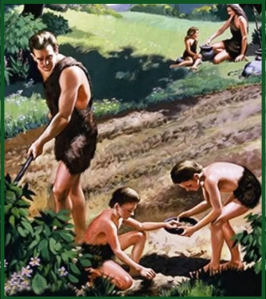
Adam Eve and family

In the beginning God created households to live in harmony. Adam and Eve were created to be husband and wife and father and mother.  The harmony of the home was short lived, however because the first household, like all subsequent ones, was corrupted by sin.  As a result of sin, Adam would struggle to provide for the family; The father and mother would vie for control; Their parenting would produce a murderer and a liar.  However at the same time as judgement and death in the home, God provided grace and mercy.  Grace redeems the household. The same parenting that produced the first murderer had also produced the first martyr.

The household can be brought back into harmony with God.

From the context of the book of Ephesians and Colossians we can learn that

Once a father has made peace with God through Christ he can be an agent of God’s peace to his household.

This takes into account the opening chapters of Colossians and Ephesians which set the scene.

This is not a self-help guide for how to behave better.  This is a godly fruit guide.  It is like the sticks in the soil that show a naturally growing plant the direction in which to grow.  However, the growth is a gift from God.  A father who wants to grow must first surrender himself to God through Jesus.  The peace of God in the household only comes to those who are at peace with God.  In Ephesians the context teaches that it is the Spirit-filled father (Eph 5:18) who carries out the commands which bring peace to his home.  Would a godless person be able to bring peace and order to their home? Yes, they would.  However, the peace that the godless receive by aligning their lives with the order of creation is a gift from God.  Without acknowledging God, though, an unsaved person does not have the capacity to experience the fullness of God in their household.  They can receive a measure as much as they knowingly or unwittingly agree with God’s design.  However, if they do not know God personally the experience of God and of grace in the home will always be deficient.

My household had moments of tenderness and peace, but it could not be the household that God wanted.  Not ultimately.  This is because my father did not know Jesus.  My mother tried diligently to live out the gospel for the sake of her home.  However, there was always a tension around the faith.  Whilst my mother was pulling toward church and serving God, my father did not contribute.  He was not antagonistic, but he stood still whilst my mother responded to God.  A father who is present and contributes to the spiritual life of the home can have a great affect.  When my father found God, just before he died, I got a glimpse of my father’s transformed heart.  His service to my mother and his selflessness toward his family – even in the face of death – left me with an imprint of God’s presence which can never be erased.  The example of a man who knows God dying well was a gift from God that I never expected to receive through my father.

man on yacht     Around what are we as fathers oriented?  Is our life saved by God?  Are we living a life in the Spirit where God will use us for our family’s good?  Ask yourself what you want from life?  Is it a yacht, a PS4, or time alone with the TV?  What does your life pull toward?  Financial advancement?  Personal happiness?  Fantasy and flight?  God has called us into relationship with himself.  If we allow disillusionment, ignorance or apathy to distract us from the pursuit of God we have no reason to expect God’s peace to reign in our home.  If we make our life’s goal the pursuit of God our household will be strongly influenced by that pursuit.  In all likelihood the life of Ephesians and Colossians will break out.

A father creates a more peaceful home when he makes it easier for a wife to submit.  In other words, if a wife is to submit to her husband it is easier if he is a safe place.

                Wives are called by God to be in a subordinate, subject position.  This has been a painful point historically.  Men have abused their role and abused and dominated women.  However, God does not give men a position of authority in order for them to abuse it.  If a man is to be a leader, he is to be a leader in the home like Christ.  Fear prevents this from happening on both sides.  Men fear that they will not live up to the high expectations women place upon them.  They sometimes give up leading before they begin.  Women my wife and I have counseled will compare their husbands to their fathers.  They seem to forget that their fathers are at least twenty years older than the young man they have just married.  When he has fathered a daughter for twenty years, he may be much more mature as a result.  When women fear for their safety and they fear for the future they can step up to the plate.  We have all met controlling women who believe the circumstances require that they take initiative.  Although some women are so filled with fear that they will rest the reigns from the strongest husband, many women will submit when a man shows initiative and compassion.  If a father wants to establish an ordered household where his leadership is appreciated, he must see issues quickly and step in to take care of them.  It is even great leadership initiative to ask for input about what might need to be done.  When I got married, like my father, I did not see dishes in the sink.  I did not see a lawn that needed cutting.  All that I saw was a game that I couldn’t watch or a couch that I was prevented from sleeping on.  Although a godly woman may still submit to a man who is ignorant of what needs to be done in the home, ignorance is not a virtue.

The model of submission that God requires is one which the godlhead exhibits itself.  The Son submits to the Father (1 Cor. 15:28).  Is he then inferior to the Father?  Is Jesus diminished by his submission?  However, to whom does Jesus submit?  The Father in heaven is the model of the father in the family.  As the Father is perfect, so should the head of each household strive for perfection.  The father creates a vision and moves the household along a path to bring about that vision.

Adolf Hitler and Pol Pot had a clear vision for the way which they wanted their countries to develop.  There was economic and military strength in the vision, but history shows that ultimately they were self-serving.  Adolf Hitler and Pol Pot are poor examples of leaders.  They manipulated and exploited those who they led in order to get the life that they wanted.  If we are leading the household to fulfil our own dreams we will find that the world works against us.  Free people know that Hitler and Pol Pot did not lead in ways that were the best for their people.  However, free people have willingly submitted to leaders like Gandhi and MLK.  These leaders also had a clear vision of a life that could be.  MLK said he had a dream.  In his ‘I have a dream’ speech he laid out a clear vision. These leaders are people who had the good of others as their primary goal.  They had a vision that made it easier for their subordinates to submit.

harassed manIf, fathers, you live in a world with an unsubmissive wife, the children are probably learning terrible lessons from the both of you in what it means to be a man.  A man is to be neither aggressive nor submissive, but he is to be assertive.  With confidence in God and the vision of faith laid out in scripture, the father is responsible to dream dreams of godliness for the children and speak truths into their lives.  As the patriarchs laid their hands on their children and communicated God’s vision for them, so we are to see God’s gifting and God’s value of each member of the home and to speak it into their daily experience.  There may be internal conflict because male leaders have not modeled leadership well in your life experience.  There may be external conflict as contributing actively to the life of the home may cause confusion about boundaries and roles.  However, others can not be blamed for a lack of backbone in a man.  A man must establish strongly the values God wants for the home within himself, then he must live out those values and hold others to the same standard.  In living out internal changes, he will lead his family toward godliness.

Husbands are to love.  The specific demands of the passage talk about a love of a husband toward his wife.

A difficult wife is a training ground for a man which makes him a more excellent lover.  There is no conditional clause that the wife must respond with appreciation or affection.  Relationships are difficult and love is the core of any great relationship.  Love is not easy but is sacrificial.  We know this because greater love has no man than that he lays down his life for his friends.  What is true of friends is also true of family.  We must be willing to love sacrificially in the ways that God has designed.  Our world has its own definitions of love and many families have been rooted in a love which is like a commercial agreement.  We invest in a relationship for the pay off.  Love is seen as an emotional flood which, when mutual, takes us to a high which we think will last if we both work hard.  However, love in the biblical sense is not an emotion, but it is a commitment.  It endures through emotional highs and lows because it sets its face like flint into the storms of life and walks toward others with purpose.  That purpose is to enrich the life of others with kindness, gentleness, words of encouragement, acts of kindness, physical touch, thoughtful gifts, and self-sacrifice.  You may feel that this kind of love and engagement is beyond you.  If you knew your family as God knows your family, you would be convinced that you do not have what it takes to love them well.  If you knew yourself as God knows you, you would probably despair of ever being able to love.  However, that is why we die to ourselves daily and throw ourselves at the foot of the cross asking God to fill us with a love that is not of this world and not of ourselves.

Husbands must love their wives as an example to their children.  Loveless households provide little nurture for children who flourish in a loving environment.  A child who sees a man hiding in the basement or disengaged in front of the T.V. does not learn how to be a man well or relate to men well.  There is a vacuum where a person should be.

The passages exhort a husband to love his wife like he loves himself.  Some people struggle with the biblical principle of self-love.  The idea does not work well if we think of love as a rush of infatuated emotion.  If we think of it more as turning our attention toward someone for their good, we see that we have to start with ourselves.  We do ourselves good when we shave, feed ourselves or take some time to reflect.  We were designed to care for ourselves as stewards of the minds, bodies and souls that God has given us.  If we neglect our own bodies we have nothing to give, or what we have to give is marred.  If we imagine a man who is so others focused that he never brushes his teeth, never showers and never cleans under his fingernails, we imagine a man who would give hugs which make his wife and children’s flesh crawl.  In taking good care of ourselves we build a base to give good things to others.  If I develop my talent to play guitar, fix cars, or build models I can play guitar, fix cars or build models for my wife and children.  The key to understanding the principles of the passage is to remember that what I develop in myself is to be given away to others.  The Bible does not condone the idea of a man loving himself by vegging in front of the TV and shutting himself off for days.  Of course, the mind and body need rest and refreshment, but some of our leisure activities in the 21st century are actually isolating and don’t show great self-care and give us nothing to share with others.

There have been two Stepford Wives movies, one made in 1975 and one in 2004.  Both are loosely based on the 1972 novel by Ira Levin.  The 1975 movie shows a sinister solution to the problem of women leading independent and spirited lives.  When their husbands move to Stepford their wives are modified by making them into machines.  This requires no change or sacrifice on the part of the men.  The women are quite literally sacrificed to make them easier to love.  It is easy to love a woman created by the fantasy in our own minds.  However, once we get to know our families well, we know that they are made up of people who think and act differently than we do.

Test your definition of love.  Does it grow under adversity or does it diminish – even disappear.  Our homes are founded on sacrificial love.  When we get married we promise to love in sickness and in health, but we rarely imagine the kinds of sickness that a home might endure.  There is sickness of the body, but there is also mental sickness.  How do we handle depression and anxiety in a marriage?  A father is called to love without condition.  A father finds limitless resources from God to be able to give himself to his wife and family even when it seems like the wife and children are negative.

Although Fireproof is not the greatest movie ever made, it is worth watching.  It shows how a man can learn how to love selflessly.  Caleb Holt, the movie’s main character, has issues which leave his wife wanting out of the marriage and feeling estranged.  Rather than give up on his cold wife, he woos her with acts of kindness and selfless attention.  It is good to see how he navigates her suspicions and her outright rejection.  The head of a household needs to know the courage to love like that.fireproof

A father is not to exasperate his children.  He is not to push them farther than they can cope.

                In the Roman world a father was responsible for the whole household in a much more authoritarian way than is normal today.  If a father thought that his son was disrespecting or disgracing him in some way he might have him flogged or even executed.  This, of course, led to some abuse in the system.

A father would send a slave with the son when he went to school.  The slave was the eyes and ears of the father and he would report the child’s behavior in school.  In some cases the slave would administer the discipline himself.  Such a strong view of fatherhood could lead to a powerful influence.  Fathers who used the values of Roman society positively would discipline and instruct them.

Discipline is often confused with punishment.  Punishment is that part of justice that administers a fitting result to the crime.  It does not necessarily change the nature of the person being punished.  The most extreme example is the death penalty.  The death penalty fits the crime of murder.  It is an equal payment of life for life.  However, the one who is punished does not learn their lesson.  They are dead.  They are done.  However, discipline improves the person who is disciplined.  At least that is its purpose.  So if a criminal commits a crime and we have them make restitution in a way that changes the criminal’s attitude, we might have issued some punishment but we have also successfully disciplined them.

Applying this to children we need to think, why is a child sent to their room?  Why is a child spanked?  Why is a child sent into a time out?  Is the child punished or disciplined?  The emphasis in Proverbs in the Bible is that a child is disciplined.  In other words, the time out or spanking should result in a more mature, more godly child.  If the child senses that there is no point in the punishment except to wound or tear down, the child will feel isolated and frustrated.  Anger in a child often comes from fear.  The child can fear that they are not accepted and loved unconditionally.  They will fight this fear with fits of anger.  A child can fear for their well-being if the punishment is severe.  A child can believe that they have no control over their own life.  This leads to depression if the child feels defeated, but it often leads to anger as well.

Again, the father’s vision for the household plays into the situation.  A father who sees no greater vision for the household will see no greater plan in their discipline.  If discipline trains toward a goal it becomes near impossible if there is no goal.  The discipline that is administered will seem arbitrary or pointless.  A child can endure much more if they can see where it is leading.  If a father loves God with all of his heart, soul, mind and strength, they will assess whether their choices for their children lead them toward God or away from God.  In many cases a good conversation about where a child’s decision has taken them will be more effective discipline than a good hard spanking.  The spanking will sometimes leave a child bewildered at the meaning of the pain.  A painful conversation sometimes forces the child to see the sin in their lives more clearly.  It is when we understand sin for what it is that we are truly horrified by it and we pursue God more fervently.

My father exasperated me many times growing up.  The pattern of exasperation would be triggered when he felt stressed or anxious.  He was particularly anxious about losing things and what he lost the most was his keys.  He would start to search the house and the emotional tension in the house would rise.  He would simmer and fume before asking my mother, in an accusatory tone, what she had done with his keys.  Because she usually had done nothing with them it was concluded, as an only child, that I must have been the one to lose the keys.  My father would tell me how irresponsible I was and then more often than not (at least in my recollection) the keys would show up where he left them. He would rarely apologise but would buy me a candy bar or something to make up for it. As a result I felt like I was truly irresponsible – I still do.  Also I was irrationally petrified of losing keys.  My father had disciplined me and exasperated me.  He wasn’t trying to.  The strangest result is that when I lose things in my house I feel an intense pressure to follow the same trail of accusations.  I want desperately to blame my wife.  I want to assume that it is my children Daryl and Amelia’s fault in some way.  This is not what my father would have intended, in fact he would have felt horrified.

What patterns of interaction, fathers, have you established in your house?  What can you take responsibility for?  Do you have patterns of discipline that lead the children closer to God?  Or is your house founded on crime and punishment?  If your house has law and no grace, it will kill the spirit of the children.  Either they will revolt in anger, or they will be defeated and crushed.  They will grow up with the passivity that we mistake for obedience.  I have seen many a proud father of a Christian home whose children lack drive and motivation.  Because they attend church or stay away from night clubs, their fathers boast about their pursuit of God.  The children’s spirit is far from the adventure that God would have for them.  I see other fathers who pursue God passionately and communicate regularly with their children what enables the pursuit of God and what hinders it.  Their children catch the fire and seek to serve the same God that their parents served, but in ways which are personal to them.

A father is the ultimate person responsible for the education of their children.  Education trains a child by developing their mind.  It is an important question to consider where the education your child is receiving is taking them.  Are those entrusted with teaching Math and English also teaching the truth about the God that math and English point to?  Are those who teach your child the facts about their subjects also living out the character that we would hope for?Picture8

The man of the house must make sure that all those who serve the house are valued and treated well according to their contribution.  As a customer for lawn care, pest control, cable television, and pizza delivery, a man must treat workers as those who are created in the image of God.

The man about the house is also represented as a Master of slaves in Ephesians and Colossians.  Although there is no direct modern equivalent of a positive and harmonious model relationship between a Roman head of household and the household slaves we should learn a couple of lessons.  To be able to learn lessons from the passage well, we have to deal with our images of slavery from the Old South.  We frequently envision barbaric images of black men being whipped and treated like animals by their racist masters.  We see movies where men and women are inspected like animals and are valued according to the work they will be able to perform. How can Paul, then insist that slaves submit to their masters?  The truth is that the Roman culture of slavery was vastly different from our own.  A slave was still the property of the master of the house, but he was given far more dignity than a household animal or piece of machinery.  Slavery was not condoned by Paul.  In fact Paul seems to indicate to Philemon in his letter to him that Philemon will release his slave Onesimus.  What Paul values more highly than the question of slavery, though, is the reputation of Jesus and the faith.  In Paul’s time slaves were becoming rebellious because of their new found status in Christ.  Because the gospel clearly teaches that slaves and their owners have equal worth, some slaves were bringing disorder to society and encouraging other slaves to be disrespectful and rebellious.  Paul answers this by showing how slaves and their masters can live in harmony so that the cause of the gospel is not hindered.

Because we are looking at fathers’ roles on Father’s Day, we will just see how the head of the house was to act toward the help in the home.  Masters should not be abusive, tyrannical, or manipulative.  If we generalize this principle to those who are in power, they should not be abusive, tyrannical, or manipulative we will find broader application for our own homes.  To be abusive we look down on another because they are not like us and we see them as less.  Maybe the difference is an issue of race.  The Bible teaches that all races are equal before God.  Maybe the difference is one of sex.  We are told that male and female are different but they are of equal status before God.  Maybe the difference is between ability and disability.  Because a person lacks the same skills that we have we assume that they are stupid or inferior.  To resort to abuse – to call the worker in our homes names either to their face or behind their back is unacceptable.  As a father it teaches terrible lessons to the children and they learn truths through abusive behavior which are contrary to scripture.

What about tyranny?  Americans believe that they threw off tyranny in 1776 but the levels of domestic abuse in North America show that there are still tyrants at large on these shores.  A tyrant is often a man filled with fear who exerts absolute control over his environment.  He micromanages and picks away at every fault of those who try and serve him.  He has one way that the work should be done and of course it is his way.  There is no freedom to create or invent.  All those in the household have the task of trying to guess what is in the tyrant’s head and then implement his dreams down to the last detail.  This is not the relationship that God wants a man to have with anyone who is performing a task for the household.

Finally we think of men who use their power to manipulate.  These men mobilize guilt or shame to bring about their own ends.  They try and make a person feel guilty about the quality of their work and so they have them do more with little verbal praise or reward.  Maybe a person manipulates others through putting on the puppy-dog eyes and making others feel sorry for them.  A man can make an illness seem more debilitating or a past relationship seem more wounding if it results in the level of service he believes will make him happy.  Such a man will not know the true nature of the people who he lives with and works with.  He will only know the false selves that they offer up in slave-like service.  For a man to have real relationships with those around him, he needs to stop manipulating and empower them to reveal their true gifts and to offer those up in service.

My disabled mother and father in law would have great interest in the work that people would do around their house.  My father-in-law would wheel himself out slowly in his wheelchair and peer around the corner at the worker fixing the sink or painting the wall.  Because of his disability he would marvel at the fluidity with which a worker performed the simplest of tasks whether it was replacing a fuse or changing a light bulb.  My mother-in-law had squeaky hearing aids which announced her impending arrival from a good distance.  She shared her husband’s appreciation of people who performed the basic tasks of home maintenance or personal service for them.  Before you think that they were perfect, though, there was one class of people in whom they were united in their distrust – that was medical doctors and nurses.  However, plumbers, electricians, and carpenters were a marvel to them and they affirmed them copiously for every screw tightened and every pipe welded.  Their encouragement wasn’t just toward paid workers, though.  My father-in-law lavished praise on me and my mother-in-law seemed to think that I could do anything that I put my hand to.  They encouraged me to try fixing things around the house myself.  Something I was afraid to do before.  As I had success in little things so I moved ahead and tried to do things that seemed like a bigger job.  A positive attitude toward people who work for us around the home leads to a harmonious home which flourishes.

I once taught a boy who wanted to know why he had to learn Spanish.  Even though this was in a Christian school, he took a superior attitude and quipped, “Maybe I just need to learn Spanish so I can talk to the people who cut my lawn.”  I was saddened when I heard him say this, but how do we communicate about the immigrants who cut our lawns and teach in our schools.  People sometimes forget that I am an immigrant without American citizenship.  When I hear people complain passionately about foreigners coming to America and taking all of the Americans’ jobs, I think that they forget that they are talking about me, too.  Of course, illegal immigration is a problem which needs addressing, but to dehumanize people in the process and see them as just another problem to be solved is not really an option.  However, many people from many countries have legally come to America and work jobs which some of us consider beneath us.  Rather than treat these hard working citizens with respect, we look on them with derision.

mcDAnother place I see derision is the way we talk about people who serve us in the fast food industry.  A job at McDonald’s is often seen by some as worse than no job at all.  To be a pizza delivery boy is seen as a worthy occupation for a high-schooler but if a mature man or woman delivers our pizza to our door we wonder what has gone wrong in their life.  It is not acceptable to treat workers who serve us with abuse.  It is not acceptable to short change wait staff because we can get away with it.  A Christian father should be known in the community not for being critical and miserly but for being affirming, grateful and generous.

When a landscaper does work around our house, it is alright to dream a dream of the landscaping and what it will look like.  However, what does a father communicate to his children if he checks on the landscaper and his workers every day to make sure that every rock is laid with exact precision?  Denying the landscaper the dignity of his professionalism teaches the children in the house that either they are to fear their father and hide their efforts from him, or they are to emulate their father and be perfectionist tyrants over others.  A father who hires a landscaper and allows them to create a beautiful landscape that incorporates their ideas with the landscaper’s professional skills teaches children to be truly collaborative and successful in an increasingly cooperative world.

A father who wants his sons to perform well at sports and introduces competition to manipulate them into better performances puts winning and losing above unconditional acceptance.  Their children will feel the competitive drive of their father even when their father is long gone.  The father is often trying to maintain the illusion of his own winning ways through the performance of his children.  This is particularly true of a father who might want desperately for his son to play soccer and to become a defender for the English national team some day?  What if his son is a gymnast or a baseball player?  The highly competitive culture that we fight against reflects a Darwinian view of life that is not ultimately real.  The way that God has designed us to win is not by climbing to the top by destroying our neighbor, but by collaborating as members of the body of Christ.

Conclusion

My father did not teach me what it meant to be a man – certainly not a man of God – because he did not know God.  My mother told me not to be like him, but gave me no alternatives.  So I grew up in a vacuum without any real ideas of what true manhood looked like.  I was petrified of being a father, especially a father of a boy.  When Daryl came along I stood aloof and backed away.  I didn’t really know how to model for him what it meant to be male.

tender warriorMy friend Gary Skinner shared with me a book called Tender Warrior which I think summarizes and expands upon many of the points that I have made today.  In it Stu Weber, a former Green Beret, and recipient of three bronze stars outlines his thesis of what it means to be a man.  It’s not essential to go to Vietnam and show our masculinity on the field of battle.  That is not open to all of us.  He says that the Tender Warrior is Every Man’s Purpose; Every Woman’s Dream; Every Child’s Hope.  What he suggests are four main areas for men to develop:

  1. We should develop as kings who are sovereign in their own home.  They reign by servanthood taking the initiative in ways to lay down their lives and lead in service to others.
  2. We should develop as warriors who do not go on the offensive, but who learn to fight to defend their values and those whom they value.
  3. We should develop as lovers who learn to speak woman and honour and connect with the women in our lives.
  4. We should develop as friends who endure through thick and thin and are generous with our resources.

The book has three chapters on being a father:

  • The Incredible Power of Fathering
  • Spanning Generations
  • Arrows in the Quiver of a Warrior

I would recommend that, if like me you have had a fuzzy idea of what being a man might mean, you check the book out and get an idea of what being a man could be.

My father made peace with God and he showed me how to die well.  His testimony was all the more powerful because he showed such a contrast to the life he had lived when he ran from God.  God is a gracious God who takes our failings and sin and makes them beautiful.  We don’t have to be perfect to be a godly father, we just need to pursue God and he even uses our imperfections for good.

When my father was young he dominated my mother and myself quite completely.  If he didn’t get his own way he pouted, sulked, simmered or exploded.  However, as he got older he became more and more mature.  He reasoned with us when he wanted to make decisions and he considered us when he was deciding where to go.  To submit to his will seemed less like a defeat or a crushing of spirit.  His desire was to share what was important to him.  One of his last acts was to pay to take the whole family to Paris as a gift.

My father talked about my mother quite often as an obstacle when he was younger.  He would call her Sybil after a domineering character in the comedy TV show Fawlty Towers.  He even called her Hitler to me once or twice.  My parents both were responsible for the fights they had in my earliest years.  However, as he grew up he saw more clearly how to value my mother.  He talked about her more positively.  He cherished her.  He claimed at the end of his life that he had been a lousy husband, but my mother and I think that he grew immensely.  He spent more time and money on my mother as they grew together.  One of his parting gifts before he passed away was to buy my mother a pendant with three diamonds on it because he said, “Diamonds are forever.”

Although my father thought it was fun to stick his toe in my ear when I was watching television or drove me crazy by changing the strokes he would give me when we played golf, I am not angry with him.  For various reasons I had to work through anger I had to my father, but after I released that anger I was able to feel the love and respect that I have always had for him.  I miss the smell of his beard.  I miss his sense of humour.  I miss Friday evening games nights when he would lose his cool playing Risk.
DJW

Like all of us I had a mixed bag as a father.  God’s grace worked through him to shape me through both my father’s strengths and his faults.  When I see how God used my father to reveal to me more of himself, I am thankful.  I am not only thankful for what my father gave to me, but I am thankful for what it teaches me about my own role as a father.  Our gracious heavenly Father takes our efforts and he forms our children through them.  My incomplete and childish attempts to be the father I wish I was are made whole in him.  God our Father shows us how to be fathers in our earthly home until he flings wide the door of heaven to welcome us and then he will perfectly parent us for ever.


2 Comments