Song of Songs 1:4-7 Confidence and Risk-taking in Relationships

We will exult and rejoice in you;
    we will extol your love more than wine;
    rightly do they love you.

I am very dark, but lovely,
    O daughters of Jerusalem,
like the tents of Kedar,
    like the curtains of Solomon.
Do not gaze at me because I am dark,
    because the sun has looked upon me.
My mother’s sons were angry with me;
    they made me keeper of the vineyards,
    but my own vineyard I have not kept!
Tell me, you whom my soul loves,
    where you pasture your flock,
    where you make it lie down at noon;
for why should I be like one who veils herself
    beside the flocks of your companions?

Confidence and Risk Taking in Relationships

In this passage the strong personality of the young woman is highlighted.  She does not lack confidence regarding her looks.  She calls herself lovely.  She knows that she is somewhat wild and untamed but that might be the reason why she has broken out of the harem and gone in search of her true love.

‘One who is veiled’ probably refers to her appearance as a prostitute.  It was common in ancient times for prostitutes to be veiled by the side of the road and for them to wait for business.  In Genesis we see that Tamar posed as such a prostitute.  The fertility cults of the time encouraged that practice.  Although David had a heart devoted to God, Solomon allowed the continuation of some pagan practices such as worship at the high places (1 Kings 3).  The woman’s passion sends her out into some dangerous territory in search of her true love.  She pleads with her true love to come and find her – to rescue her.

Marital love should exhibit both confidence and a willingness to engage with danger.  Often we bring a lack of confidence forward in life which is deep rooted.  However, when someone affirms our looks we come alive and develop a spring in our step.  However, after the complements get old or don’t come as frequently we blame our lover for going cold or drying up.  If someone develops a healthy self image, seeing their body as a gift from God, and the loveliness that is in each of us due to the imago dei, we will make more excellent lovers.  We bring an assurance that regardless of compliments or flattery I am beautiful in the eyes of God and therefore in my own eyes.  This is the kind of confidence that will be consistent if the relationship with God remains primary.

One of the things which originally attracted me to my wife Kelli  was that she had jumped out of an airplane – with a parachute.  Engaging with danger gets the adrenaline running.  Exploring the world, serving God in closed countries, taking risks in careers and romance.  All of these can enhance a relationship.  They make a person more attractive in terms of friendship and romantic love.

HappyHouseWifey » Thankful Thursday: Risk-taking Behaviour

Prayer

God.  May I see myself as you see me.  May I have confidence that because of your Son I look good at least to you.  May I then hold my chin up high and have the confidence to take healthy risks.

Questions

  1. How does the woman describe herself?
  2. What might the woman be mistaken for?
  3. Why is she taking a risk in searching for her lover?
  4. How could you express confidence in your relationships?
  5. What risks might enhance your relationships?
18 Comments

Song of Songs 1:1-4 Marriage with Eros

The Song of Songs, which is Solomon’s.

Let him kiss me with the kisses of his mouth!
For your love is better than wine;
    your anointing oils are fragrant;
your name is oil poured out;
    therefore virgins love you.
Draw me after you; let us run.
    The king has brought me into his chambers.

Marriage with Eros

Solomon married hundreds of women.  He was a sweet-talker and a collector of women like some people collect stamps.  This is not a critical report which comes from outside of the Bible, the Bible itself reports that Solomon married hundreds of women and had hundreds of concubines.  Why would we turn to him for marital advice?

I agree with translators who do not think that the Song of Songs was written by Solomon or in praise of Solomon.  I think that the phrase translated above to be read ‘Solomon’s’ is better translated ‘regarding Solomon.’  I believe the book can be read as a book about Solomon the villain who is the antithesis of all a father would want for his daughter as a prospective mate.

The context of the book is generally seen as a love poem written by Solomon in praise of his bride.  However, I believe that it reads much better if it is a poem regarding the pure love of a shepherd and his wife despite the fact that Solomon has added her to his harem by force.

Also, Song of Songs is a very sexual book.  It shows that the God who made sex heartily agrees when it is part of a marriage which is healthy.  However, many Christians are at odds with eros.  God, so they say is the God of a pure love called agape.  He created humans so that they could have phileo, storge, and eros.  However, he himself would never stoop so low as to participate in these lesser loves.  However, upon studying Warfield and C.S. Lewis I have come to the conclusion that God loves in all ways.  His practices are not equivalent to ours, but they represent all four loves not just one out of four.

These opening verses show a passion.  It is a passion that consumes the soul and makes giddy like an alcoholic beverage.  Although Pentecostals and Charismatics embrace passion, many denominations do not.  Passion, it is thought, is associated with  sinful lusts.  Indeed when a person consumes another for their own gratification, it is sin.  However, I would argue that abstaining from passion also falls short of God’s loving design for us.  Jesus’ passionate desire for us is shown in his pursuit of us through the pain and the trials of the passion.  Although this love is not sexual, I think that it represents a pure form of eros.  Eros holds nothing back, it reveals everything.  It abandons self.  Without God a person becomes idolatrous when they abandon self.  However, the Christian abandons self to God and the result is a love that lives for God but is vulnerable with others, too.

In the lines above I believe that Solomon has called his young victim to his chambers to use her as a sex toy.  In contrast she is abandoned to her lover.  At risk of punishment – even death – she calls to her lover to elope with her.  Given the circumstances this passionate display is appropriate.  Like those who married in WWII before their lover was shipped off to war, so the heroine promises everything to her true love before the abuser can take his prize.

Healthy marriage has passion.  It surrenders self to the healthy desires that a body created by God can bring.  Creative couples can be quite giddy with the plans for play that they can bring to their honeymoon and their bedroom.  However, they can also share a passion for the creativity of the theatre, preaching, or sudoku.  A shared passion pulls a couple out of their self focus.  Although agape describes the fact that God loves in many ways, we must also think of him as having a passionate desire for us.  Made in his image, we reflect his nature when we have a passionate desire to explore another person with respect and joy.  We see this in Song of Songs.  We can also allow us to see this in our marriages.

Prayer

The word ‘erotic’ has become a dirty word for us.  Fifty Shades of Gray and pornography make a mockery of the innocence that passion can maintain.  Let us love with passion and abandon ourselves appropriately to the waves of love that would wash over us.  Where passion is lost give us a path to follow.  Let excitement and anticipation come into our lives when we dare to become emotionally whole.

Questions

  1. Who is the subject of the book Song of Songs (SoS)?
  2. What does the woman in the passage desire?
  3. How can love between a man and a woman be both passionate and pure?
  4. How do you think the case is built that SoS is not in praise of Solomon?
  5. In what ways do you express appropriate passion?

17 Comments

Genesis 3 and The Moody Bible Commentary

Now the serpent was the most cunning of all the wild animals that the Lord God had made. He said to the woman, “Did God really say, ‘You can’t eat from any tree in the garden’?”

The woman said to the serpent, “We may eat the fruit from the trees in the garden. But about the fruit of the tree in the middle of the garden, God said, ‘You must not eat it or touch it, or you will die.’”

“No! You will not die,” the serpent said to the woman. “In fact, God knows that when you eat it your eyes will be opened and you will be like God,knowing good and evil.” Then the woman saw that the tree was good for food and delightful to look at, and that it was desirable for obtaining wisdom. So she took some of its fruit and ate it; she also gave some to her husband, who was with her, and he ate it. Then the eyes of both of them were opened, and they knew they were naked; so they sewed fig leaves together and made loincloths for themselves.

Then the man and his wife heard the sound of the Lord God walking in the garden at the time of the evening breeze, and they hid themselves from the Lord God among the trees of the garden. So the Lord God called out to the man and said to him, “Where are you?”

10 And he said, “I heard You in the garden and I was afraid because I was naked, so I hid.”

11 Then He asked, “Who told you that you were naked? Did you eat from the tree that I commanded you not to eat from?”

12 Then the man replied, “The woman You gave to be with me—she gave me some fruit from the tree, and I ate.”

13 So the Lord God asked the woman, “What is this you have done?”

And the woman said, “It was the serpent. He deceived me, and I ate.”

14 Then the Lord God said to the serpent:

Because you have done this,
you are cursed more than any livestock
and more than any wild animal.
You will move on your belly
and eat dust all the days of your life.
15 I will put hostility between you and the woman,
and between your seed and her seed.
He will strike your head,
and you will strike his heel.

16 He said to the woman:

I will intensify your labor pains;
you will bear children in anguish.
Your desire will be for your husband,
yet he will rule over you.

17 And He said to Adam, “Because you listened to your wife’s voice and ate from the tree about which I commanded you, ‘Do not eat from it’:

The ground is cursed because of you.
You will eat from it by means of painful labor
all the days of your life.
18 It will produce thorns and thistles for you,
and you will eat the plants of the field.
19 You will eat bread by the sweat of your brow
until you return to the ground,
since you were taken from it.
For you are dust,
and you will return to dust.”

20 Adam named his wife Eve because she was the mother of all the living.21 The Lord God made clothing out of skins for Adam and his wife, and He clothed them.

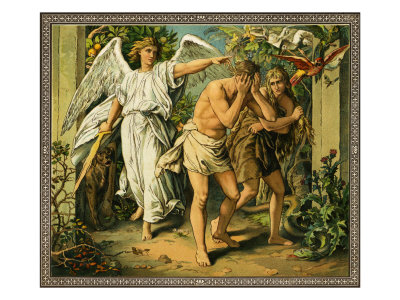
22 The Lord God said, “Since man has become like one of Us, knowing good and evil, he must not reach out, take from the tree of life, eat, and live forever.”23 So the Lord God sent him away from the garden of Eden to work the ground from which he was taken. 24 He drove man out and stationed the cherubim and the flaming, whirling sword east of the garden of Eden to guard the way to the tree of life.

The Moody Bible Commentary: Michael A Rydelnik, Michael ...

After reading Genesis 3 a few times I read through the Moody Bible Commentary and it gave me some insights.  Here are some that struck me:

  • Although Americans think of themselves as individuals, the text teaches that all mankind fell through Adam.
  • The text shows steps of temptation which often lead to sin.
  • The command regarding the Tree of the Knowledge of Good and Evil was given to the man, Adam.  The serpent worked on Eve.  This may have been because she had not heard from God directly concerning the command.
  • The couple are described as inseparable by the commentator.
  • The serpent addresses Eve but uses plural pronouns which shows he is talking to both people.  In only addressing Eve he marginalizes her husband.
  • The rephrasing of the command by the serpent focuses on God’s restriction rather than his bounty.
  • The serpent questions God’s motives in giving his command.  He implies God is keeping godhood from Adam and Eve.
  • Seeing the tree and pronouncing that it is good mirrors how God has looked at Creation and made his pronouncement, “It is good!”  in Genesis 1.
  • Eve assessed the “good,” or appeal of eating the fruit in three distinct ways:  it was practical, being useful for food, it was aesthetically beautiful, and it had the possibility for wisdom.  These three areas preyed upon the woman’s physical, emotional, and spiritual desires.  Some have seen these same three categories of temptation reflected in “the lust of the flesh and the lust of the eyes and the boastful pride of life” (1 Jn 2:16).
  • Keeping silent, like Adam did, is tacit approval.
  • The death that the couple immediately experienced was separation.  the ideal experience of relationship with each other and with God was broken.
  • The word for naked includes shameful and guilty nakedness resulting from sin, not just the simple fact of being undressed.
  • The leaf coverings try and hide the guilty parties in more ways than one.
  • The death they have died can be called division and disruption.
  • God ‘strolls’ in the garden.  The couple was meant to stroll with him.
  • Woman becomes vexed by Adam’s role of initiative.
  • The condition of humanity is like God but not with God.
  • To be sent East means to be sent farther from God.

Prayer

Thank you that those who work at Moody have taken the time to study and to share their insights on the passage.  Help us to discern which of these insights is helpful and which should be left behind.

Questions

  1. When you read the passage what do you think is the main idea?
  2. Is the serpent, Adam, or Eve to blame for the fall?
  3. Which of the Moody insights is new to you?
  4. Which one speaks to you the most?
  5. How has your community been broken because of sin?
15 Comments

Genesis 3:8-24 Curse

Garden of Eden | Sound Doctrine Ministries

And they heard the sound of the Lord God walking in the garden in the cool[c]of the day, and the man and his wife hid themselves from the presence of the Lord God among the trees of the garden. But the Lord God called to the man and said to him, “Where are you?” 10 And he said, “I heard the sound of you in the garden, and I was afraid, because I was naked, and I hid myself.” 11 He said, “Who told you that you were naked? Have you eaten of the tree of which I commanded you not to eat?” 12 The man said, “The woman whom you gave to be with me, she gave me fruit of the tree, and I ate.” 13 Then the Lord God said to the woman, “What is this that you have done?” The woman said, “The serpent deceived me, and I ate.”

14 The Lord God said to the serpent,

“Because you have done this,
    cursed are you above all livestock
    and above all beasts of the field;
on your belly you shall go,
    and dust you shall eat
    all the days of your life.
15 I will put enmity between you and the woman,
    and between your offspring and her offspring;
he shall bruise your head,
    and you shall bruise his heel.”

16 To the woman he said,

“I will surely multiply your pain in childbearing;
    in pain you shall bring forth children.
Your desire shall be for your husband,
    and he shall rule over you.”

17 And to Adam he said,

“Because you have listened to the voice of your wife
    and have eaten of the tree
of which I commanded you,
    ‘You shall not eat of it’,
cursed is the ground because of you;
    in pain you shall eat of it all the days of your life;
18 thorns and thistles it shall bring forth for you;
    and you shall eat the plants of the field.
19 By the sweat of your face
    you shall eat bread,
till you return to the ground,
    for out of it you were taken;
for you are dust,
    and to dust you shall return.”

20 The man called his wife’s name Eve, because she was the mother of all living.[g] 21 And the Lord God made for Adam and for his wife garments of skins and clothed them.

22 Then the Lord God said, “Behold, the man has become like one of us in knowing good and evil. Now, lest he reach out his hand and take also of the tree of life and eat, and live for ever—” 23 therefore the Lord God sent him out from the garden of Eden to work the ground from which he was taken. 24 He drove out the man, and at the east of the garden of Eden he placed the cherubim and a flaming sword that turned every way to guard the way to the tree of life.

Curse

When I play some card games and board games we have to play good versus evil.  My friends like to cast themselves as the good guys and so I often have to play the role of the bad guys.  In one game I have often played as the Dark Elves and they often cast a hex on their enemies.  A hex is a spell that disables or damages an opponent.  Maybe it drains their life away.  Maybe it freezes them.  When I think of the word curse I often think of it in those terms.  I think of a voodoo woman in the bayou sticking pins in a cloth doll.  So how does God curse mankind in the above passage?  I see no cauldron or pointed black hats.

The curse of Genesis three is the removal of God’s blessing and the removal of his presence.  We see that God had caused the vegetation and the animals to flourish in the Garden of Eden.  No more.  Now God will allow the land to grow wild.  Mankind will need to work the ground harder.  There will be fewer instances of low-lying fruit.  Plants like thorn bushes and thistles will make the landscape more hostile.  Maybe they always grew outside the garden, but now ‘outside the garden’ has become the home of the first couple.

In leaving the garden mankind leaves their communion with God.  Having abused the relationship, like all relationships, the level of intimacy is damaged.  God still sustains and exists wherever people live, but there is no fellowship.  Now evil forces will work against mankind and mankind will fight against them.  There will be wars on earth and there will be death.  There will be decay of Adam and Eve and they will fade back into the dust from which they are formed.

In pronouncing a curse, God does not pronounce some hideous action toward Adam and Eve.  God pronounces their departure from Utopia.  The rest of scripture will describe mankind’s quest to regain Eden.  It is not because of the destination, though.  It is because of God’s presence.

Prayer

For many today, Lord, this curse sounds like no curse at all.  It sounds like freedom and independence.  It sounds like mankind’s dreams were realised.  I don’t feel that way.  I see you as absent in too many ways and I long for re-admittance to The Garden.  Show us the way to bring your ideals to this earth once more.

Questions

  1. How is Adam cursed?
  2. How is Eve Cursed?
  3. How is the land cursed?
  4. What does it mean ‘to curse’?
  5. How do you work to reverse the curse?
17 Comments

Genesis 3:8-24 Blaming Your Spouse

And they heard the sound of the Lord God walking in the garden in the cool[c]of the day, and the man and his wife hid themselves from the presence of the Lord God among the trees of the garden. But the Lord God called to the man and said to him, “Where are you?” 10 And he said, “I heard the sound of you in the garden, and I was afraid, because I was naked, and I hid myself.” 11 He said, “Who told you that you were naked? Have you eaten of the tree of which I commanded you not to eat?” 12 The man said, “The woman whom you gave to be with me, she gave me fruit of the tree, and I ate.” 13 Then the Lord God said to the woman, “What is this that you have done?” The woman said, “The serpent deceived me, and I ate.”

14 The Lord God said to the serpent,

“Because you have done this,
    cursed are you above all livestock
    and above all beasts of the field;
on your belly you shall go,
    and dust you shall eat
    all the days of your life.
15 I will put enmity between you and the woman,
    and between your offspring[e] and her offspring;
he shall bruise your head,
    and you shall bruise his heel.”

16 To the woman he said,

“I will surely multiply your pain in childbearing;
    in pain you shall bring forth children.
Your desire shall be for[f] your husband,
    and he shall rule over you.”

17 And to Adam he said,

“Because you have listened to the voice of your wife
    and have eaten of the tree
of which I commanded you,
    ‘You shall not eat of it’,
cursed is the ground because of you;
    in pain you shall eat of it all the days of your life;
18 thorns and thistles it shall bring forth for you;
    and you shall eat the plants of the field.
19 By the sweat of your face
    you shall eat bread,
till you return to the ground,
    for out of it you were taken;
for you are dust,
    and to dust you shall return.”

20 The man called his wife’s name Eve, because she was the mother of all living.[g] 21 And the Lord God made for Adam and for his wife garments of skins and clothed them.

22 Then the Lord God said, “Behold, the man has become like one of us in knowing good and evil. Now, lest he reach out his hand and take also of the tree of life and eat, and live for ever—” 23 therefore the Lord God sent him out from the garden of Eden to work the ground from which he was taken. 24 He drove out the man, and at the east of the garden of Eden he placed the cherubim and a flaming sword that turned every way to guard the way to the tree of life.

Blaming Your Spouse

It often starts with dating.  In my twenties I would blame my girlfriend for how I felt.  I was never quite happy.  Alone I felt awful, but with a girlfriend the sense of inadequacy subsided.  I got into a pattern of casting myself as the hero – the victim in many cases.  Life just happened to me and I was cast a bad lot.  I often felt unloved or misunderstood and I blamed my girlfriends for being immature or lacking intelligence.  In talking to twentysomethings I find that this story is often repeated.  I am aghast sometimes at how I am told by people the flaws that drive them crazy in their girlfriends because I see the same flaws in the one who is telling me.  There are many reasons for this.  A cousin of denial is projection.  To deal with our own stuff we often project our flaws on someone who is close to us.  In doing that we can tell the flaw in ourselves what we really think of it because we don’t own it any more.  A second reason for blame is the consequences that we hide from.  What do we believe the consequences of failure or inadequacy are?  Our families may have trained us very well in thinking that flaws are reasons for rejection and so we reject others whose flaws we see while hiding from the flaws that we have.  Finally, a reason that we blame others is ‘locus of control’.  If you believe that you have no control because control is outside of yourself, nothing is really ever your fault.  You have no sense of real responsibility.

In the passage the blame game runs quickly down the line.  Man blames God and woman.  Woman blames serpent.  Serpent is stuck.  However, God dishes out the punishment by going back up the line.  Serpent.  Woman.  Man.  Rather than no-one being responsible, everyone is.  That is more frequently the case in marriage.  When we are focusing on our spouse’s garbage we are hiding from our own.  We can’t stand the emotional pain of our own shortcomings so we pass it on.  However, if we could tolerate the pain of our own depravity we might be able to address it better.  When our emotions, especially fear and anger, start raging, rather than go on the warpath it is better to ask a question:  What is this really about?  How have I felt this way before?  Is this a pattern?

We can’t change our spouse.  We can only learn to accept them with their flaws.  Some spouses are truly abusive and we need to hand them over to God and leave the abuse.  In most cases of domestic conflict there is a fight for power and control.  One spouse must win the game, so we think.  The winner will triumph by proving themselves righteous – by assigning blame.  They may win the battle of the moment, but they are losing the war for their marriage.

Prayer

May we not pass blame on down the line.  May we accept what is ours.  When we feel bad, let us see more clearly what has caused the hurt.  If it is a pattern of our own making, let us be mature enough to address that.

Questions

  1. What was the immediate consequence of sin?
  2. Who blamed whom?
  3. How would you describe the change in relationship?
  4. Do you blame others?  When?
  5. How do you stop the blame game from taking hold?
17 Comments

Genesis 3:1-7 No Independence for You!

Now the serpent was more crafty than any other beast of the field that the Lord God had made.

He said to the woman, “Did God actually say, ‘You shall not eat of any tree in the garden’?” And the woman said to the serpent, “We may eat of the fruit of the trees in the garden, but God said, ‘You shall not eat of the fruit of the tree that is in the midst of the garden, neither shall you touch it, lest you die.’” But the serpent said to the woman, “You will not surely die. For God knows that when you eat of it your eyes will be opened, and you will be like God, knowing good and evil.” So when the woman saw that the tree was good for food, and that it was a delight to the eyes, and that the tree was to be desired to make one wise, she took of its fruit and ate, and she also gave some to her husband who was with her, and he ate. Then the eyes of both were opened,and they knew that they were naked. And they sewed fig leaves together and made themselves loincloths.

Estranged

No Independence for You!

I was raised in a family where everyone was encouraged to be independent.  With sun streaming in Aunty Jackie and Uncle Den’s picture window, we talked with a view of ships setting sail from Plymouth Sound to various destinations around the world.  My cousin Tim left for Bath University at 18 and graduated in mechanical engineering.  Not satisfied to work domestically on British Rail, he worked for the Egyptian and Ethiopian railways.  His sister, Sally, went to live in Hong Kong and set up textile lines for famous fashion houses in China.  I went to Japan and Pakistan and taught in schools.  I first lived in Gujranwala for a year when I was 18.  I was only back in England long enough to get my degree, but soon I was being independent again and flying far from home.

As parents we want our children to grow up and be independent of us.  We wrestle with teenagers who want freedom from the rules of home at the same time as expecting the use of the family car and a well-stocked fridge.  However, at age 18 we classify the children as adults and if they haven’t left the fold by age twenty we start having ‘failure-to-launch’ conversations.  However, in this life, the desire is not to be free from EVERYTHING.  The freedom we seek in this life is never actually freedom to do ANYTHING.  Our freedom is always limited.  We are never truly independent.  Those who are most independent of others are the most isolated.

It is the myth of self-determination and the illusion of independence that leads mankind astray.  Of course, we should be self-starters and we should not be codependent.  But God is not like our earthly parents.  He does not raise us to be less dependent and finally leave him.  He raises us to be more aware of who he is and more consciously dependent upon him.  We are dependent on him for air, water, food and clothing.  Independence from God means death.  We are also dependent on him for emotional well-being, laws for a healthy society, and the salvation that he provides in his Son.  Independence from God in these ways is equally lethal.  Dependence on God actually brings life, liberty, and the pursuit of godliness.  Independence from God brings a false dependence on humanity, self, and lies.  We are never independent.  The real choice is, what will bring us most freedom?

In the Garden, the delusion of the serpent is that God has limited freedom.  The grass is greener when I choose to wander where I will.  The pastures are better beyond the horizons of home.  The only part of my boundaries that I am truly grateful for is the exit door.  We leave God.  We leave marriages.  We leave friendships.  We leave countries.  We leave neighbourhoods.  Our belief is that we will find hope elsewhere.  Our belief is that we will find the freedom that the serpent has promised.  Then we sit in silence in the darkness of our own depravity.  We blame others.  We blame God.  We become angry, depressed and anxious as we journey East of Eden.  However, wherever we go we take our own heart with us – a heart that is broken.

Prayer

May I accept that independence is not the goal.  May I accept that my life was given to me to be dependent upon You.  May I find freedom where I am rather than believe the myth that freedom is always elsewhere.  May I choose you over myself.  Please silence the serpent.

Questions

  1. What is the accuser/adversary asking in the passage?
  2. What is Eve’s reply?
  3. What is Adam’s role?
  4. How do your adversaries (spiritual and physical) oppose your dependence on God and his people?
  5. How do you combat the myth of total freedom and independence?
15 Comments

Genesis 3 Did God Really Say?

Now the serpent was more crafty than any other beast of the field that theLord God had made.

He said to the woman, “Did God actually say, ‘You shall not eat of any tree in the garden’?” And the woman said to the serpent, “We may eat of the fruit of the trees in the garden, but God said, ‘You shall not eat of the fruit of the tree that is in the midst of the garden, neither shall you touch it, lest you die.’” But the serpent said to the woman, “You will not surely die. For God knows that when you eat of it your eyes will be opened, and you will be like God, knowing good and evil.” So when the woman saw that the tree was good for food, and that it was a delight to the eyes, and that the tree was to be desired to make one wise, she took of its fruit and ate, and she also gave some to her husband who was with her, and he ate. Then the eyes of both were opened,and they knew that they were naked. And they sewed fig leaves together and made themselves loincloths.

And they heard the sound of the Lord God walking in the garden in the cool of the day, and the man and his wife hid themselves from the presence of the Lord God among the trees of the garden. But the Lord God called to the man and said to him, “Where are you?” 10 And he said, “I heard the sound of you in the garden, and I was afraid, because I was naked, and I hid myself.” 11 He said, “Who told you that you were naked? Have you eaten of the tree of which I commanded you not to eat?” 12 The man said, “The woman whom you gave to be with me, she gave me fruit of the tree, and I ate.” 13 Then the Lord God said to the woman, “What is this that you have done?” The woman said, “The serpent deceived me, and I ate.”

14 The Lord God said to the serpent,

“Because you have done this,
    cursed are you above all livestock
    and above all beasts of the field;
on your belly you shall go,
    and dust you shall eat
    all the days of your life.
15 I will put enmity between you and the woman,
    and between your offspring and her offspring;
he shall bruise your head,
    and you shall bruise his heel.”

16 To the woman he said,

“I will surely multiply your pain in childbearing;
    in pain you shall bring forth children.
Your desire shall be foryour husband,
    and he shall rule over you.”

17 And to Adam he said,

“Because you have listened to the voice of your wife
    and have eaten of the tree
of which I commanded you,
    ‘You shall not eat of it’,
cursed is the ground because of you;
    in pain you shall eat of it all the days of your life;
18 thorns and thistles it shall bring forth for you;
    and you shall eat the plants of the field.
19 By the sweat of your face
    you shall eat bread,
till you return to the ground,
    for out of it you were taken;
for you are dust,
    and to dust you shall return.”

20 The man called his wife’s name Eve, because she was the mother of all living. 21 And the Lord God made for Adam and for his wife garments of skins and clothed them.

22 Then the Lord God said, “Behold, the man has become like one of us in knowing good and evil. Now, lest he reach out his hand and take also of the tree of life and eat, and live for ever—” 23 therefore the Lord God sent him out from the garden of Eden to work the ground from which he was taken. 24 He drove out the man, and at the east of the garden of Eden he placed the cherubim and a flaming sword that turned every way to guard the way to the tree of life.

Did God Really Say?

‘Did God really say?’  Temptation still whispers this thought into my ear with the breath of a snake.  Could a serpent really talk?  Was the serpent other than it has now become?  Did God really part a sea so that his people could walk through on dry land?  Did God really create a fish to swallow a man and spit him up onto the shore?  Did God really come to earth and sacrifice himself on a cross of crucifixion?  Does anyone come back from the dead?  … Did God really say?

Satan slides into the subconscious and hamstrings humanity.  We are disarmed by doubt.  We are succumbed by curiosity.  Why is forbidden fruit withheld from us?  Why is belief in another being demanded from us?  Why are we slaves in paradise to a master who withholds a freedom to think?

However, breaking from slavery to our Master brings downfall.  In choosing independence we choose isolation.  In choosing a taste for taboos, we choose to feast on poison.  In letting go of faith in God and a written record of miracles and majesty, we embrace the chaos that raged before God spoke.  We have undone creation and we have shattered God’s gift of peace.  Shame breeds anxiety and anxiety distrust.  What once was sure is now deconstructed in waves of confusion, blame, hiding, and regret.

Those who once walked with God will walk new paths.  However, the father and mother of mankind lose communion with their maker.  Curse replaces bounty.  The privilege of serving God is usurped by the vapid service of self.  We are slaves now to sin.  Death is our companion.  Damnation claws icy fingers around the heart of man.

The fall of man and the 20th century | Examiner.com

Prayer

How can you see our lack of service and our poor faith and allow us to live?  Shame marks our lives.  We blame and hide and fight and fly.  Oh God, we are sorry for who we have become.  We are sorry that we are riddled with doubts.  We are sorry for following our sinful desires.  Bring us home.

Questions

  1. What was the serpent’s question?
  2. What was Eve’s reply?
  3. What was Adam’s role?
  4. How is the sin of Adam repeated through history?
  5. How can we communicate the reality and devastation of The Fall?
14 Comments

Genesis 2:15-25 A Theology of Work

My students are reading a book I was assigned at Trinity Evangelical Divinity School in the doctoral program.  The book is by Timothy Keller and it is called Every Good Endeavor.  The Amazon summary of the book reads:

With deep conviction and often surprising advice, Keller shows readers that biblical wisdom is immensely relevant to our questions about work today. In fact, the Christian view of work—that we work to serve others, not ourselves—can provide the foundation of a thriving professional and balanced personal life. Keller shows how excellence, integrity, discipline, creativity, and passion in the workplace can help others and even be considered acts of worship—not just of self-interest.

The original married couple were assigned work before the Fall of mankind.  Work is meant to be a shared delight in a marriage.  It is not the drudgery of the typical honey-do list or chores.  The joy is that we join in a vocation.  Vocation comes from the Latin vocare which means to call or to summon.  Work is created by the God who calls us to action.  It has dignity.

In our economic system, worth is attributed by salary not by calling.  A higher salary calls more loudly to the fresh college graduate than the voice of God.  To what has God called you?  How has God wired you?  Are you using the unique gifts with which God has equipped you?

Genesis 2:15-25

15 The Lord God took the man and put him in the garden of Eden to work it and keep it. 16 And the Lord God commanded the man, saying, “You may surely eat of every tree of the garden, 17 but of the tree of the knowledge of good and evil you shall not eat, for in the day that you eat of it you shall surely die.”

18 Then the Lord God said, “It is not good that the man should be alone; I will make him a helper fit for him.” 19 Now out of the ground the Lord God had formed every beast of the field and every bird of the heavens and brought them to the man to see what he would call them. And whatever the man called every living creature, that was its name. 20 The man gave names to all livestock and to the birds of the heavens and to every beast of the field. But for Adam there was not found a helper fit for him. 21 So the Lord God caused a deep sleep to fall upon the man, and while he slept took one of his ribs and closed up its place with flesh. 22 And the rib that the Lord God had taken from the man he made into a woman and brought her to the man. 23 Then the man said,

“This at last is bone of my bones
    and flesh of my flesh;
she shall be called Woman,
    because she was taken out of Man.”

24 Therefore a man shall leave his father and his mother and hold fast to his wife, and they shall become one flesh. 25 And the man and his wife were both naked and were not ashamed.

Prayer

As we choose our work, let us listen to your voice calling us.  Once we choose our work, let us see beyond the paycheck to its deeper purpose.  Let us seek to serve others through our vocation rather than focus on how our job serves us.

Questions

  1. Why does mankind work?
  2. What do you think was Adam’s attitude to work?
  3. What attitude to work does the Bible advocate?
  4. How do you think theologically about work?
  5. If you worked the job called called you to do, what would that be?
15 Comments

Genesis 2:15-25 Feeling No Shame

My grandmother, the formidable Myrtle May, could point out a hussy when she saw one.  The hussy would be described as brazen or shameless.  The last descriptor sounded rather attractive to me.  My grandmother used it to describe a woman who had no sense of wrongdoing, I thought of it as ‘being without shame’ or being in a condition where the self-defeating emotion was absent.  There is a sense in which the condition of Man and Woman before the fall has both aspects.  The individuals are free from understanding that their actions may be right or wrong.  They do not know what sin is and they do not experience the burden of self-loathing which comes with a knowledge of right and wrong after lines have been crossed.

Imagine a marriage lived without shame.  Imagine the joy.  Rather than fear rejection because of shame, we could be bold in walking naked together.  I do not mean that in an entirely physical sense, but also in the emotional.  A bond becomes deeper when a person feels the confidence to reveal their heart.  The environment is safe and the  God of Creation protects his children.  In the Garden of God mankind could walk fully exposed to each other and to their maker.  There was no fear in their love because fear has to do with punishment (1 John 4:18).  When we look back past Genesis 3 we see a world of vulnerability.  We should imagine open conversations and mutually fulfilling conversations.  When we imagine two, young, naked lovers walking shameless through a green arboretum and by rivers bordered with flowering plants we need to ask ourselves a question:  How do we return to The Garden?  How do we find the strength to walk without hiding ourselves?

Genesis 2:15-25

15 The Lord God took the man and put him in the garden of Eden to work it and keep it. 16 And the Lord God commanded the man, saying, “You may surely eat of every tree of the garden, 17 but of the tree of the knowledge of good and evil you shall not eat, for in the day that you eat of it you shall surely die.”

18 Then the Lord God said, “It is not good that the man should be alone; I will make him a helper fit for him.” 19 Now out of the ground the Lord God had formed every beast of the field and every bird of the heavens and brought them to the man to see what he would call them. And whatever the man called every living creature, that was its name. 20 The man gave names to all livestock and to the birds of the heavens and to every beast of the field. But for Adam there was not found a helper fit for him. 21 So the Lord God caused a deep sleep to fall upon the man, and while he slept took one of his ribs and closed up its place with flesh. 22 And the rib that the Lord God had taken from the man he made[h] into a woman and brought her to the man. 23 Then the man said,

“This at last is bone of my bones
    and flesh of my flesh;
she shall be called Woman,
    because she was taken out of Man.”

24 Therefore a man shall leave his father and his mother and hold fast to his wife, and they shall become one flesh. 25 And the man and his wife were both naked and were not ashamed.

michael bauzon | Genesis 2:23-25 | ArtWanted.com

Prayer

May we find the strength to be vulnerable.  Can you lead us along a path to a Garden free from shame?  Give us the strength to be honest, transparent and true.  May we return to innocence.

Questions

  1. How does the last verse describe the man and woman?
  2. How does this set up chapter 3?
  3. What ideals regarding relationship does the passage communicate?
  4. To whom do you reveal yourself and why?
  5. How do we find a path back to a world free from shame?
16 Comments

Genesis 2:15 What Work Was Too Much for Man To Do Alone?

As I continue to think about the design of a happy marriage, I have to start with singleness.  Whether you believe in a literal Adam or a figurative Adam, or no Adam at all, the Bible wants to teach that mankind has a purpose.  In the biblical story, when Adam is placed in the garden he has a job to do. He is to work the garden and keep it.  the scale of the job is unclear, is he to tend a keep the whole Earth or just one section.  John H. Walton would have us believe that the headwaters of four great rivers is in Eden, but that the Garden of Eden is not Eden itself.  It is a garden like the gardens of palaces in Europe, or the Botanical Gardens in Chicago.  The four rivers irrigate this garden and Adam tends it.  Alone.

Cattlegate Continues » Silenced

For poor Adam this proves too much to do alone.  God knows that it is not good and allows Adam to parade all the animals and assess their ability to help him perform the task that is required of him.  Although oxen are great at pulling carts they are weak when it comes to hedge trimming and making a decent cup-of-tea.  Although a parrot can fly a message from one end of Eden to the other, they can not redirect water with a new irrigation ditch.  All animals fall short in some way to help mankind with the tasks of working and keeping The Garden of Eden.  That is when woman is formed.

The original language doesn’t have a shining white rib as the origin of Eve.  It has the man possibly ripped in half or possibly a huge, fleshy fistful of man is made into a woman.  She is his equal and together they will be able to perform the task.  Man has a purpose and woman has a purpose.  It is identical and they will only complete it if they pull together.

In this individualised and narcissistic age, we have a lot to learn here.  Our focus is not to be on our spouse and whether we picked the right one from the shelf.  We aren’t to assess whether they give us maximum pleasure or keep our shirts ironed.  The assessment is whether together we can do the task to which God has called us.  If we are to reach our potential, God often gives us more work than we can achieve alone.  The marriage works ideally when we have a clear vision and both see our roles in achieving it.

Do you know what you and your spouse are called to do?  Do you have a God-focused strategy to complete the work?  Are you working as a team?

If you are single, how does this idea of a calling inform who you might marry?  What happens if one day you feel you are called to plant a church in Africa and the next day God seems to keep you caring for family in Boston?

Genesis 2:15

15 The Lord God took the man and put him in the garden of Eden to work it and keep it.

Prayer

God, I thank you for the partnership of marriage.  Help us to see the strength in the sexes.  help us to see how together we can build and tend to what you have called us to.  May your kingdom come.

Questions

  1. What did God do with the man (Adam)?
  2. What was Adam’s job?
  3. Do you think the job of mankind was different than when Adam was alone?
  4. To what has God called you?
  5. How might a partnership with a member of the opposite sex assist you in completing God’s work?
14 Comments