Epistles

For our purposes a brief overview from Wikipedia will suffice:

Epistle

From Wikipedia, the free encyclopedia

An epistle (pronounced /ɨˈpɪsəl/; Greek ἐπιστολή, epistolē, ‘letter’) is a writing directed or sent to a person or group of people, usually a letter and a very formal, often didactic and elegant one. The epistle genre of letter-writing was common in ancient Egypt as part of the scribal-school writing curriculum. The letters in the New Testament from Apostles to Christians are usually referred to as epistles. Those traditionally attributed to Paul are known as Pauline epistles and the others as catholic (i.e., “general”) epistles.

Ancient Greece and Rome

Epistles in prose and verse were a major genre of literature among the Greeks and particularly the Romans. The letters of Cicero are one of the most important sources on the history of the late Roman Republic and preserve features of colloquial Latin not always in evidence in his speeches and treatises. The letters of Pliny the Younger likewise are studied as both examples of Latin prose and sources for historical information, as well as for their self-conscious literary qualities. Ovid produced three collections of verse epistles, composed in elegiac couplets: the Heroides, letters written in the person of legendary women to their absent lovers; and the Tristia and Ex Ponto, written in first person during the poet’s exile. The epistles of Seneca, with their moral or philosophical ruminations, influenced later patristic writers.

Form of Christian epistles

Epistles are written in strict accordance to formalized, Hellenistic tradition, especially the Pauline epistles. This reflects the amount of Hellenistic influence upon the epistle writers. Any deviancy is not the result of accident but indicates an unusual motive of the writer.

Opening

In contrast to modern letters, epistles usually named the author at the very beginning, followed by the recipient (for example, see Philippians 1:1). The scribe (or more correctly, the amanuensis) who wrote down the letter may be named at the end of the episte (e.g. Romans 16:22). In the absence of a postal system, the courier may also be named (e.g. Ephesians 6:21-22).

After the names of the author and recipient, Pauline epistles often open with the greeting, “Grace and peace to you.” “Grace” was a common Hellenistic greeting, while “peace” (shalom) was the common Jewish greeting; this reflected Paul’s dual identity in Jewish faith and Hellenistic culture. There may also be a word of thanks to the audience. In secular letters, a prayer or wish for health followed.

Body

The body begins with a brief statement introducing the main topic of the entire body.

Style

To English readers, the epistles may appear more formalized than originally read, due to the process of translation. The writer sought to establish ‘philophronesis’, an intimate extension of their relationship as similar as a face to face encounter as possible. The writer hoped to revive the friendship, making the epistle a substitute for the actual writer. Letters written to a group of people, which include most of the New Testament epistles, were not read individually but read aloud to the entire church congregation.

The content is concise compared to modern letters. Writing required a great financial expense of paper and ink and long process of time.

The letter often intends to establish theological points (as in many of Paul’s epistles), to comfort in the face of persecution (for example, 1 Peter), or to exhort Christians to do good works (James).

New Testament epistles

There are epistles that are written to particular areas, and general epistles that are written to groups or communities. Taking at face value the traditional ascription of epistles to their superscribed authors, Paul wrote more epistles to particular churches, as well as personal letters to Timothy, Philemon, and Titus. Peter was the author of his own. John was the author of his own, James was the author of his own, Jude was the author of his own. Sometimes Paul’s epistles are divided into subgroups. For instance, the ‘prison epistles’ are the ones written by Paul while he was in prison, while the ‘pastoral epistles’ are the letters to Timothy and Titus, since they contain advice about providing pastoral care to their churches.

Questions:

  1. What two cultures influenced how Paul wrote his epistles?
  2. Which culture’s style had the main influence on the form of Paul’s letters?
  3. Is it a problem that Paul’s style is not uniquely inspired?
  4. When communicating a message what tools do we have today to make it as clear as possible?
  5. How might you make sure taht you clearly communicate to clients, friends, family and your church?
Posted in Daily Devotions | Leave a comment

1 Corinthians Introduction II

Yesterday we saw a series of visuals regarding the city of Corinth.  Today we will pull from the NIV Study Bible introduction to 1 Corinthians.  Why is reading an introduction to a book important?  This was not part of the original biblical text.  The original recipients would have known this context because they lived it.  They knew the nuances of the context that Paul refers to in his letter.  As we have become more distanced historically from the time the book was written, we tend to read our own context into the book.  This can be harmless, but in too many cases we make the Bible say what we want to say.  By traveling back and closing the historical distance we come much closer to understanding the timeless principles.

Corinth in the Time of Paul

The city of Corinth, perched like a one-eyed Titan astride the narrow isthmus connecting the Greek mainland with the Peloponnese, was one of the dominant commercial centers of the Mediterranean world as early as the eighth century b.c.

No city in Greece was more favorably situated for land and sea trade. With a high, strong citadel at its back, it lay between the Saronic Gulf and the Ionian Sea, with ports at Lechaion and Cenchrea. A diolkos, or stone road for the overland transport of ships, linked the two seas. Crowning the Acrocorinth was the temple of Aphrodite, served, according to Strabo, by more than 1,000 pagan priestess-prostitutes.

By the time the gospel reached Corinth in the spring of a.d. 52, the city had a proud history of leadership in the Achaian League, and a spirit of revived Hellenism under Roman domination after 44 b.c. following the destruction of the city by Mummius in 146 b.c.

Archaeological DataPaul’s lengthy stay in Corinth brought him directly in contact with the major monuments of the agora, many of which still survive. The fountain-house of the spring Peirene, the temple of Apollo, the macellum or meat market (1Co 10:25) and the theater, the bema (Ac 18:12), and the unimpressive synagogue all played a part in the experience of the apostle. An inscription from the theater names the city official Erastus, probably the friend of Paul mentioned in Ro 16:23 (see note there).

Author and Date

Description and/or characterization of a person or a people.Paul is acknowledged as the author both by the letter itself (1:1–2; 16:21) and by the early church fathers. His authorship was attested by Clement of Rome as early as a.d. 96, and today practically all NT interpreters concur. The letter was written c. 55 (see chart, p. 2261) toward the close of Paul’s three-year residency in Ephesus (see 16:5–9; Ac 20:31). It is clear from his reference to staying at Ephesus until Pentecost (16:8) that he intended to remain there somewhat less than a year when he wrote 1 Corinthians.

The City of Corinth

Corinth was a thriving city; it was at the time the chief city of Greece both commercially and politically. See map and diagram, p. 2355.

  1.  
    1. Its commerce. Located just off the Corinthian isthmus (see map, p. 2288), it was a crossroads for travelers and traders. It had two harbors: (1) Cenchrea, six miles to the east on the Saronic Gulf, and (2) Lechaion, a mile and a half to the north on the Corinthian Gulf. Goods were transported across the isthmus on the Diolkos, a stone road by which smaller ships could be hauled fully loaded across the isthmus, and by which cargoes of larger ships could be transported by wagons from one side to the other. Trade flowed through the city from Italy and Spain to the west and from Asia Minor, Phoenicia and Egypt to the east.
    2. Its culture. Although Corinth was not a university town like Athens, it was characterized nevertheless by typical Greek culture. Its people were interested in Greek philosophy and placed a high premium on wisdom.
    3. Archaeological DataIts religion. Corinth contained at least 12 temples. Whether they were all in use during Paul’s time is not known for certain. One of the most infamous was the temple dedicated to Aphrodite, the goddess of love, whose worshipers practiced religious prostitution. About a fourth of a mile north of the theater stood the temple of Asclepius, the god of healing, and in the middle of the city the sixth-century b.c. temple of Apollo was located. In addition, the Jews had established a synagogue; the inscribed lintel of it has been found and placed in the museum at old Corinth.
    4. Its immorality. Like any large commercial city, Corinth was a center for open and unbridled immorality. The worship of Aphrodite fostered prostitution in the name of religion. At one time 1,000 sacred (priestess) prostitutes served her temple. So widely known did the immorality of Corinth become that the Greek verb “to Corinthianize” came to mean “to practice sexual immorality.” In a setting like this it is no wonder that the Corinthian church was plagued with numerous problems.

Occasion and Purpose

Paul had received information from several sources concerning the conditions existing in the church at Corinth. Some members of the household of Chloe had informed him of the factions that had developed in the church (1:11). There were three individuals—Stephanas, Fortunatus and Achaicus—who had come to Paul in Ephesus to make some contribution to his ministry (16:17), but whether these were the ones from Chloe’s household we do not know.

Some of those who had come had brought disturbing information concerning moral irregularities in the church (chs. 5–6). Immorality had plagued the Corinthian assembly almost from the beginning. From 5:9–10 it is apparent that Paul had written previously concerning moral laxness. He had urged believers “not to associate with sexually immoral people” (5:9). Because of misunderstanding he now finds it necessary to clarify his instruction (5:10–11) and to urge immediate and drastic action (5:3–5,13).

Other Corinthian visitors had brought a letter from the church that requested counsel on several subjects (see 7:1 and note; cf. 8:1; 12:1; 16:1).

It is clear that, although the church was gifted (see 1:4–7), it was immature and unspiritual (3:1–4). Paul’s purposes for writing were: (1) to instruct and restore the church in its areas of weakness, correcting erroneous practices such as divisions (1:10—4:21), immorality (ch. 5; 6:12–20), litigation in pagan courts (6:1–8) and abuse of the Lord’s Supper (11:17–34); (2) to correct false teaching concerning the resurrection (ch. 15); and (3) to answer questions addressed to Paul in the letter that had been brought to him (see previous paragraph).

Theme

The letter revolves around the theme of problems in Christian conduct in the church. It thus has to do with progressive sanctification, the continuing development of a holy character. Obviously Paul was personally concerned with the Corinthians’ problems, revealing a true pastor’s (shepherd’s) heart.

Relevance

This letter continues to be timely for the church today, both to instruct and to inspire. Christians are still powerfully influenced by their cultural environment, and most of the questions and problems that confronted the church at Corinth are still very much with us—problems like immaturity, instability, divisions, jealousy and envy, lawsuits, marital difficulties, sexual immorality and misuse of spiritual gifts. Yet in spite of this concentration on problems, Paul’s letter contains some of the most familiar and beloved chapters in the entire Bible—e.g., ch. 13 (on love) and ch. 15 (on resurrection).

Questions

  1. Who wrote 1 Corinthians?
  2. Why was he writing?
  3. Why is the book relevant?
  4. What would you hope to learn from the book of 1 Corinthians?
  5. How can you develop a positive desire to read the book?

Going Deeper

Observation

  1. When was the book written?
  2. Where was paul when he wrote it?
  3. What four distinctions set Corinth apart?
  4. How many free people and slaves did Corinth have?
  5. What plagued the Corinthian church from the beginning?

Interpretation

  1. What does the c. before 55 stand for?
  2. Why would people choose the Diolkos rather than sail around the Peloponnesian peninsula?
  3. Why do you think Corinth didn’t have a university?
  4. Was the church at Corinth a ‘house church’?
  5. How can a person not associate with moral people when it is what the city is known for?

Application

  1. Whose writings do you trust to tell you the state of your country, city, or church?
  2. Have you ever read anything by Ravi Zacharias?  What do you think of his social commentary? http://www.rzim.org/
  3. Have you read any of the Barna study statistics regarding the state of America, or the church? http://www.barna.org/
  4. How sexually immoral are those inside and outside the church in North America?  Why?
  5. Are people in the church generally spiritually mature or immature?  How do you know?
  6. How can you learn from small group, church, and by yourself so that you create a morally upright, spiritually mature household?
Posted in Daily Devotions | Leave a comment

Corinthian Introduction

Firstly, I said in the previous entry that I was not going to post until I had written out the book of Deuteronomy.  Yesterday I finished that task. 

Secondly, our small group is now starting a study on 1 Corinthians.  This is the introduction to that book.

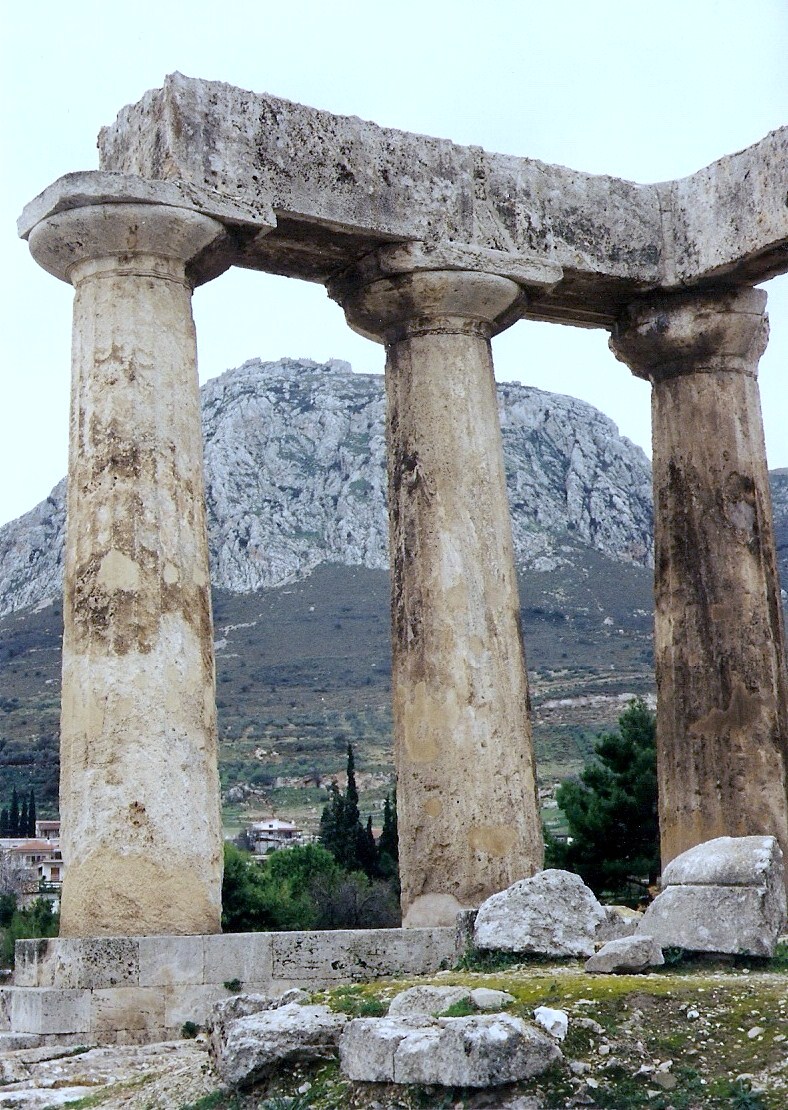
the first exercise is to look at the following images and just write what you think you see:

What is in the foreground and what is in the background?

What details can you pick out in these ruins?

The Corinthians were living in a pluralistic, multiethnic metropolis.  It was the centre of a Romanized Greece.  Transportation routes would come through the Isthmus of Corinth by land and by sea.  How might this give us hope that the problems faced by Corinth would be very similar to the problems of living in a city like Chicago today?

Going Deeper:

Look through the slides of the following Powerpoint and think how the first slides of Corinth relate to the latter slides of Chicago.Corinth and Chicago

Use a browser like Google, Yahoo, or Bing to look up the terms:  Corinth, Diolkos, Apollo, Bema, and Aphrodite.

Posted in Daily Devotions | Leave a comment

Down With Deuteronomy

I am studying Deuteronomy at the moment.  Like the kings of old I had been hand writing by personal copy of the book.  I am on chapter 20.  When I have finished the book I will resume posting.

Posted in Daily Devotions | Leave a comment

Numbers 35 -36

Shortly after arriving in Chicago I saw Illinois put the death penalty on hold.  In England the death penalty has been abolished for years.  It seemed to be progressive to me for America to abolish antiquated procedures that frequently killed the wrong man (or woman).  My views on crime and punishment have changed since arriving in America and trying to understand the thinking behind passage like Numbers 35-36.  Remediation is not always the goal of the law.  Sometimes punishment ascribes value.  In the case of the death penalty the statement coming from the Bible is that the life of each person is equal to the life of another.  We instinctively are aware of the value of our own lives, but we are not always aware of the value of another’s life.  A law which tells you that your own life is forfeit if you murder establishes an understanding of the value of human life.  The rules for trying a murderer in the Bible are quite different than laws in states like Illinois.  For example, if you give false evidence in a murder case and are caught your own life is forfeit.  This would greatly reduce the draw of falsely accusing a rival or enemy to get revenge.  Do you think that the eath penalty is appropriate?

Numbers 35-36

 On the plains of Moab by the Jordan across from Jericho, [a] the LORD said to Moses, 2 “Command the Israelites to give the Levites towns to live in from the inheritance the Israelites will possess. And give them pasturelands around the towns. 3 Then they will have towns to live in and pasturelands for their cattle, flocks and all their other livestock.

 4 “The pasturelands around the towns that you give the Levites will extend out fifteen hundred feet [b] from the town wall. 5 Outside the town, measure three thousand feet [c] on the east side, three thousand on the south side, three thousand on the west and three thousand on the north, with the town in the center. They will have this area as pastureland for the towns.

Cities of Refuge

 6 “Six of the towns you give the Levites will be cities of refuge, to which a person who has killed someone may flee. In addition, give them forty-two other towns. 7 In all you must give the Levites forty-eight towns, together with their pasturelands. 8 The towns you give the Levites from the land the Israelites possess are to be given in proportion to the inheritance of each tribe: Take many towns from a tribe that has many, but few from one that has few.”

 9 Then the LORD said to Moses: 10 “Speak to the Israelites and say to them: ‘When you cross the Jordan into Canaan, 11 select some towns to be your cities of refuge, to which a person who has killed someone accidentally may flee. 12 They will be places of refuge from the avenger, so that a person accused of murder may not die before he stands trial before the assembly. 13 These six towns you give will be your cities of refuge. 14 Give three on this side of the Jordan and three in Canaan as cities of refuge. 15 These six towns will be a place of refuge for Israelites, aliens and any other people living among them, so that anyone who has killed another accidentally can flee there.

 16 ” ‘If a man strikes someone with an iron object so that he dies, he is a murderer; the murderer shall be put to death. 17 Or if anyone has a stone in his hand that could kill, and he strikes someone so that he dies, he is a murderer; the murderer shall be put to death. 18 Or if anyone has a wooden object in his hand that could kill, and he hits someone so that he dies, he is a murderer; the murderer shall be put to death. 19 The avenger of blood shall put the murderer to death; when he meets him, he shall put him to death. 20 If anyone with malice aforethought shoves another or throws something at him intentionally so that he dies 21 or if in hostility he hits him with his fist so that he dies, that person shall be put to death; he is a murderer. The avenger of blood shall put the murderer to death when he meets him.

 22 ” ‘But if without hostility someone suddenly shoves another or throws something at him unintentionally 23 or, without seeing him, drops a stone on him that could kill him, and he dies, then since he was not his enemy and he did not intend to harm him, 24 the assembly must judge between him and the avenger of blood according to these regulations. 25 The assembly must protect the one accused of murder from the avenger of blood and send him back to the city of refuge to which he fled. He must stay there until the death of the high priest, who was anointed with the holy oil.

 26 ” ‘But if the accused ever goes outside the limits of the city of refuge to which he has fled 27 and the avenger of blood finds him outside the city, the avenger of blood may kill the accused without being guilty of murder. 28 The accused must stay in his city of refuge until the death of the high priest; only after the death of the high priest may he return to his own property.

 29 ” ‘These are to be legal requirements for you throughout the generations to come, wherever you live.

 30 ” ‘Anyone who kills a person is to be put to death as a murderer only on the testimony of witnesses. But no one is to be put to death on the testimony of only one witness.

 31 ” ‘Do not accept a ransom for the life of a murderer, who deserves to die. He must surely be put to death.

 32 ” ‘Do not accept a ransom for anyone who has fled to a city of refuge and so allow him to go back and live on his own land before the death of the high priest.

 33 ” ‘Do not pollute the land where you are. Bloodshed pollutes the land, and atonement cannot be made for the land on which blood has been shed, except by the blood of the one who shed it. 34 Do not defile the land where you live and where I dwell, for I, the LORD, dwell among the Israelites.’ “

Numbers 36

Inheritance of Zelophehad’s Daughters

 1 The family heads of the clan of Gilead son of Makir, the son of Manasseh, who were from the clans of the descendants of Joseph, came and spoke before Moses and the leaders, the heads of the Israelite families. 2 They said, “When the LORD commanded my lord to give the land as an inheritance to the Israelites by lot, he ordered you to give the inheritance of our brother Zelophehad to his daughters. 3 Now suppose they marry men from other Israelite tribes; then their inheritance will be taken from our ancestral inheritance and added to that of the tribe they marry into. And so part of the inheritance allotted to us will be taken away. 4 When the Year of Jubilee for the Israelites comes, their inheritance will be added to that of the tribe into which they marry, and their property will be taken from the tribal inheritance of our forefathers.”

 5 Then at the LORD’s command Moses gave this order to the Israelites: “What the tribe of the descendants of Joseph is saying is right. 6 This is what the LORD commands for Zelophehad’s daughters: They may marry anyone they please as long as they marry within the tribal clan of their father. 7 No inheritance in Israel is to pass from tribe to tribe, for every Israelite shall keep the tribal land inherited from his forefathers. 8 Every daughter who inherits land in any Israelite tribe must marry someone in her father’s tribal clan, so that every Israelite will possess the inheritance of his fathers. 9 No inheritance may pass from tribe to tribe, for each Israelite tribe is to keep the land it inherits.”

 10 So Zelophehad’s daughters did as the LORD commanded Moses. 11 Zelophehad’s daughters—Mahlah, Tirzah, Hoglah, Milcah and Noah—married their cousins on their father’s side. 12 They married within the clans of the descendants of Manasseh son of Joseph, and their inheritance remained in their father’s clan and tribe.

 13 These are the commands and regulations the LORD gave through Moses to the Israelites on the plains of Moab by the Jordan across from Jericho.

Questions:

  1.  How far from the walls of the Levite cities should their land extend?
  2. Who runs to a city of refuge?
  3. Who may Zelophad’s daughters marry?
  4. How would a modern girl react to being told whom she could marry?
  5. What does arrange marriage teach us about loving our spouse?
Posted in Daily Devotions | Leave a comment

Numbers 32-34

I am sometimes amazed at how people think of their own needs before others.  When I was growing up my parents would say, “Oh, look-after-yourself-time, is it?”  We so quickly default to making sure our own needs are met without being motivated to care for others.  In today’s passage two tribes almost settle on the east side of the Jordan and leave their fellow Israelites to conquer the Promised Land alone.  Moses points out how selfish this is.  we would expect the Gadites and Reubenits to throw a tantrum and be smitten by God.  However, they are mature enough to have realised their ways.  The 12 tribes will cross the Jordan together.  Is there an area where you have relaxed because you have got what you wanted while others are still struggling?

Numbers 32-34

 1 The Reubenites and Gadites, who had very large herds and flocks, saw that the lands of Jazer and Gilead were suitable for livestock. 2 So they came to Moses and Eleazar the priest and to the leaders of the community, and said, 3 “Ataroth, Dibon, Jazer, Nimrah, Heshbon, Elealeh, Sebam, Nebo and Beon- 4 the land the LORD subdued before the people of Israel—are suitable for livestock, and your servants have livestock. 5 If we have found favor in your eyes,” they said, “let this land be given to your servants as our possession. Do not make us cross the Jordan.”

 6 Moses said to the Gadites and Reubenites, “Shall your countrymen go to war while you sit here? 7 Why do you discourage the Israelites from going over into the land the LORD has given them? 8 This is what your fathers did when I sent them from Kadesh Barnea to look over the land. 9 After they went up to the Valley of Eshcol and viewed the land, they discouraged the Israelites from entering the land the LORD had given them. 10 The LORD’s anger was aroused that day and he swore this oath: 11 ‘Because they have not followed me wholeheartedly, not one of the men twenty years old or more who came up out of Egypt will see the land I promised on oath to Abraham, Isaac and Jacob- 12 not one except Caleb son of Jephunneh the Kenizzite and Joshua son of Nun, for they followed the LORD wholeheartedly.’ 13 The LORD’s anger burned against Israel and he made them wander in the desert forty years, until the whole generation of those who had done evil in his sight was gone.

 14 “And here you are, a brood of sinners, standing in the place of your fathers and making the LORD even more angry with Israel. 15 If you turn away from following him, he will again leave all this people in the desert, and you will be the cause of their destruction.”

 16 Then they came up to him and said, “We would like to build pens here for our livestock and cities for our women and children. 17 But we are ready to arm ourselves and go ahead of the Israelites until we have brought them to their place. Meanwhile our women and children will live in fortified cities, for protection from the inhabitants of the land. 18 We will not return to our homes until every Israelite has received his inheritance. 19 We will not receive any inheritance with them on the other side of the Jordan, because our inheritance has come to us on the east side of the Jordan.”

 20 Then Moses said to them, “If you will do this—if you will arm yourselves before the LORD for battle, 21 and if all of you will go armed over the Jordan before the LORD until he has driven his enemies out before him- 22 then when the land is subdued before the LORD, you may return and be free from your obligation to the LORD and to Israel. And this land will be your possession before the LORD.

 23 “But if you fail to do this, you will be sinning against the LORD; and you may be sure that your sin will find you out. 24 Build cities for your women and children, and pens for your flocks, but do what you have promised.”

 25 The Gadites and Reubenites said to Moses, “We your servants will do as our lord commands. 26 Our children and wives, our flocks and herds will remain here in the cities of Gilead. 27 But your servants, every man armed for battle, will cross over to fight before the LORD, just as our lord says.”

 28 Then Moses gave orders about them to Eleazar the priest and Joshua son of Nun and to the family heads of the Israelite tribes. 29 He said to them, “If the Gadites and Reubenites, every man armed for battle, cross over the Jordan with you before the LORD, then when the land is subdued before you, give them the land of Gilead as their possession. 30 But if they do not cross over with you armed, they must accept their possession with you in Canaan.”

 31 The Gadites and Reubenites answered, “Your servants will do what the LORD has said. 32 We will cross over before the LORD into Canaan armed, but the property we inherit will be on this side of the Jordan.”

 33 Then Moses gave to the Gadites, the Reubenites and the half-tribe of Manasseh son of Joseph the kingdom of Sihon king of the Amorites and the kingdom of Og king of Bashan—the whole land with its cities and the territory around them.

 34 The Gadites built up Dibon, Ataroth, Aroer, 35 Atroth Shophan, Jazer, Jogbehah, 36 Beth Nimrah and Beth Haran as fortified cities, and built pens for their flocks. 37 And the Reubenites rebuilt Heshbon, Elealeh and Kiriathaim, 38 as well as Nebo and Baal Meon (these names were changed) and Sibmah. They gave names to the cities they rebuilt.

 39 The descendants of Makir son of Manasseh went to Gilead, captured it and drove out the Amorites who were there. 40 So Moses gave Gilead to the Makirites, the descendants of Manasseh, and they settled there. 41 Jair, a descendant of Manasseh, captured their settlements and called them Havvoth Jair. [a] 42 And Nobah captured Kenath and its surrounding settlements and called it Nobah after himself.

 1 Here are the stages in the journey of the Israelites when they came out of Egypt by divisions under the leadership of Moses and Aaron. 2 At the LORD’s command Moses recorded the stages in their journey. This is their journey by stages:

 3 The Israelites set out from Rameses on the fifteenth day of the first month, the day after the Passover. They marched out boldly in full view of all the Egyptians, 4 who were burying all their firstborn, whom the LORD had struck down among them; for the LORD had brought judgment on their gods.

 5 The Israelites left Rameses and camped at Succoth.

 6 They left Succoth and camped at Etham, on the edge of the desert.

 7 They left Etham, turned back to Pi Hahiroth, to the east of Baal Zephon, and camped near Migdol.

 8 They left Pi Hahiroth [b] and passed through the sea into the desert, and when they had traveled for three days in the Desert of Etham, they camped at Marah.

 9 They left Marah and went to Elim, where there were twelve springs and seventy palm trees, and they camped there.

 10 They left Elim and camped by the Red Sea. [c]

 11 They left the Red Sea and camped in the Desert of Sin.

 12 They left the Desert of Sin and camped at Dophkah.

 13 They left Dophkah and camped at Alush.

 14 They left Alush and camped at Rephidim, where there was no water for the people to drink.

 15 They left Rephidim and camped in the Desert of Sinai.

 16 They left the Desert of Sinai and camped at Kibroth Hattaavah.

 17 They left Kibroth Hattaavah and camped at Hazeroth.

 18 They left Hazeroth and camped at Rithmah.

 19 They left Rithmah and camped at Rimmon Perez.

 20 They left Rimmon Perez and camped at Libnah.

 21 They left Libnah and camped at Rissah.

 22 They left Rissah and camped at Kehelathah.

 23 They left Kehelathah and camped at Mount Shepher.

 24 They left Mount Shepher and camped at Haradah.

 25 They left Haradah and camped at Makheloth.

 26 They left Makheloth and camped at Tahath.

 27 They left Tahath and camped at Terah.

 28 They left Terah and camped at Mithcah.

 29 They left Mithcah and camped at Hashmonah.

 30 They left Hashmonah and camped at Moseroth.

 31 They left Moseroth and camped at Bene Jaakan.

 32 They left Bene Jaakan and camped at Hor Haggidgad.

 33 They left Hor Haggidgad and camped at Jotbathah.

 34 They left Jotbathah and camped at Abronah.

 35 They left Abronah and camped at Ezion Geber.

 36 They left Ezion Geber and camped at Kadesh, in the Desert of Zin.

 37 They left Kadesh and camped at Mount Hor, on the border of Edom. 38 At the LORD’s command Aaron the priest went up Mount Hor, where he died on the first day of the fifth month of the fortieth year after the Israelites came out of Egypt. 39 Aaron was a hundred and twenty-three years old when he died on Mount Hor.

 40 The Canaanite king of Arad, who lived in the Negev of Canaan, heard that the Israelites were coming.

 41 They left Mount Hor and camped at Zalmonah.

 42 They left Zalmonah and camped at Punon.

 43 They left Punon and camped at Oboth.

 44 They left Oboth and camped at Iye Abarim, on the border of Moab.

 45 They left Iyim [d] and camped at Dibon Gad.

 46 They left Dibon Gad and camped at Almon Diblathaim.

 47 They left Almon Diblathaim and camped in the mountains of Abarim, near Nebo.

 48 They left the mountains of Abarim and camped on the plains of Moab by the Jordan across from Jericho. [e] 49 There on the plains of Moab they camped along the Jordan from Beth Jeshimoth to Abel Shittim.

 50 On the plains of Moab by the Jordan across from Jericho the LORD said to Moses, 51 “Speak to the Israelites and say to them: ‘When you cross the Jordan into Canaan, 52 drive out all the inhabitants of the land before you. Destroy all their carved images and their cast idols, and demolish all their high places. 53 Take possession of the land and settle in it, for I have given you the land to possess. 54 Distribute the land by lot, according to your clans. To a larger group give a larger inheritance, and to a smaller group a smaller one. Whatever falls to them by lot will be theirs. Distribute it according to your ancestral tribes.

 55 ” ‘But if you do not drive out the inhabitants of the land, those you allow to remain will become barbs in your eyes and thorns in your sides. They will give you trouble in the land where you will live. 56 And then I will do to you what I plan to do to them.’ “

Numbers 34

 1 The LORD said to Moses, 2 “Command the Israelites and say to them: ‘When you enter Canaan, the land that will be allotted to you as an inheritance will have these boundaries:

 3 ” ‘Your southern side will include some of the Desert of Zin along the border of Edom. On the east, your southern boundary will start from the end of the Salt Sea, [f] 4 cross south of Scorpion [g] Pass, continue on to Zin and go south of Kadesh Barnea. Then it will go to Hazar Addar and over to Azmon, 5 where it will turn, join the Wadi of Egypt and end at the Sea. [h]

 6 ” ‘Your western boundary will be the coast of the Great Sea. This will be your boundary on the west.

 7 ” ‘For your northern boundary, run a line from the Great Sea to Mount Hor 8 and from Mount Hor to Lebo [i] Hamath. Then the boundary will go to Zedad, 9 continue to Ziphron and end at Hazar Enan. This will be your boundary on the north.

 10 ” ‘For your eastern boundary, run a line from Hazar Enan to Shepham. 11 The boundary will go down from Shepham to Riblah on the east side of Ain and continue along the slopes east of the Sea of Kinnereth. [j] 12 Then the boundary will go down along the Jordan and end at the Salt Sea.
      ” ‘This will be your land, with its boundaries on every side.’ “

 13 Moses commanded the Israelites: “Assign this land by lot as an inheritance. The LORD has ordered that it be given to the nine and a half tribes, 14 because the families of the tribe of Reuben, the tribe of Gad and the half-tribe of Manasseh have received their inheritance. 15 These two and a half tribes have received their inheritance on the east side of the Jordan of Jericho, [k] toward the sunrise.”

 16 The LORD said to Moses, 17 “These are the names of the men who are to assign the land for you as an inheritance: Eleazar the priest and Joshua son of Nun. 18 And appoint one leader from each tribe to help assign the land. 19 These are their names:
       Caleb son of Jephunneh,
       from the tribe of Judah;

 20 Shemuel son of Ammihud,
       from the tribe of Simeon;

 21 Elidad son of Kislon,
       from the tribe of Benjamin;

 22 Bukki son of Jogli,
       the leader from the tribe of Dan;

 23 Hanniel son of Ephod,
       the leader from the tribe of Manasseh son of Joseph;

 24 Kemuel son of Shiphtan,
       the leader from the tribe of Ephraim son of Joseph;

 25 Elizaphan son of Parnach,
       the leader from the tribe of Zebulun;

 26 Paltiel son of Azzan,
       the leader from the tribe of Issachar;

 27 Ahihud son of Shelomi,
       the leader from the tribe of Asher;

 28 Pedahel son of Ammihud,
       the leader from the tribe of Naphtali.”

 29 These are the men the LORD commanded to assign the inheritance to the Israelites in the land of Canaan.

Questions

  1. Why did Reuben and Gad want to stay East of the Jordan?
  2. Whose descendants drove out the Amorites?
  3. What does the list of place names retell?
  4. Why was it wrong for Reuben and Gad not to help their fellow Israelites?
  5. How do people renege on their responsibilities when they have what they want?
Posted in Daily Devotions | Leave a comment

Numbers 31

The circumstances of the Old Testament invasion have not been repeated.  Although God does seem to have sanctioned genocide at a crucial point n the development of the faith, there is no reason why anyone would annihilate others in the name of religion.  Religious wars, whether Jihads or Crusades, are not part of God’s plan.  They were necessary to establish a distinct nation in the ancient world that would not be subsumed into the pluralistic cultures of Canaan.  Notice, though, that God did not send his people on a rampage against all the polytheists and atheists of the world.  Neither should Christians take up arms and move to conquer the world for the Kingdom of God.

Numbers 31

 1 The LORD said to Moses, 2 “Take vengeance on the Midianites for the Israelites. After that, you will be gathered to your people.”

 3 So Moses said to the people, “Arm some of your men to go to war against the Midianites and to carry out the LORD’s vengeance on them. 4 Send into battle a thousand men from each of the tribes of Israel.” 5 So twelve thousand men armed for battle, a thousand from each tribe, were supplied from the clans of Israel. 6 Moses sent them into battle, a thousand from each tribe, along with Phinehas son of Eleazar, the priest, who took with him articles from the sanctuary and the trumpets for signaling.

 7 They fought against Midian, as the LORD commanded Moses, and killed every man. 8 Among their victims were Evi, Rekem, Zur, Hur and Reba—the five kings of Midian. They also killed Balaam son of Beor with the sword. 9 The Israelites captured the Midianite women and children and took all the Midianite herds, flocks and goods as plunder. 10 They burned all the towns where the Midianites had settled, as well as all their camps. 11 They took all the plunder and spoils, including the people and animals, 12 and brought the captives, spoils and plunder to Moses and Eleazar the priest and the Israelite assembly at their camp on the plains of Moab, by the Jordan across from Jericho. [a]

 13 Moses, Eleazar the priest and all the leaders of the community went to meet them outside the camp. 14 Moses was angry with the officers of the army—the commanders of thousands and commanders of hundreds—who returned from the battle.

 15 “Have you allowed all the women to live?” he asked them. 16 “They were the ones who followed Balaam’s advice and were the means of turning the Israelites away from the LORD in what happened at Peor, so that a plague struck the LORD’s people. 17 Now kill all the boys. And kill every woman who has slept with a man, 18 but save for yourselves every girl who has never slept with a man.

 19 “All of you who have killed anyone or touched anyone who was killed must stay outside the camp seven days. On the third and seventh days you must purify yourselves and your captives. 20 Purify every garment as well as everything made of leather, goat hair or wood.”

 21 Then Eleazar the priest said to the soldiers who had gone into battle, “This is the requirement of the law that the LORD gave Moses: 22 Gold, silver, bronze, iron, tin, lead 23 and anything else that can withstand fire must be put through the fire, and then it will be clean. But it must also be purified with the water of cleansing. And whatever cannot withstand fire must be put through that water. 24 On the seventh day wash your clothes and you will be clean. Then you may come into the camp.”

Dividing the Spoils

 25 The LORD said to Moses, 26 “You and Eleazar the priest and the family heads of the community are to count all the people and animals that were captured. 27 Divide the spoils between the soldiers who took part in the battle and the rest of the community. 28 From the soldiers who fought in the battle, set apart as tribute for the LORD one out of every five hundred, whether persons, cattle, donkeys, sheep or goats. 29 Take this tribute from their half share and give it to Eleazar the priest as the LORD’s part. 30 From the Israelites’ half, select one out of every fifty, whether persons, cattle, donkeys, sheep, goats or other animals. Give them to the Levites, who are responsible for the care of the LORD’s tabernacle.” 31 So Moses and Eleazar the priest did as the LORD commanded Moses.

 32 The plunder remaining from the spoils that the soldiers took was 675,000 sheep, 33 72,000 cattle, 34 61,000 donkeys 35 and 32,000 women who had never slept with a man.

 36 The half share of those who fought in the battle was:
       337,500 sheep, 37 of which the tribute for the LORD was 675;

 38 36,000 cattle, of which the tribute for the LORD was 72;

 39 30,500 donkeys, of which the tribute for the LORD was 61;

 40 16,000 people, of which the tribute for the LORD was 32.

 41 Moses gave the tribute to Eleazar the priest as the LORD’s part, as the LORD commanded Moses.

 42 The half belonging to the Israelites, which Moses set apart from that of the fighting men- 43 the community’s half—was 337,500 sheep, 44 36,000 cattle, 45 30,500 donkeys 46 and 16,000 people. 47 From the Israelites’ half, Moses selected one out of every fifty persons and animals, as the LORD commanded him, and gave them to the Levites, who were responsible for the care of the LORD’s tabernacle.

 48 Then the officers who were over the units of the army—the commanders of thousands and commanders of hundreds—went to Moses 49 and said to him, “Your servants have counted the soldiers under our command, and not one is missing. 50 So we have brought as an offering to the LORD the gold articles each of us acquired—armlets, bracelets, signet rings, earrings and necklaces—to make atonement for ourselves before the LORD.”

 51 Moses and Eleazar the priest accepted from them the gold—all the crafted articles. 52 All the gold from the commanders of thousands and commanders of hundreds that Moses and Eleazar presented as a gift to the LORD weighed 16,750 shekels. [b] 53 Each soldier had taken plunder for himself. 54 Moses and Eleazar the priest accepted the gold from the commanders of thousands and commanders of hundreds and brought it into the Tent of Meeting as a memorial for the Israelites before the LORD.

Questions

  1. Who did Israel destroy as a nation?
  2. Who did Israel destroy as an individual?
  3. Why was such a war necessary?
  4. Is there such a thing as a just war?
  5. Do you think of the war on terror as Christian v. Muslim?  How should you pray about the war that we are in?
Posted in Daily Devotions | Leave a comment

Numbers 30

At first glance it seems that a woman’s vows are subjected to a husband’s whims.  However, this chapter provides protection for a woman.  If she makes a vow and her husband annuls it her husband has to carry the burden of that decision.  In a patristic society men frequently wielded power to the detriment of women.  By removing her from responsibility, the husband has no grounds to blame her.

Note that an independent woman is responsible to herself.  This is not a passage that insists that men be in control.  God’s grace is shown that when a woman makes a vow that the husband breaks, God forgives her.  this is particularly important when an unmarried woman becomes married.  What happens to the vows the woman made under her father that conflict with the interests of the new spouse.  They can be discarded.

Numbers 30

1 Moses said to the heads of the tribes of Israel: “This is what the LORD commands: 2 When a man makes a vow to the LORD or takes an oath to obligate himself by a pledge, he must not break his word but must do everything he said.

 3 “When a young woman still living in her father’s house makes a vow to the LORD or obligates herself by a pledge 4 and her father hears about her vow or pledge but says nothing to her, then all her vows and every pledge by which she obligated herself will stand. 5 But if her father forbids her when he hears about it, none of her vows or the pledges by which she obligated herself will stand; the LORD will release her because her father has forbidden her.

 6 “If she marries after she makes a vow or after her lips utter a rash promise by which she obligates herself 7 and her husband hears about it but says nothing to her, then her vows or the pledges by which she obligated herself will stand. 8 But if her husband forbids her when he hears about it, he nullifies the vow that obligates her or the rash promise by which she obligates herself, and the LORD will release her.

 9 “Any vow or obligation taken by a widow or divorced woman will be binding on her.

 10 “If a woman living with her husband makes a vow or obligates herself by a pledge under oath 11 and her husband hears about it but says nothing to her and does not forbid her, then all her vows or the pledges by which she obligated herself will stand. 12 But if her husband nullifies them when he hears about them, then none of the vows or pledges that came from her lips will stand. Her husband has nullified them, and the LORD will release her. 13 Her husband may confirm or nullify any vow she makes or any sworn pledge to deny herself. 14 But if her husband says nothing to her about it from day to day, then he confirms all her vows or the pledges binding on her. He confirms them by saying nothing to her when he hears about them. 15 If, however, he nullifies them some time after he hears about them, then he is responsible for her guilt.”

 16 These are the regulations the LORD gave Moses concerning relationships between a man and his wife, and between a father and his young daughter still living in his house.

Questions

  1. What happens when a man makes a vow?
  2. Under what conditions may a woman break a vow?
  3. What transition does v. 16 emphasize?
  4. Do women serve their husbands?
  5. How are we to make decisions between a man and a woman?
Posted in Daily Devotions | Leave a comment

Easter

I decided to take a break over Easter.  The break lasted a little longer than I anticipated.

I thought that Jeff’s Easter talk, Doubt , was compelling.  I had heard about Anthony Flew and his adoption of theism.  I hope and pray that one day Richard Dawkins and Sam Harris will follow suit.  If you did not hear the talk you could hear it by going to www.chapel.org

Do you have some doubts?  What are they?

Posted in Daily Devotions | Leave a comment

Numbers 28-29

It is important to have rituals in a consistent relationship.  Today we celebrated Colton’s first birthday.  He didn’t have a lot to say about it, but he is a happy and active child.  as we celebrate his birthday each year he will kow that there is a community that celebrates him, loves him, and is connected to him.  Hallmark has probably invented more celebrations than we would have thought possible.  However, God himself proscribed rituals that were to be carried out at regular intervals.  Some of them were weekly, some yearly, but all of them were important.

How did you decide to celebrate Easter?

Numbers 28-29

 1 The LORD said to Moses, 2 “Give this command to the Israelites and say to them: ‘See that you present to me at the appointed time the food for my offerings made by fire, as an aroma pleasing to me.’ 3 Say to them: ‘This is the offering made by fire that you are to present to the LORD : two lambs a year old without defect, as a regular burnt offering each day. 4 Prepare one lamb in the morning and the other at twilight, 5 together with a grain offering of a tenth of an ephah [a] of fine flour mixed with a quarter of a hin [b] of oil from pressed olives. 6 This is the regular burnt offering instituted at Mount Sinai as a pleasing aroma, an offering made to the LORD by fire. 7 The accompanying drink offering is to be a quarter of a hin of fermented drink with each lamb. Pour out the drink offering to the LORD at the sanctuary. 8 Prepare the second lamb at twilight, along with the same kind of grain offering and drink offering that you prepare in the morning. This is an offering made by fire, an aroma pleasing to the LORD.

 9 ” ‘On the Sabbath day, make an offering of two lambs a year old without defect, together with its drink offering and a grain offering of two-tenths of an ephah [c] of fine flour mixed with oil. 10 This is the burnt offering for every Sabbath, in addition to the regular burnt offering and its drink offering.

 11 ” ‘On the first of every month, present to the LORD a burnt offering of two young bulls, one ram and seven male lambs a year old, all without defect. 12 With each bull there is to be a grain offering of three-tenths of an ephah [d] of fine flour mixed with oil; with the ram, a grain offering of two-tenths of an ephah of fine flour mixed with oil; 13 and with each lamb, a grain offering of a tenth of an ephah of fine flour mixed with oil. This is for a burnt offering, a pleasing aroma, an offering made to the LORD by fire. 14 With each bull there is to be a drink offering of half a hin [e] of wine; with the ram, a third of a hin [f] ; and with each lamb, a quarter of a hin. This is the monthly burnt offering to be made at each new moon during the year. 15 Besides the regular burnt offering with its drink offering, one male goat is to be presented to the LORD as a sin offering.

 16 ” ‘On the fourteenth day of the first month the LORD’s Passover is to be held. 17 On the fifteenth day of this month there is to be a festival; for seven days eat bread made without yeast. 18 On the first day hold a sacred assembly and do no regular work. 19 Present to the LORD an offering made by fire, a burnt offering of two young bulls, one ram and seven male lambs a year old, all without defect. 20 With each bull prepare a grain offering of three-tenths of an ephah of fine flour mixed with oil; with the ram, two-tenths; 21 and with each of the seven lambs, one-tenth. 22 Include one male goat as a sin offering to make atonement for you. 23 Prepare these in addition to the regular morning burnt offering. 24 In this way prepare the food for the offering made by fire every day for seven days as an aroma pleasing to the LORD; it is to be prepared in addition to the regular burnt offering and its drink offering. 25 On the seventh day hold a sacred assembly and do no regular work.

 26 ” ‘On the day of firstfruits, when you present to the LORD an offering of new grain during the Feast of Weeks, hold a sacred assembly and do no regular work. 27 Present a burnt offering of two young bulls, one ram and seven male lambs a year old as an aroma pleasing to the LORD. 28 With each bull there is to be a grain offering of three-tenths of an ephah of fine flour mixed with oil; with the ram, two-tenths; 29 and with each of the seven lambs, one-tenth. 30 Include one male goat to make atonement for you. 31 Prepare these together with their drink offerings, in addition to the regular burnt offering and its grain offering. Be sure the animals are without defect.


 1 ” ‘On the first day of the seventh month hold a sacred assembly and do no regular work. It is a day for you to sound the trumpets. 2 As an aroma pleasing to the LORD, prepare a burnt offering of one young bull, one ram and seven male lambs a year old, all without defect. 3 With the bull prepare a grain offering of three-tenths of an ephah [g] of fine flour mixed with oil; with the ram, two-tenths [h] ; 4 and with each of the seven lambs, one-tenth. [i] 5 Include one male goat as a sin offering to make atonement for you. 6 These are in addition to the monthly and daily burnt offerings with their grain offerings and drink offerings as specified. They are offerings made to the LORD by fire—a pleasing aroma.

 7 ” ‘On the tenth day of this seventh month hold a sacred assembly. You must deny yourselves [j] and do no work. 8 Present as an aroma pleasing to the LORD a burnt offering of one young bull, one ram and seven male lambs a year old, all without defect. 9 With the bull prepare a grain offering of three-tenths of an ephah of fine flour mixed with oil; with the ram, two-tenths; 10 and with each of the seven lambs, one-tenth. 11 Include one male goat as a sin offering, in addition to the sin offering for atonement and the regular burnt offering with its grain offering, and their drink offerings.

 12 ” ‘On the fifteenth day of the seventh month, hold a sacred assembly and do no regular work. Celebrate a festival to the LORD for seven days. 13 Present an offering made by fire as an aroma pleasing to the LORD, a burnt offering of thirteen young bulls, two rams and fourteen male lambs a year old, all without defect. 14 With each of the thirteen bulls prepare a grain offering of three-tenths of an ephah of fine flour mixed with oil; with each of the two rams, two-tenths; 15 and with each of the fourteen lambs, one-tenth. 16 Include one male goat as a sin offering, in addition to the regular burnt offering with its grain offering and drink offering.

 17 ” ‘On the second day prepare twelve young bulls, two rams and fourteen male lambs a year old, all without defect. 18 With the bulls, rams and lambs, prepare their grain offerings and drink offerings according to the number specified. 19 Include one male goat as a sin offering, in addition to the regular burnt offering with its grain offering, and their drink offerings.

 20 ” ‘On the third day prepare eleven bulls, two rams and fourteen male lambs a year old, all without defect. 21 With the bulls, rams and lambs, prepare their grain offerings and drink offerings according to the number specified. 22 Include one male goat as a sin offering, in addition to the regular burnt offering with its grain offering and drink offering.

 23 ” ‘On the fourth day prepare ten bulls, two rams and fourteen male lambs a year old, all without defect. 24 With the bulls, rams and lambs, prepare their grain offerings and drink offerings according to the number specified. 25 Include one male goat as a sin offering, in addition to the regular burnt offering with its grain offering and drink offering.

 26 ” ‘On the fifth day prepare nine bulls, two rams and fourteen male lambs a year old, all without defect. 27 With the bulls, rams and lambs, prepare their grain offerings and drink offerings according to the number specified. 28 Include one male goat as a sin offering, in addition to the regular burnt offering with its grain offering and drink offering.

 29 ” ‘On the sixth day prepare eight bulls, two rams and fourteen male lambs a year old, all without defect. 30 With the bulls, rams and lambs, prepare their grain offerings and drink offerings according to the number specified. 31 Include one male goat as a sin offering, in addition to the regular burnt offering with its grain offering and drink offering.

 32 ” ‘On the seventh day prepare seven bulls, two rams and fourteen male lambs a year old, all without defect. 33 With the bulls, rams and lambs, prepare their grain offerings and drink offerings according to the number specified. 34 Include one male goat as a sin offering, in addition to the regular burnt offering with its grain offering and drink offering.

 35 ” ‘On the eighth day hold an assembly and do no regular work. 36 Present an offering made by fire as an aroma pleasing to the LORD, a burnt offering of one bull, one ram and seven male lambs a year old, all without defect. 37 With the bull, the ram and the lambs, prepare their grain offerings and drink offerings according to the number specified. 38 Include one male goat as a sin offering, in addition to the regular burnt offering with its grain offering and drink offering.

 39 ” ‘In addition to what you vow and your freewill offerings, prepare these for the LORD at your appointed feasts: your burnt offerings, grain offerings, drink offerings and fellowship offerings. [k] ‘ “

 40 Moses told the Israelites all that the LORD commanded him.

Questions

  1. What celebration occurs each week?
  2. What must be offered each month?
  3. What are the names of the annual celebrations?
  4. Why does God institute regular times of coming together?
  5. How do you come together with God regularly?
Posted in Daily Devotions | 1 Comment