John 1:19-28 Straightening Things Out

19 And this is the testimony of John, when the Jews sent priests and Levites from Jerusalem to ask him, “Who are you?” 20 He confessed, and did not deny, but confessed, “I am not the Christ.” 21 And they asked him, “What then? Are you Elijah?” He said, “I am not.” “Are you the Prophet?” And he answered, “No.” 22 So they said to him, “Who are you? We need to give an answer to those who sent us. What do you say about yourself?” 23 He said, “I am the voice of one crying out in the wilderness, ‘Make straight the way of the Lord’, as the prophet Isaiah said.”

24 (Now they had been sent from the Pharisees.) 25 They asked him, “Then why are you baptizing, if you are neither the Christ, nor Elijah, nor the Prophet?” 26 John answered them, “I baptize with water, but among you stands one you do not know, 27 even he who comes after me, the strap of whose sandal I am not worthy to untie.” 28 These things took place in Bethany across the Jordan, where John was baptizing.

Straightening Things Out

It always surprises me that John has people repent and be baptised before they are introduced to Jesus.  Jesus is seen by me as the means to repentance, so how come John is doing it.  What does it mean?  Was it worthless?  It is like the child who will meet with the principal after a fight on the playground.  They know that the real discipline is coming, but to be prepared to meet the principle, they tuck in their shirt and brush themselves down.  They may start crying because they know what they have done is wrong and they may promise themselves never to do such a thing again.  Then the principal, who knows what the child needs even better than they do, explains the course of action that the child will take in order to make things better.  This example falls short of the preparatory repentance that John brought when compared with the heart-deep repentance that Jesus brought.  However, it helps me to see that the repentance of John makes some sense.

Israel was in a bad way and needed to turn from the combination of self-assured righteousness or hopeless self-loathing.  The masses who loathed themselves flocked to John.  They wanted the new life that he foresaw, but John knew that he was just the herald for the one who would bring real transformation.  John aided the people by preparing their hearts to receive the truth.

Prayer

Sometimes we are busy and sometimes we are hardened by life.  We resist the tender transformation that You would work in us.  Let us not get into a life that solves tasks, hides in a corner, or controls our surroundings.  Help us to adopt a posture of surrender.  Help us to be in a position to receive your truth.

Questions

  1. What did John proclaim?
  2. What does the people’s response tell you about the culture in Israel at this time?
  3. How were the people changed?  Were they ‘saved’?
  4. How can the unsaved be prepared for the gospel?
  5. How can both the unsaved and the saved change their actions for the betterment of God’s world?
22 Comments

John 1:1-18 Jesus: The Life, The Light, The Word

In the beginning was the Word, and the Word was with God, and the Word was God. He was with God in the beginning. Through him all things were made; without him nothing was made that has been made. In him was life, and that life was the light of all mankind. The light shines in the darkness, and the darkness has not overcome it.

There was a man sent from God whose name was John. He came as a witness to testify concerning that light, so that through him all might believe. He himself was not the light; he came only as a witness to the light.

The true light that gives light to everyone was coming into the world. 10 He was in the world, and though the world was made through him, the world did not recognize him. 11 He came to that which was his own, but his own did not receive him. 12 Yet to all who did receive him, to those who believed in his name, he gave the right to become children of God— 13 children born not of natural descent, nor of human decision or a husband’s will, but born of God.

14 The Word became flesh and made his dwelling among us. We have seen his glory, the glory of the one and only Son, who came from the Father, full of grace and truth.

15 (John testified concerning him. He cried out, saying, “This is the one I spoke about when I said, ‘He who comes after me has surpassed me because he was before me.’”) 16 Out of his fullness we have all received grace in place of grace already given. 17 For the law was given through Moses; grace and truth came through Jesus Christ. 18 No one has ever seen God, but the one and only Son, who is himself God and is in closest relationship with the Father, has made him known.

Jesus:  The Life; The Light; The Word

The creativity of God emanates through the Son.  People in Palestine had seen the embodiment of a light that could not be extinguished.  They had seen the embodiment of a life that could not die.  They had experienced a word that could not be silenced.  The world in Jesus’ day was a horrific place at times.  Tyrant kings could invade a region, plagues could decimate a region, and famine could starve a region.  Jesus brings the promise of peace and abundant living if people will turn to him.  This is not wealth and its pursuit, but it is a quality of life that triumphs in spite of circumstances.  Jesus would change hungry crowds into satisfied crowds; he would change sick people into well people; and he would still creation when it seemed it would overwhelm his disciples.

Jesus is the combination of a powerful, creative word going forth from the father and a cosmic reality sustaining all things.  Jesus transcends our perceptions of him and we must allow him that majesty.

Prayer

Jesus, be more to me than a subject in the curriculum, be the living Word who brings life and light.  Lord be my light.

Questions

  1. How is Jesus described?
  2. Do you believe the introduction was written after the rest of the book?  What would this mean?
  3. What did ancient people associate with The Word?
  4. How can the life and light of Jesus touch our dark world?
  5. How does Jesus speak into your life these days?
23 Comments

John: Introduction

John seems so different from the other gospels because it is.  Much of the material in John is not shared with the synoptic gospels of Matthew, Mark and Luke. The content focuses on themes of light and darkness, Jesus as a cosmic phenomenon called The Word or Logos.  Signs to Jesus transcendent identity are arranged with growing intensity in the text and Jesus’ words are recorded with incredible detail.  Is this because they were made up after the fact, are these the fanciful creations of a playwright who wants to entertain with a story on a par with a primitive Jesus Christ Superstar?  The text leads us to believe that John wrote the book with is named after him.  There are similarities in style with John’s epistles and with the Revelation of John.  John was one of the inner group of disciples who was privy to much of Jesus’ personal thoughts and reflections.  He was ideally positioned to write a book like the gospel of John which covers many details not related already.

The question of inspiration is an important one here.  Did the Holy Spirit lead John to remember what he had heard in this great detail?  Unlike us, many ancient people developed their ability to memorize.  We have technology like books and computers which help us record what we have seen and heard, in the ancient near east a pencil case or a computer would be impossible to find.  Jesus’ disciples would have memorized large sections of the Old Testament, they would have memorized local stories, and they would have memorized much of Jesus’ teaching.  It also seems as though Jesus repeated his teachings with slight variations according to his audience, so the idea that John and others memorized so much is not out of the question.  However, there is the problem of how John recalls such detail of a private prayer made by Jesus shortly before he died.  John may have been present, but whether he was or wasn’t, for centuries Christians have believed that God can inform people supernaturally of the truths he wants them to communicate.  By faith we accept that the book of John is a contrasting perspective to the other gospels, but it is none the less true.

Why do we have this book?  We have it so that we might believe.  Christians can gain insight into the author and perfecter of their faith, Jesus.  Their faith grows with knowledge and depth of insight.  Those who do not know Christ are introduced to him through the eyes of one of his closest disciples and in so doing might come to a new faith.  This is why the gospel of John is often handed to those who do not know God or who are new to the faith.

Prayer

Help me to love you in a similar way to the author of this book.  Help me to walk in a vibrant way that shows I have a growing faith.  Grow my faith through the inspired words of your servant.

Questions

  1. How many times have you read John?
  2. What are some of the things you remember about John’s gospel?
  3. Read an introduction in a study Bible – what is new to you?
  4. What do you expect to gain from reading John’s gospel?
21 Comments

Luke 12:13-34 Aligning Heaven and Earth for Eternal Riches

Aligning Heaven and Earth for Eternal Riches

I have more stuff now than I have ever had.  I have a house, two cars, and a positive bank account.  I am never really hungry and I am never really thirsty.  I have enough.  However, sometimes my house is dirty and dusty, my cars are not new enough, and my food isn’t quite to my taste.  I often think of myself as better than many because I do not chase money.  However, I am sometimes melancholy because I forget what really matters.  Disney would tell us that what really matters is family.  There is some truth to that, but heaven is what matters the most.  Some capitalists still love the idea that in the end their investments here are worthless, but because of a prayer they prayed half-heartedly at kids’ camp, they have it made in the shade for eternity.  Heaven, for most, is a grand hotel overlooking the ocean with margaritas by the pool.  However, heaven is not a geographical country-club with joys and toys.  First and foremost heaven is where God reigns directly.  This is why we can pray that heaven will come to earth.

The future kingdom of God is a kingdom where relationship with God and his creation is untainted by sin.  Is that the treasure that you want?  Is that what I want?  Then walking with Jesus will align creation with God’s will and that reward will last for eternity.  Walk independently of God and all that we amass will be cast out when the world and heaven are aligned.

Questions

  1. How are the aims of capitalism and the Kingdom of God at odds in this passage?
  2. What does Ecclesiastes say about trusting in long term capital gains?
  3. What goals is a disciple to pursue?
  4. Are your riches heavenly riches?
  5. How does family replace God as the ultimate treasure in our culture today?

https://i0.wp.com/revivenations.org/blog/wp-content/uploads/2012/11/revival-lifestyle-heaven-on-earth.jpg

Prayer

Father, you are our treasure.  Help us to pursue you.

Text:

13 Someone in the crowd said to him, “Teacher, tell my brother to divide the inheritance with me.”

14 Jesus replied, “Man, who appointed me a judge or an arbiter between you?” 15 Then he said to them, “Watch out! Be on your guard against all kinds of greed; life does not consist in an abundance of possessions.”

16 And he told them this parable: “The ground of a certain rich man yielded an abundant harvest. 17 He thought to himself, ‘What shall I do? I have no place to store my crops.’

18 “Then he said, ‘This is what I’ll do. I will tear down my barns and build bigger ones, and there I will store my surplus grain. 19 And I’ll say to myself, “You have plenty of grain laid up for many years. Take life easy; eat, drink and be merry.”’

20 “But God said to him, ‘You fool! This very night your life will be demanded from you. Then who will get what you have prepared for yourself?’

21 “This is how it will be with whoever stores up things for themselves but is not rich toward God.”

22 Then Jesus said to his disciples: “Therefore I tell you, do not worry about your life, what you will eat; or about your body, what you will wear. 23 For life is more than food, and the body more than clothes. 24 Consider the ravens: They do not sow or reap, they have no storeroom or barn; yet God feeds them. And how much more valuable you are than birds! 25 Who of you by worrying can add a single hour to your life[b]? 26 Since you cannot do this very little thing, why do you worry about the rest?

27 “Consider how the wild flowers grow. They do not labor or spin. Yet I tell you, not even Solomon in all his splendor was dressed like one of these. 28 If that is how God clothes the grass of the field, which is here today, and tomorrow is thrown into the fire, how much more will he clothe you—you of little faith! 29 And do not set your heart on what you will eat or drink; do not worry about it. 30 For the pagan world runs after all such things, and your Father knows that you need them. 31 But seek his kingdom, and these things will be given to you as well.

32 “Do not be afraid, little flock, for your Father has been pleased to give you the kingdom. 33 Sell your possessions and give to the poor. Provide purses for yourselves that will not wear out, a treasure in heaven that will never fail, where no thief comes near and no moth destroys. 34 For where your treasure is, there your heart will be also.

Leave a comment

Luke 12:1-12 Fearing Satan or Fearing God

Fearing Satan or Fearing God

“But I will show you whom you should fear: Fear him who, after your body has been killed, has authority to throw you into hell” (v. 5)

N.T. Wright thinks the verse above is talking of Satan, but I always thought it was talking about God.  The way I thought was that God should be feared and that we should remember that in order to pursue holiness.  In other words, in this passage, we should be mindful of God’s just punishment and turn to him in repentance.  N.T. Wright would say that Satan as authority to throw people into hell in this passage.  Hell is an interesting concept here because it is Gehenna in the Greek.  Gehenna was the valley outside Jerusalem which was a rubbish-dump or landfill.  It stank and burned continuously with the refuse of Jerusalem.  The idea of hell, then, is the place where things have ceased to serve their purpose and are burned up as garbage.  People are created for a purpose to serve God, but some of them do not.  Those who do not become remade in a way that God sees fit are collected as trash and burned.  So who is the garbage collector?  Does God collect his garbage or does Satan delight in declaring people as garbage?  I would say that the fear should not be rooted in the one who throws out the garbage, but that we would not serve our purpose and therefore be declared garbage.  We should fear either God or Satan throwing us aside with either Satanic glee or Fatherly grief.  We have choices that lead us to hell.  We make decisions that put us by the curb ready for collection on garbage day.

The idea of being useless contrasts with the idea of being useful.  The Bible calls us pots and Paul commends people for being useful to him in his ministry.  Although the Pharisees and Sadducees had a lot to do, they were missing the true path of God and had created a path of burdensome self-righteousness.  In the world today, there are those who advance science and medicine in ways that I believe please God, but they often miss God himself.  Jesus, in the passage below, is starting to divide his disciples from the masses.  There are those who find the true path and those who do not.  The consequences are eternally significant.  What path defines your life?

Prayer

My discipline is poor and my patience is thin.  My resources are meaningless and my life is a breath.  I pray that your work would be done through me so that my words would have weight and my life would have significance because I was created for eternity and not for this meagre life span that I have on earth.  You are God and I fear you with reverent awe.  Satan desires me and I fear the darkness that engulfed me in times I have not been guarded. 

Questions

  1. Who is coming to Jesus?
  2. Who does Jesus draw to himself?
  3. What is Jesus’ point in doing so?
  4. Why are Christians shy about discussing Gehenna or Hell?
  5. What is the significance today of Jesus’ words?

Text:

Meanwhile, when a crowd of many thousands had gathered, so that they were trampling on one another, Jesus began to speak first to his disciples, saying: “Be on your guard against the yeast of the Pharisees, which is hypocrisy. There is nothing concealed that will not be disclosed, or hidden that will not be made known. What you have said in the dark will be heard in the daylight, and what you have whispered in the ear in the inner rooms will be proclaimed from the roofs.

“I tell you, my friends, do not be afraid of those who kill the body and after that can do no more. But I will show you whom you should fear: Fear him who, after your body has been killed, has authority to throw you into hell. Yes, I tell you, fear him. Are not five sparrows sold for two pennies? Yet not one of them is forgotten by God. Indeed, the very hairs of your head are all numbered. Don’t be afraid; you are worth more than many sparrows.

“I tell you, whoever publicly acknowledges me before others, the Son of Man will also acknowledge before the angels of God. But whoever disowns me before others will be disowned before the angels of God. 10 And everyone who speaks a word against the Son of Man will be forgiven, but anyone who blasphemes against the Holy Spirit will not be forgiven.

11 “When you are brought before synagogues, rulers and authorities, do not worry about how you will defend yourselves or what you will say, 12 for the Holy Spirit will teach you at that time what you should say.”

Leave a comment

Luke 11:29-54 Scurrying into Darkness

Scurrying into Darkness

We have a new guinea-pig called Sugar Cookie.  He has an unusual name for a boy, but he is white and light brown which is why Daryl, my son, named him that way.

Photo: Happy 6th birthday, Daryl!! And welcome to the family, Sugar Cookie!

Spotting the guinea-pig was a problem because every time we turned on the light he would scurry away to his shelter.  He is less nervous now, but he spends a lot of time living in darkness.  It is sometimes easy to point the finger at the godless masses and accuse them of loving darkness, like Daryl’s guinea-pig, but Jesus is leveling his accusations at religious people.  In recent days Muslim Jihadists have beheaded journalist James Foley, Jewish people have killed Hamas leaders and also women and children in Gaza, and the Russian Orthodox Church sides with Putin on Ukraine.  Depending on our political stance, each of these acts might be seen as evil.  However, we easily continue in pointing the finger away from ourselves.  The resentment that resulted in Jesus’ death starts here in Luke 11.  He claims that his teaching and his kingdom will be a like a lamp for people showing them the path in which they should walk.  The religious people of his day have a different perspective and Jesus takes an offensive, exclusivist perspective.  He calls the religious practices of his day dark and blinding.  Because people were following rules, some of which were laid out by God in the Old Testament and many of which they had invented to keep themselves pure, they thought they were walking in the light.  However, Jesus says that their teaching is so dark that it causes people to fall into empty graves.  Their ‘faith’ was not about a dynamic relationship with God, it was about a rigid series of rules which prevented intimacy with God.

This last accusation comes home to the church.  Many people have substituted a radical faith in Jesus with a nice set of pleasant rules which demand very little from middle-class people in many western countries.  If the rules of pleasant society are challenged and a radical call to exclusive and total commitment to the person of Jesus is requested by anyone, they are seen as strange.  In centuries past they were labeled an ‘enthusiast’, now they might be called a ‘fundamentalist’ or ‘extremist’.  Our present infatuation with ‘balance’ doesn’t gel with Jesus’ calling.  He does not call for people to balance commitment to him with commitment to our religious traditions, daily responsibilities, and work commitments.  He becomes the foundation upon which we build a life of religious tradition, daily responsibility and work commitment.  He becomes the person around whom we build our lives.  He becomes the capstone.  This kind of teaching offended the Jewish culture in which he lived, but he was proposing a Judaism centered on him.  He was the fulfillment of all they hoped for. 

Do we hide in routine? Are we alive in the way we were built to live?  Is God our vision?

Prayer

Be Thou my Vision, O Lord of my heart;
Naught be all else to me, save that Thou art.
Thou my best Thought, by day or by night,
Waking or sleeping, Thy presence my light.

Be Thou my Wisdom, and Thou my true Word;
I ever with Thee and Thou with me, Lord;
Thou my great Father, I Thy true son;
Thou in me dwelling, and I with Thee one.

Be Thou my battle Shield, Sword for the fight;
Be Thou my Dignity, Thou my Delight;
Thou my soul’s Shelter, Thou my high Tower:
Raise Thou me heavenward, O Power of my power.

Riches I heed not, nor man’s empty praise,
Thou mine Inheritance, now and always:
Thou and Thou only, first in my heart,
High King of Heaven, my Treasure Thou art.

High King of Heaven, my victory won,
May I reach Heaven’s joys, O bright Heaven’s Sun!
Heart of my own heart, whatever befall,
Still be my Vision, O Ruler of all.

Questions

  1. If the lamp of the body lights the way, how does this connect with people falling into empty graves?
  2. Why were the Pharisees upset?
  3. How does Jesus treat his host?
  4. What false lamps are given to light our way today?
  5. How does one truly train their eyes to be a lamp so that their feet walk in the right way?

Text:

 As the crowds increased, Jesus said, “This is a wicked generation. It asks for a sign, but none will be given it except the sign of Jonah. 30 For as Jonah was a sign to the Ninevites, so also will the Son of Man be to this generation. 31 The Queen of the South will rise at the judgment with the people of this generation and condemn them, for she came from the ends of the earth to listen to Solomon’s wisdom; and now something greater than Solomon is here. 32 The men of Nineveh will stand up at the judgment with this generation and condemn it, for they repented at the preaching of Jonah; and now something greater than Jonah is here.

33 “No one lights a lamp and puts it in a place where it will be hidden, or under a bowl. Instead they put it on its stand, so that those who come in may see the light. 34 Your eye is the lamp of your body. When your eyes are healthy,[g] your whole body also is full of light. But when they are unhealthy,[h] your body also is full of darkness. 35 See to it, then, that the light within you is not darkness. 36 Therefore, if your whole body is full of light, and no part of it dark, it will be just as full of light as when a lamp shines its light on you.”

37 When Jesus had finished speaking, a Pharisee invited him to eat with him; so he went in and reclined at the table. 38 But the Pharisee was surprised when he noticed that Jesus did not first wash before the meal.

39 Then the Lord said to him, “Now then, you Pharisees clean the outside of the cup and dish, but inside you are full of greed and wickedness. 40 You foolish people! Did not the one who made the outside make the inside also? 41 But now as for what is inside you—be generous to the poor, and everything will be clean for you.

42 “Woe to you Pharisees, because you give God a tenth of your mint, rue and all other kinds of garden herbs, but you neglect justice and the love of God. You should have practiced the latter without leaving the former undone.

43 “Woe to you Pharisees, because you love the most important seats in the synagogues and respectful greetings in the marketplaces.

44 “Woe to you, because you are like unmarked graves, which people walk over without knowing it.”

45 One of the experts in the law answered him, “Teacher, when you say these things, you insult us also.”

46 Jesus replied, “And you experts in the law, woe to you, because you load people down with burdens they can hardly carry, and you yourselves will not lift one finger to help them.

47 “Woe to you, because you build tombs for the prophets, and it was your ancestors who killed them. 48 So you testify that you approve of what your ancestors did; they killed the prophets, and you build their tombs. 49 Because of this, God in his wisdom said, ‘I will send them prophets and apostles, some of whom they will kill and others they will persecute.’ 50 Therefore this generation will be held responsible for the blood of all the prophets that has been shed since the beginning of the world, 51 from the blood of Abel to the blood of Zechariah, who was killed between the altar and the sanctuary. Yes, I tell you, this generation will be held responsible for it all.

52 “Woe to you experts in the law, because you have taken away the key to knowledge. You yourselves have not entered, and you have hindered those who were entering.”

53 When Jesus went outside, the Pharisees and the teachers of the law began to oppose him fiercely and to besiege him with questions, 54 waiting to catch him in something he might say.

Leave a comment

Luke 11:14-28 Dismissing Jesus

Dismissing Jesus

There are many ways that people put Jesus aside.  For the atheist Jesus is a myth at best, but usually he is a petty Jewish peasant who said a few interesting things about morality that are outmoded.  For many Jesus is distant and irrelevant.  A devout Jew from two millennia ago is not as compelling as the business of living each day.  Some see Jesus as having authority over a religious component of their lives – a component that requires less and less attention in lives dominated by materialism and consumerism.  Jesus’ claim is that he is to be the center of life was put aside by many in his day.  However, they did not have compartments for religious and practical matters.  They understood better than we do how the supernatural permeates all of life.  So when they dismissed Jesus’ authority over their lives they did so with an appeal to the supernatural.  If Jesus had supernatural authority it was only because it was given to him by evil forces, not those for good.

However, Jesus uses sound argument to show that what the Pharisees say doesn’t make sense.  They do not accept what he says, but he tells them anyway.  Why does he waste his breath?  Well, we are reading these words years later and our faith is bolstered by seeing the truth in what Jesus says.  In other words, we don’t always oppose those who denigrate our faith for their own sake, we reason with them for the sake of onlookers and for those whose faith is shaken by the accusations.

Most of the attacks against Christianity and its beliefs at the popular level are lazy and shallow.  However, The Da Vinci Code, Richard Dawkins, and gay activists have leveled accusations against the faith that have gained traction with shallow Christians who are unwilling to think deeply in response to criticism.  Our children are growing up in schools that indoctrinate into social constructivism, but many parents send their children off to school without thinking what methods schools are using or why they exist.  When someone finds some new ‘missing link’ that disproves faith, or finds some artifact in Israel that discredits the Bible, do we just accept the views of skeptic scholars or do we see the response of faithful thinkers?

Christianity is a faith that grows the mind.  Jesus was a thinker and a brilliant man.  We are to walk in his ways and develop the mind.  How can we love God with all of our mind if we don’t understand its capacity more each day?

Prayer

God, I am sad when I see people walk away from you for many reasons.  I feel challenged by objections to your authority.  Give me strength to read and give me faith to believe, that I may be stronger for my doubts.  Let me be driven closer to you by efforts to pull me away.

Questions

  1. Why are Pharisees out to discredit Jesus?
  2. How do they do it?
  3. In what way does Jesus respond?
  4. How do people discredit the faith today?
  5. How do you respond?

Text:

14 Jesus was driving out a demon that was mute. When the demon left, the man who had been mute spoke, and the crowd was amazed. 15 But some of them said, “By Beelzebul, the prince of demons, he is driving out demons.” 16 Others tested him by asking for a sign from heaven.

17 Jesus knew their thoughts and said to them: “Any kingdom divided against itself will be ruined, and a house divided against itself will fall. 18 If Satan is divided against himself, how can his kingdom stand? I say this because you claim that I drive out demons by Beelzebul. 19 Now if I drive out demons by Beelzebul, by whom do your followers drive them out? So then, they will be your judges. 20 But if I drive out demons by the finger of God, then the kingdom of God has come upon you.

21 “When a strong man, fully armed, guards his own house, his possessions are safe. 22 But when someone stronger attacks and overpowers him, he takes away the armor in which the man trusted and divides up his plunder.

23 “Whoever is not with me is against me, and whoever does not gather with me scatters.

24 “When an impure spirit comes out of a person, it goes through arid places seeking rest and does not find it. Then it says, ‘I will return to the house I left.’ 25 When it arrives, it finds the house swept clean and put in order. 26 Then it goes and takes seven other spirits more wicked than itself, and they go in and live there. And the final condition of that person is worse than the first.”

27 As Jesus was saying these things, a woman in the crowd called out, “Blessed is the mother who gave you birth and nursed you.”

28 He replied, “Blessed rather are those who hear the word of God and obey it.”

Leave a comment

Luke 11:1-13 Prayer and Petition

I am challenged at the moment to pray.  Melissa Hagan, who attends the International House of Prayer, has sent me some material to read about petition and intercession.  Communication with God is an essential element of our relationship with him.  Many of us think that we have a relationship because we know about God, but not because we know him with intimacy.  In the passage listed above, God is presented as a friend who responds to constant communication. He is presented as a good Father who gives to his children good gifts.  He gives us what we need (not always the trinkets or the relief that we want).

Scott Chapman, from the Chapel, gave me a book on prayer called ‘Prayer’.  It was by Richard Foster, who is a little more charismatic than some of the professors at Moody Bible Institute, but the book was helpful.  It started by describing ‘simple prayer’ and progressed through more and more involved ways of talking to God.  Yancey has also published a book on prayer which I found helpful.  It did not increase my prayer life, but it relieved some of the guilt that was leaving me frozen.  It was descriptive of Christian prayer and the confusion and complications that lead to a lack of prayer.

We can all start by using the liturgy of scripture:  “Our Father, who art in heaven …”  Our small group studied the prayer in Matthew and then made liturgy for our families.

The Worrall Family Prayer reads:

Father God,  You are love.  Help us to love.  You are peace.  Help us to bring peace.  You are faithful.  Help us to be faithful.  You are kind.  Help us to be kind.  Thank you for your mercy.  Thank you for your grace.  Bless our family.  Lead us on your adventure.  Amen.

Questions

  1. Write a prayer to God.

Text:

One day Jesus was praying in a certain place. When he finished, one of his disciples said to him, “Lord, teach us to pray, just as John taught his disciples.”

He said to them, “When you pray, say:

“‘Father,
hallowed be your name,
your kingdom come.
Give us each day our daily bread.
Forgive us our sins,
    for we also forgive everyone who sins against us.
And lead us not into temptation.”

Then Jesus said to them, “Suppose you have a friend, and you go to him at midnight and say, ‘Friend, lend me three loaves of bread; a friend of mine on a journey has come to me, and I have no food to offer him.’ And suppose the one inside answers, ‘Don’t bother me. The door is already locked, and my children and I are in bed. I can’t get up and give you anything.’ I tell you, even though he will not get up and give you the bread because of friendship, yet because of your shameless audacity he will surely get up and give you as much as you need.

“So I say to you: Ask and it will be given to you; seek and you will find; knock and the door will be opened to you. 10 For everyone who asks receives; the one who seeks finds; and to the one who knocks, the door will be opened.

11 “Which of you fathers, if your son asks for a fish, will give him a snake instead? 12 Or if he asks for an egg, will give him a scorpion? 13 If you then, though you are evil, know how to give good gifts to your children, how much more will your Father in heaven give the Holy Spirit to those who ask him!”

Leave a comment

Luke 10:38-42 Challenging a Woman’s Role

Challenging a Woman’s Role

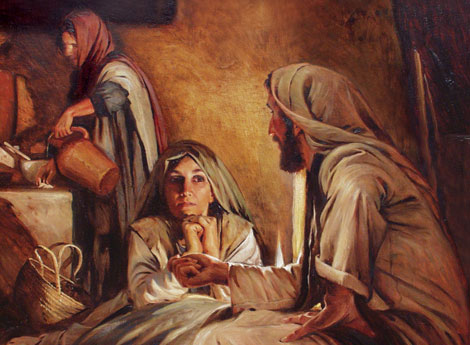
Some of you know that I am reading N. T. Wright’s Commentary, “Luke for Everyone”.  Wright says that the radical nature of what Jesus is doing with Mary and Martha is often lost in translation.  Some commentaries have the women competing for Jesus’ attention because of romantic infatuation, others have Mary gazing with star-struck wonder at the rock star of her day.  Wright asks whether the real issue is that Mary is behaving like a man.  In many places in the world today a woman’s role is clearly defined.  This role is demarcated by space.  A woman’s place is in the kitchen and the bedroom and the man’s place is in the living-room.  When I was in Pakistan, if I was invited to a Muslim’s house to meet with him, the women of the house would not be present.  It would not be appropriate.

The implication is that Jesus is teaching and training disciples.  Mary is behaving like any of the other male disciples by learning at the feet of Jesus, but the disciples were male.  Mary has chosen to follow the path of the rabbi which would hint that she thought she could be a rabbi in this new way that Jesus is laying out.  She might become a preacher and teacher.

I was raised in a church where women’s roles were distinct from men’s, especially in the church.  Women were to be silent in the assembly.  They could ask their husband at home if they had a question and they could suggest to their husband any hymn or song if they wanted it sung in worship.  There were certain ironies that occurred and also problems.  What if an older woman was single?  Was it appropriate to have a woman play the organ and lead the congregation in singing whilst at the same time prohibiting her from requesting a song to be sung?  The aim was to create a strong male role of leadership in the church.  Ironically, in a number of cases, what the church tried to create in public worship was a facade covering female dominance in the home.

Some have said that our society has been feminized and men have become overly effeminate.  I would be inclined to agree.  A distinctly male role seems less talked about than the need for women to define their roles and assert themselves.  Both sides of the conversation are needed.  When I was growing up I heard a lot of talk about the sameness of the genders, but science has been catching up with theology and realises that men and women are distinct and have distinct needs and callings.

However, women are to also learn at the feet of Jesus.  They are not just to concern themselves with their children’s packed lunch, the husband’s laundry, and the cleaning of the dishes.  Whilst men need to participate in the daily running of the family, every individual is responsible for developing a sound theology.  Men and women need to continue the discussion about their roles, but any way forward is as a devoted disciple of Jesus with all the learning that entails.

How are you developing your theology and following Jesus regardless of pressures to give up?

Prayer

Jesus, you values men and women equally.  You had intimate times of teaching with both.  Let us not exclude people based on gender bias.  Let us also find what it means to be truly male and female whilst not using it as a measure of worth.

Question

  1. Where is Mary?
  2. What is the problem?
  3. How is the problem resolved?
  4. What is a woman’s responsibility in life?
  5. How do women pursue theological training today?

Text:

38 As Jesus and his disciples were on their way, he came to a village where a woman named Martha opened her home to him. 39 She had a sister called Mary, who sat at the Lord’s feet listening to what he said. 40 But Martha was distracted by all the preparations that had to be made. She came to him and asked, “Lord, don’t you care that my sister has left me to do the work by myself? Tell her to help me!”

41 “Martha, Martha,” the Lord answered, “you are worried and upset about many things, 42 but few things are needed—or indeed only one. Mary has chosen what is better, and it will not be taken away from her.”

Posted in Daily Devotions | Leave a comment

Luke 10:25-37 Good Samaritan and Gaza

I had not thought of the Good Samaritan in the same way that N.T. Wright lays out in Luke for Everyone.  In it he says, “Can you recognize the hated Samaritan as your neighbour?  If you can’t you will be left for dead.”  I had read the story thinking that the Jewish lawyer was to see himself as the Samaritan or the Priest or Levite who passes by.  The thrust of the story is only to show the Jewish man that he should be like the Samaritan in the story, not that he is in desperate need of help.  I only saw him as one of the able-bodied participants.

This story has particular relevance for events in Gaza.  As you know from the news, Israelis have responded with overwhelming force to the launching of rockets by Hamas.  Israel, once again, is beaten up and bleeding.  Will they reach out to the Muslims who are willing to help them, or must their help only come from Israel?  Israel does reach out to other countries, but many people around the world side with the Palestinians because as Israel cut through the meat-shield that Hamas has constructed, alienating images of dead women and children become easier for Hamas to circulate.

Jesus’ point is still potent.  Take an isolationist approach and you will die.  Reach out to neighbours and you will live.  The Samaritans were the hated Palestinians of the day.  Are there Palestinians who are willing to be neighbours and is Israel willing to take their hand?

On the personal level, are you isolated from others who could help you?  Are you reaching across religious, ethnic, and cultural boundaries to be a neighbour?  The challenge from Jesus is timeless.

Prayer

Jesus, I see the strife in Gaza and I wonder if the cycle of violence will ever stop.  Let nations hear the political power of your challenge  resonate through history to bring peace.  If I am withdrawn from a neighbour through fear or pride, let me grow into a more loving response.

Questions

  1. What is the question for Jesus?
  2. How does he respond?
  3. Why is Jesus’ response radical?
  4. How does the response of Jesus challenge Israel and Hamas?
  5. How does Jesus’ response challenge you to both be a neighbour and to accept help?

Passage:

25 On one occasion an expert in the law stood up to test Jesus. “Teacher,” he asked, “what must I do to inherit eternal life?”

26 “What is written in the Law?” he replied. “How do you read it?”

27 He answered, “‘Love the Lord your God with all your heart and with all your soul and with all your strength and with all your mind’[c]; and, ‘Love your neighbor as yourself.’[d]

28 “You have answered correctly,” Jesus replied. “Do this and you will live.”

29 But he wanted to justify himself, so he asked Jesus, “And who is my neighbor?”

30 In reply Jesus said: “A man was going down from Jerusalem to Jericho, when he was attacked by robbers. They stripped him of his clothes, beat him and went away, leaving him half dead. 31 A priest happened to be going down the same road, and when he saw the man, he passed by on the other side. 32 So too, a Levite, when he came to the place and saw him, passed by on the other side. 33 But a Samaritan, as he traveled, came where the man was; and when he saw him, he took pity on him. 34 He went to him and bandaged his wounds, pouring on oil and wine. Then he put the man on his own donkey, brought him to an inn and took care of him. 35 The next day he took out two denarii[e] and gave them to the innkeeper. ‘Look after him,’ he said, ‘and when I return, I will reimburse you for any extra expense you may have.’

36 “Which of these three do you think was a neighbor to the man who fell into the hands of robbers?”

37 The expert in the law replied, “The one who had mercy on him.”

Jesus told him, “Go and do likewise.”

Posted in Daily Devotions | Leave a comment