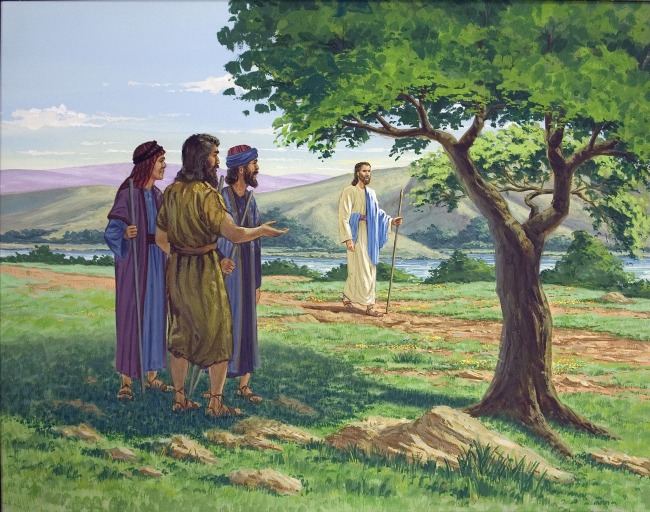
John 4:16-26 Changing the Subject

16 Jesus said to her, “Go, call your husband, and come here.” 17 The woman answered him, “I have no husband.” Jesus said to her, “You are right in saying, ‘I have no husband’; 18 for you have had five husbands, and the one you now have is not your husband. What you have said is true.” 19 The woman said to him, “Sir, I perceive that you are a prophet. 20 Our fathers worshiped on this mountain, but you say that in Jerusalem is the place where people ought to worship.” 21 Jesus said to her, “Woman, believe me, the hour is coming when neither on this mountain nor in Jerusalem will you worship the Father. 22 You worship what you do not know; we worship what we know, for salvation is from the Jews. 23 But the hour is coming, and is now here, when the true worshipers will worship the Father in spirit and truth, for the Father is seeking such people to worship him. 24 God is spirit, and those who worship him must worship in spirit and truth.” 25 The woman said to him, “I know that Messiah is coming (he who is called Christ). When he comes, he will tell us all things.” 26 Jesus said to her, “I who speak to you am he.”

Changing the Subject

The Samaritan women gets pressed about her own condition and she doesn’t want to go there.  It is possible to see her changing the conversation in order to defend herself.  The point might be that if the leadership of Israel and Samaria argue over where people should worship, how can anyone have authority to tell her what she should be doing with her life?  She then continues in a coherent vein by saying that it’ll all be sorted out when Messiah comes.  Busted!  “I am he,” responds Jesus. 

Many people today look at religious disagreement and use it to change the subject away from religious claims.  Look at ISIS in Syria and Iraq? These people are religious fanatics, so why get involved in questions of religion?  Look at how many denominations there are.  Surely that is a sign that church is messed up.  However, Jesus cuts across these arguments about disagreement through the ages.  The reality of his existence demands a response.  Jesus walked the dusty roads of Samaria, Galilee and Judea and he taught the people.  He revealed a kingdom of closeness with God and he proved that he had authority as the King of Heaven.  Will we try and distract ourselves and others from the personal claims he makes on us or will we submit to his questions and insights?

So how are you growing through the difficulties that surround you?  How have your past mistakes highlighted your need for Jesus?  How is your life stagnant and stale and how does Jesus want to revitalize your relationship with him and show you the path forward?

Prayer

You come to us and ask us to be taught by you.  You use scripture, mentors, friends, family and circumstances.  Help us not to deflect your touch on our lives by raising objections or changing the subject.  Help us to be open to your work to give us strength in our circumstances and a will to grow.

Questions

  1. What does Jesus tell the woman about herself?
  2. How does she try and change the subject?
  3. What is Jesus’ purpose in this conversation?
  4. What is Jesus trying to tell you about yourself?
  5. How might you attempt to deflect his attempts to communicate through scripture, mentors, friends, family and circumstances?
21 Comments

John 4:1-15 Samaritan Slut

Now Jesus learned that the Pharisees had heard that he was gaining and baptizing more disciples than John— although in fact it was not Jesus who baptized, but his disciples. So he left Judea and went back once more to Galilee.

Now he had to go through Samaria. So he came to a town in Samaria called Sychar, near the plot of ground Jacob had given to his son Joseph. Jacob’s well was there, and Jesus, tired as he was from the journey, sat down by the well. It was about noon.

When a Samaritan woman came to draw water, Jesus said to her, “Will you give me a drink?” (His disciples had gone into the town to buy food.)

The Samaritan woman said to him, “You are a Jew and I am a Samaritan woman. How can you ask me for a drink?” (For Jews do not associate with Samaritans.[a])

10 Jesus answered her, “If you knew the gift of God and who it is that asks you for a drink, you would have asked him and he would have given you living water.”

11 “Sir,” the woman said, “you have nothing to draw with and the well is deep. Where can you get this living water? 12 Are you greater than our father Jacob, who gave us the well and drank from it himself, as did also his sons and his livestock?”

13 Jesus answered, “Everyone who drinks this water will be thirsty again, 14 but whoever drinks the water I give them will never thirst. Indeed, the water I give them will become in them a spring of water welling up to eternal life.”

15 The woman said to him, “Sir, give me this water so that I won’t get thirsty and have to keep coming here to draw water.”

Samaritan Slut

Jesus knew what kind of woman the Samaritan woman was.  She was collecting water in the middle of the day when she wouldn’t be gossiped about by other women.  Most women gathered their water in the morning or evening when the temperature was a bit cooler.  This woman came in the heat of the day.  She was also racially inferior in the eyes of the Jews.  The Samaritans were half-breeds descended from the unfaithful northern kingdom of Israel and guilty of intermarriage with foreigners.  As we read forward we will see that this woman was either cast aside by multiple men or was a flirt who seduced multiple men and none of them satisfied.  Either way, this woman was one of society’s undesirables.  Women started life disadvantaged and this woman had more disadvantages than most.

Jesus, then, has a natural and open conversation with a woman.  We do not discredit his reputation in hindsight, but at the time Jesus was taking a great risk.  What if people started accusing him of being a womanizer?  What kind of holy man sits alone and converses with a racially inferior slut?

Jesus does not condemn people for the life that they have lived and he has cultivated an inner strength that is not going to give in to any sexual temptation here.  In North America I think that fear of reputation and fear of sexual attraction has created an unnatural relationship between men and women.  Where honour and spiritual fortitude should allow men and women to talk freely we quickly separate them lest they spontaneously have sex on the spot.  Of course I am being facetious, but I do think we cultivate a strange relationship in North America by our undue caution.  I also think that we are not Jesus and we should be aware of our own weakness or the wisdom of being alone with a member of the opposite sex.  Also we need to examine whether we do not mix with people of other races because of godly reasons or subtle prejudice.

Jesus reaches out to us in spite of our unworthiness and our difference from him.  He offers us refreshing life.  I want that life.  Maybe we should pass it on to others and include those who are different in gender, race, or cultural background.

Prayer

Jesus, I want the living water that you offer.  I also want to pass it on that I may be a channel for your love and grace.

Questions

  1. Where is Jesus?
  2. Why is this strange?
  3. Why does Jesus reach out to such a woman?
  4. What are we to learn from this passage about God?
  5. What do we learn about people?
24 Comments

John 3:22-36 Losing Supporters

22 After this, Jesus and his disciples went out into the Judean countryside, where he spent some time with them, and baptized. 23 Now John also was baptizing at Aenon near Salim, because there was plenty of water, and people were coming and being baptized. 24 (This was before John was put in prison.) 25 An argument developed between some of John’s disciples and a certain Jew over the matter of ceremonial washing. 26 They came to John and said to him, “Rabbi, that man who was with you on the other side of the Jordan—the one you testified about—look, he is baptizing, and everyone is going to him.”

27 To this John replied, “A person can receive only what is given them from heaven. 28 You yourselves can testify that I said, ‘I am not the Messiah but am sent ahead of him.’ 29 The bride belongs to the bridegroom. The friend who attends the bridegroom waits and listens for him, and is full of joy when he hears the bridegroom’s voice. That joy is mine, and it is now complete. 30 He must become greater; I must become less.”

31 The one who comes from above is above all; the one who is from the earth belongs to the earth, and speaks as one from the earth. The one who comes from heaven is above all. 32 He testifies to what he has seen and heard, but no one accepts his testimony. 33 Whoever has accepted it has certified that God is truthful. 34 For the one whom God has sent speaks the words of God, for God gives the Spirit without limit. 35 The Father loves the Son and has placed everything in his hands. 36 Whoever believes in the Son has eternal life, but whoever rejects the Son will not see life, for God’s wrath remains on them.

Losing Supporters

The England national football (soccer) team didn’t fill their stadium for their last friendly with Norway.  After an abysmal performance at the world cup people are not interested in paying a lot of money to see mediocre football (soccer).  If Germany come into town things might change, their football is clinical and crisp.  They have good individual skills but they are always extremely disciplined.  When I moved to Chicago I became a Sox and a Fire fan.  However, I didn’t become a Bears fan.  I am a Vikings fan, but if the season opener is anything to go by people might start selling their season tickets and watching the games from home (if they bother at all).  When our team is outperformed by other teams it is hard to keep up our support.  Sometimes though it is the right thing to move on and change allegiance.  In sports a geographic change might change perspective, in the passage the end of an era justifies the change.

Early in the gospels John prepares the way.  That was his role.  However, when Jesus begins his ministry in Galilee and Judea what is John’s role?  John’s disciples are concerned that John is losing support, but John has a healthy perspective.  It is time for his support to decline.  There is a time to prepare for the Lord, there is a time to follow him.

We can learn the same thing about our attachment to ministers or family and friends.  It is good when someone points us to Jesus, but Jesus should continually be exalted as the main thing.  It is good when our ministry points to Jesus, but sometimes a ministry runs its course and should go away.  Sometimes a minister becomes a distraction from Jesus.  The sign obscures the road along which we should travel. 

Prayer

Jesus, may we ever point to you.  Let us not be self-important and proud.  Let us be more like John the Baptist.  Also, let us not get obsessed with an individual in this life when the purpose of all existence is to point to you.

Questions

  1. Who has concerns?
  2. Who might the ‘certain Jew’ be?
  3. How is John a model for us here?
  4. How might you decrease?
  5. Who might you ‘decrease’ in your sphere of living so that Jesus might increase?
24 Comments

John 3:14-21 Jesus the Serpent

14 And as Moses lifted up the serpent in the wilderness, so must the Son of Man be lifted up, 15 that whoever believes in him may have eternal life. 16 “For God so loved the world, that he gave his only Son, that whoever believes in him should not perish but have eternal life. 17 For God did not send his Son into the world to condemn the world, but in order that the world might be saved through him. 18 Whoever believes in him is not condemned, but whoever does not believe is condemned already, because he has not believed in the name of the only Son of God. 19 And this is the judgement: the light has come into the world, and people loved the darkness rather than the light because their works were evil. 20 For everyone who does wicked things hates the light and does not come to the light, lest his works should be exposed. 21 But whoever does what is true comes to the light, so that it may be clearly seen that his works have been carried out in God.”

Jesus the Serpent

Taking John 3:16 in context thoroughly roots it in the story from Numbers 21.  The people of Israel are justly struck down for their disobedience, but when they cry out to God a serpent is provided that will save them from an attack of deadly serpents. Hezekiah ends up smashing the bronze serpent because the people had begun to worship it as an idol.  It was a powerful symbol of God’s grace and forgiveness to a people who were stubborn in their pursuit of evil.

Jesus is powerful in the same way, but his being lifted up is far more effective.  When people look to Jesus and put their trust in him they are cleansed before God in their entirety.  However, just like in Numbers an element of choice on behalf of the suffering is included.  ‘Whosoever believes …’ parallels the whosoever would look up at the serpent in the Numbers story.  God does not force the issue but allows choice to be a part of the process.  It is insane not to take this free gift of cleansing but it is entirely possible to die from a snakebite in Numbers 21 and it is entirely possible to die with the disease of sin in John 3.  In history there are multiple cases where God provides a road to light from darkness, but in Genesis through Revelation we see stories of people justifying their own walk in darkness.  All these chances in history point to the one Saviour, Jesus Christ, who is the means of all God’s grace. 

Today God allows us to survive Isis, Russian expansionism, Ebola, and other threats to mankind.  However, the only reason we can draw another breath is that a chance has been purchased by Christ.  We live in a time where Christ is raised up on the cross and the world knows of his crucifixion.  Although many make excuses for looking elsewhere, those who look to him live in the knowledge that they will not perish but they will have eternal life.

Prayer

We sometimes feel overwhelmed, sick or run down.  We need someone to save us from the frailty of our bodies and the life-sapping poison of sin that pulses through our bodies.  Thank you for sending Jesus, Father, that we may escape the darkness of our limitations.  Let us embrace the light and the salvation that is ours in Jesus.  Let us look to the cross and then to depend on it daily.

Questions

  1. What is the Old Testament context for John 3:16?
  2. What is added to our understanding by not taking it out of context?
  3. What is the result of looking to Jesus on the cross?
  4. How might John 3:16 be taught better to young Christians?
  5. How can we focus more on the life we receive because Jesus is lifted up?
22 Comments

John 3:1-13 Born Again to What?

Now there was a man of the Pharisees named Nicodemus, a ruler of the Jews. This man came to Jesus by night and said to him, “Rabbi, we know that you are a teacher come from God, for no one can do these signs that you do unless God is with him.” Jesus answered him, “Truly, truly, I say to you, unless one is born again he cannot see the kingdom of God.” Nicodemus said to him, “How can a man be born when he is old? Can he enter a second time into his mother’s womb and be born?” Jesus answered, “Truly, truly, I say to you, unless one is born of water and the Spirit, he cannot enter the kingdom of God. That which is born of the flesh is flesh, and that which is born of the Spirit is spirit. Do not marvel that I said to you, ‘You must be born again.’ The wind blows where it wishes, and you hear its sound, but you do not know where it comes from or where it goes. So it is with everyone who is born of the Spirit.”

Nicodemus said to him, “How can these things be?” 10 Jesus answered him, “Are you the teacher of Israel and yet you do not understand these things? 11 Truly, truly, I say to you, we speak of what we know, and bear witness to what we have seen, but you do not receive our testimony. 12 If I have told you earthly things and you do not believe, how can you believe if I tell you heavenly things? 13 No one has ascended into heaven except he who descended from heaven, the Son of Man.

Born Again to What?

The positioning of the passage with Nicodemus is important.  It is shrouded in darkness at the beginning of the book of John.  Nicodemus comes at night and the detail is not irrelevant.  Although he is a member of the council he participates with Joseph of Arimathea in the burial of Jesus (John 19:38-42).  Because we memorize John 3 we can fall into a trap of seeing the act of being ‘born again’ as the sum of the Christian life.  However, it is an entrance into the way that Jesus gives us in order to move from darkness to light or from night to day.  A person becomes born again not in order to be born again but in order to see the Kingdom of God.  For God to reign in the life of a person and all that they touch, they must completely restart their life.  The transition from a faithful religious life (Nicodemus was religious), to the new life that Jesus wishes for us requires a rebirth.

It was common at the time of Jesus for people to commit to a life of service to God through rule-keeping and the making of vows.  However, their approach to the whole purpose of life was backward.  The national identity of being born Jewish did not mean that one was spiritually in tune with the calling of the father of the nation, Abraham.  The true start to Christian living was to open the window to the wind of the Spirit and surrender oneself to God’s sovereignty.  Living a life where God is in control is different from a life of nationalistic entitlement or religious rule keeping.  If chapter 19 is anything to go by, one of Israel’s religious leaders understood that they were leading the nation the wrong way by demanding sacrifices and obedience without a heart devoted to God.

Prayer

Jesus, help us to live a life for the Kingdom of God born anew by the Spirit.  Let us not be babies, living eternally in a state that is merely born and not grown.  Help us to see clearly the purpose of being born again.  When we evangelize let us call people to life in the Kingdom of God, as you did.  Let us not just call them to an instant of birth and leave them helpless in the delivery room.

Questions

  1. When and why does Nicodemus come to Jesus?
  2. Define ‘born again’.
  3. What is Nicodemus lacking despite a lifetime of theological training?
  4. How do people use ‘born again’ today?
  5. How would you lead Nicodemus from the instant he arrives in this scene to the bold commitment to bury Jesus’ body and anoint it at personal expense in chapter 19?
18 Comments

John 2:13-25 What Happened in Jerusalem?

13 The Passover of the Jews was at hand, and Jesus went up to Jerusalem. 14 In the temple he found those who were selling oxen and sheep and pigeons, and the money-changers sitting there. 15 And making a whip of cords, he drove them all out of the temple, with the sheep and oxen. And he poured out the coins of the money-changers and overturned their tables. 16 And he told those who sold the pigeons, “Take these things away; do not make my Father’s house a house of trade.” 17 His disciples remembered that it was written, “Zeal for your house will consume me.”

18 So the Jews said to him, “What sign do you show us for doing these things?” 19 Jesus answered them, “Destroy this temple, and in three days I will raise it up.” 20 The Jews then said, “It has taken forty-six years to build this temple, and will you raise it up in three days?” 21 But he was speaking about the temple of his body. 22 When therefore he was raised from the dead, his disciples remembered that he had said this, and they believed the Scripture and the word that Jesus had spoken.

23 Now when he was in Jerusalem at the Passover Feast, many believed in his name when they saw the signs that he was doing. 24 But Jesus on his part did not entrust himself to them, because he knew all people 25 and needed no one to bear witness about man, for he himself knew what was in man.

What Happened in Jerusalem?

How many times did Jesus go up to Jerusalem?  The synoptic gospels paint a picture where Jerusalem is far from the action for much of the book.  Jesus eventually is called to the centre of Jewish power and it kills him.  However, John has Jesus visiting Jerusalem fairly early in his ministry.  Did he drive out the traders in the temple once or twice?  I would say that Jesus went to Jerusalem throughout his ministry and he made grand gestures there.  This would explain more easily why people from Judea are coming to Galilee to check into him.  Jesus did not drive out the money changers and the animals in the temple courts because he expected them to stay out.  Jesus was making a symbolic gesture.  He was stating that the system in Jerusalem was corrupt and that the Jewish sacrificial system itself would be overturned and replaced.  His life and death would in reality overturn what he overturned symbolically.  I believe he did this more than once to drive the message home.  He did it early in his ministry, as we read here in John, and he did it again the day after Palm Sunday. 

The question of signs is raised again and therefore a link is made between the signs and authority in this context.  A sign would point to authority, Jesus produces no sign that the priests are aware of and so in their view he has no authority.  However, he foreshadows his death and points to it as the ultimate sign.  It is by their acceptance or denial of his sacrificial death that they will be judged, not by their reliance on a well-oiled sacrificial system that had become corrupt.

Finally, we have Jesus’ assessment of mankind.  He doesn’t share the wild optimism of today’s humanism.  He doesn’t think that deep down everyone is good. He thinks that mankind is corrupt and so he does not trust himself to be lifted up by them.

Prayer

Jesus, you seem both confident and isolated at this time.  Your own sanctity sets you apart from the religious masses.  The people were following rules and a system, but the system was killing the spiritual heart of your chosen people.  I feel there are parallels today.  We have those who are very casual about you and don’t really follow you with fervour.  However, I am more often among those who condemn each other for falling short and set up neat systems of discipleship or condemn others for not reading the Bible correctly.  We do so much still to prove that we are alright apart from a dynamic relationship with you, however we only find rest when we rest in you.

Questions

  1. What does Jesus do in this passage?
  2. How many times did Jesus visit Jerusalem and wreck the trading for the day?
  3. What was his point?
  4. How do people develop little systems in the name of Christianity that bypass their daily need for the cross?
  5. How does Jesus overturn the tables of those whose lives have been ease and comfort?
20 Comments

John 2:1-12 Treasure Hunt

On the third day there was a wedding at Cana in Galilee, and the mother of Jesus was there. Jesus also was invited to the wedding with his disciples. When the wine ran out, the mother of Jesus said to him, “They have no wine.” And Jesus said to her, “Woman, what does this have to do with me? My hour has not yet come.” His mother said to the servants, “Do whatever he tells you.”

Now there were six stone water jars there for the Jewish rites of purification, each holding twenty or thirty gallons. Jesus said to the servants, “Fill the jars with water.” And they filled them up to the brim. And he said to them, “Now draw some out and take it to the master of the feast.” So they took it. When the master of the feast tasted the water now become wine, and did not know where it came from (though the servants who had drawn the water knew), the master of the feast called the bridegroom 10 and said to him, “Everyone serves the good wine first, and when people have drunk freely, then the poor wine. But you have kept the good wine until now.” 11 This, the first of his signs, Jesus did at Cana in Galilee, and manifested his glory. And his disciples believed in him.

12 After this he went down to Capernaum, with his mother and his brothers and his disciples, and they stayed there for a few days.

Treasure Hunt

There are many minor points that intrigue me in this passage, but the point of the passage is clear.  The miracle is a sign.  It is a clue.  We will have a number of miraculous signs which point deeper and deeper into the essence of who Jesus is.  This is not just an academic exercise but a personal and relational journey.  Imagine if you are going to work at a summer camp with someone and the camp canteen starts to run out of orange juice at breakfast on the first day.  Then your new acquaintance takes you through the kitchen and asks you to bring the large water bottles that hold drinking water behind the kitchen.  He asks you to taste the water and it tastes like … water.  Then he touches the water bottles and they change from clear to orange and he asks you to taste it again.  Now imagine the shock when the taste that hits your taste buds is the sweetest fresh-squeezed orange juice you have ever tasted.  Then he tells you to tell the camp director that there are huge amounts of orange-juice out back ready for consumption.  What kind of person would do this and, more importantly, how would you relate to them?

Mary is shown here as knowing that her son is special, but in the synoptic gospels she also comes to deter Jesus when she thinks he has gone too far (perhaps insane).  The disciples do not know the end of the story, where he dies.  They would have seen the abundance and it would have confirmed their ideas that he was the Messiah.  However, their Messiah wasn’t destined to suffer and die, the disciples’ Messiah was meant to flourish and expand.  He would conquer and hand out rewards to them.  Why does your Jesus change water into wine?  Is it because he loves to lavish abundance on his friends?  Is it to show who he is? 

Prayer

Jesus, why did you change water into wine? You showed us something of who you are.  You were generous.  You were compassionate in that instant.  You saved the hosts from embarrassment.  However, more than that you had control over the elements.  You provided abundance because you are the one through whom everything was created.  We see you as more than the rest of us.  We see you as set apart … holy.

Questions

  1. What did Jesus do?
  2. Why?
  3. What was an appropriate response of those who were with Jesus?
  4. Where does this sign point you?
  5. How does the passage challenge other areas in life like interpersonal boundaries, partying, obedience, drinking, the absence of a father?
23 Comments

John 1:43-50 Nazareth, really?

43 The next day Jesus decided to go to Galilee. He found Philip and said to him, “Follow me.” 44 Now Philip was from Bethsaida, the city of Andrew and Peter. 45 Philip found Nathanael and said to him, “We have found him of whom Moses in the Law and also the prophets wrote, Jesus of Nazareth, the son of Joseph.” 46 Nathanael said to him, “Can anything good come out of Nazareth?” Philip said to him, “Come and see.” 47 Jesus saw Nathanael coming towards him and said of him, “Behold, an Israelite indeed, in whom there is no deceit!” 48 Nathanael said to him, “How do you know me?” Jesus answered him, “Before Philip called you, when you were under the fig tree, I saw you.” 49 Nathanael answered him, “Rabbi, you are the Son of God! You are the King of Israel!” 50 Jesus answered him, “Because I said to you, ‘I saw you under the fig tree’, do you believe? You will see greater things than these.” 51 And he said to him, “Truly, truly, I say to you you will see heaven opened, and the angels of God ascending and descending on the Son of Man.”

Nazareth, Really?

Word about Jesus is spreading around the region of Galilee, especially around the shores of The Sea of Galilee.  Jesus did not come from down by the shores, but he came from a town on the side of a hill to the south.  Galilee is a much larger region than just the shores of the lake.  I came from Devon, England and I lived in Plymouth.  Totnes had a reputation in my family for being a bit backward.  Totnes boys (pronounced ‘buy’) were deemed stupid and probably worked down the treacle mines (fictional mines where the particularly stupid worked).  If my friends had announced that they were dating a girl from Totnes I would have probably doubted whether they were serious.  Could anything good come from Totnes?  In the Chicago area similar things might be said about the south side of town.  Can anything good come from the south side?  Jesus comes from the wrong side of the tracks and from a questionable birth, however a personal encounter with him removes all prejudice.

We are invited, like Nathanael, to just come and see.  Put our presuppositions about Jews, men, God, and religion to one side and just meet with Jesus.  It is anticipated that when you meet with him he will speak a truth that disarms you.  Even if you think you know Jesus, try and put your ideas about him to one side.  Try and let him be fresh and new in ways that perhaps he has ceased to be.  He will surprise you with who he truly is and you might see heaven through him. 

Prayer

Jesus, please show me that you are near.  Show me my own blocks to your truth.  We all need to learn and we all have our preconceptions.  However, Nathanael’s humility in just letting you in is a lesson to us all.

Questions

  1. Who comes to Nathanael?
  2. Why do you think he is a skeptic?
  3. How does Nathanael change?
  4. What presuppositions do people have today about Jesus?
  5. How might you need to drop prejudice or preconceptions about Jesus?
29 Comments

John 1:35-42 Changing Masters

35 The next day again John was standing with two of his disciples, 36 and he looked at Jesus as he walked by and said, “Behold, the Lamb of God!” 37 The two disciples heard him say this, and they followed Jesus. 38 Jesus turned and saw them following and said to them, “What are you seeking?” And they said to him, “Rabbi” (which means Teacher), “where are you staying?” 39 He said to them, “Come and you will see.” So they came and saw where he was staying, and they stayed with him that day, for it was about the tenth hour. 40 One of the two who heard John speak and followed Jesus was Andrew, Simon Peter’s brother. 41 He first found his own brother Simon and said to him, “We have found the Messiah” (which means Christ). 42 He brought him to Jesus. Jesus looked at him and said, “So you are Simon the son of John? You shall be called Cephas” (which means Peter).

Changing Masters

Andrew and John had a master, John the Baptist.  He had prepared their hearts and now the one who is greater than John had arrived.  They seem to take their first master’s teaching seriously as they move on to a new master.  Jesus can take them further on the way that they can go than John can.  I wonder how John the baptist felt losing his namesake and Andrew.  The text doesn’t tell us, because life is not about movement toward John or a baptism of water.  The important thing is that when the time came, those who encountered Jesus went with him and brought others along too.  Andrew and all of Israel had been looking for the Messiah, and although they have found him they do not know really what a ‘Messiah’ is. 

They think they know what they have found, but in reality Jesus is the one who knows their identity better than they know themselves.  Jesus invited people into a relationship where they would come and see.  They dwelt with him.  A friendship developed.

Good counseling and self-help move us into understanding our limitations and our strengths.  Great friendships can help us reform on a superficial level, but the changes are real.  However, any positive change in life should lead us to the One who can complete our transformation.  Jesus knows who we should be and he calls us to come and stay with him, but we must leave our previous understandings and walk in the path where he leads.

Prayer

Jesus, I am struck by your mentorship as a master.  You take disciples and you take them through disciplines so that they become more the rounded and complete people you created them to be.  The call is not primarily about feeling comfortable, receiving joy in our calling, or fulfilling our own dreams.  We are to harmonize our will and our dreams to your dreams and find a life of peace through discipline that is sometimes painful and also infused with joy.  Help me to commit my entire being to your training as my sensei and to let go of false masters I have tended to serve.

Questions

  1. Who changes allegiance in the passage?  How do you know the name of both characters?
  2. What are the results of their approaching Jesus?
  3. Why is this passage in scripture?
  4. To what disciplines or ways do people submit?
  5. How can one be encouraged to move away from one master to a new master?

22 Comments

John 1:29-34 Levitical Foreshadowing

29 The next day he saw Jesus coming towards him, and said, “Behold, the Lamb of God, who takes away the sin of the world! 30 This is he of whom I said, ‘After me comes a man who ranks before me, because he was before me.’ 31 I myself did not know him, but for this purpose I came baptizing with water, that he might be revealed to Israel.” 32 And John bore witness: “I saw the Spirit descend from heaven like a dove, and it remained on him. 33 I myself did not know him, but he who sent me to baptize with water said to me, ‘He on whom you see the Spirit descend and remain, this is he who baptizes with the Holy Spirit.’ 34 And I have seen and have borne witness that this is the Son of God.”

Levitical Foreshadowing

I have been doing some reading of the Pentateuch recently and in the Moody Commentary entry on Leviticus it says how the book helps us to understand Jesus’ life.  The sacrifices of the Pentateuch paid for the sin of Israel.  Each individual had to bring a sin offering to pay for their sin.  The wages of sin is death.  The death of an animal foreshadowed the death that Jesus would die.  The animals had to be sacrificed repeatedly in the tabernacle and the temple in order for the people to draw near to God.  Now God draws near to the people and provides his own Son as a sin offering. 

The Son pays the price for sin in his death.  That means that the death he dies is the death that we should die.  There is a lot of blood and horror in Leviticus and the Pentateuch and there is a lot of horror at the cross.  Blood is thrown over the people, the altar and poured with alarming frequency.  We are alarmed because most of our interaction with lambs, cattle, and poultry is shrink wrapped in the supermarket.  My children are surprised and horrified when they realize that chicken nougats are made from chickens.  The Passover Lamb spent time eating, drinking and sleeping in the family home.  It’s easier to see the price the lamb pays under those circumstances.

Jesus was born to take the price and bridge the chasm between a holy God and humans stained by evil.  Beyond that, all of creation is restored through the death and rebirth available in Christ.  The question is how seriously do we take the concept of the Lamb of God who takes away the sin of the world?

Prayer

Father God, you bought us at great cost.  You removed the horror of our sin by having the ghastly consequences taken by your son.  Your Son was obedient and perfect, but he was a man like us walking the shores of the Jordan.  Help us to have a relationship with your Son which is overflowing with gratitude because we are more aware of our condition without you.

Questions

  1. How does John describe Jesus?
  2. What is the biblical meaning of a lamb?
  3. How does Jesus fit John’s description?
  4. How do people today think of lambs?
  5. How can the symbol of Jesus as Lamb be further developed by Jesus’ followers?
20 Comments