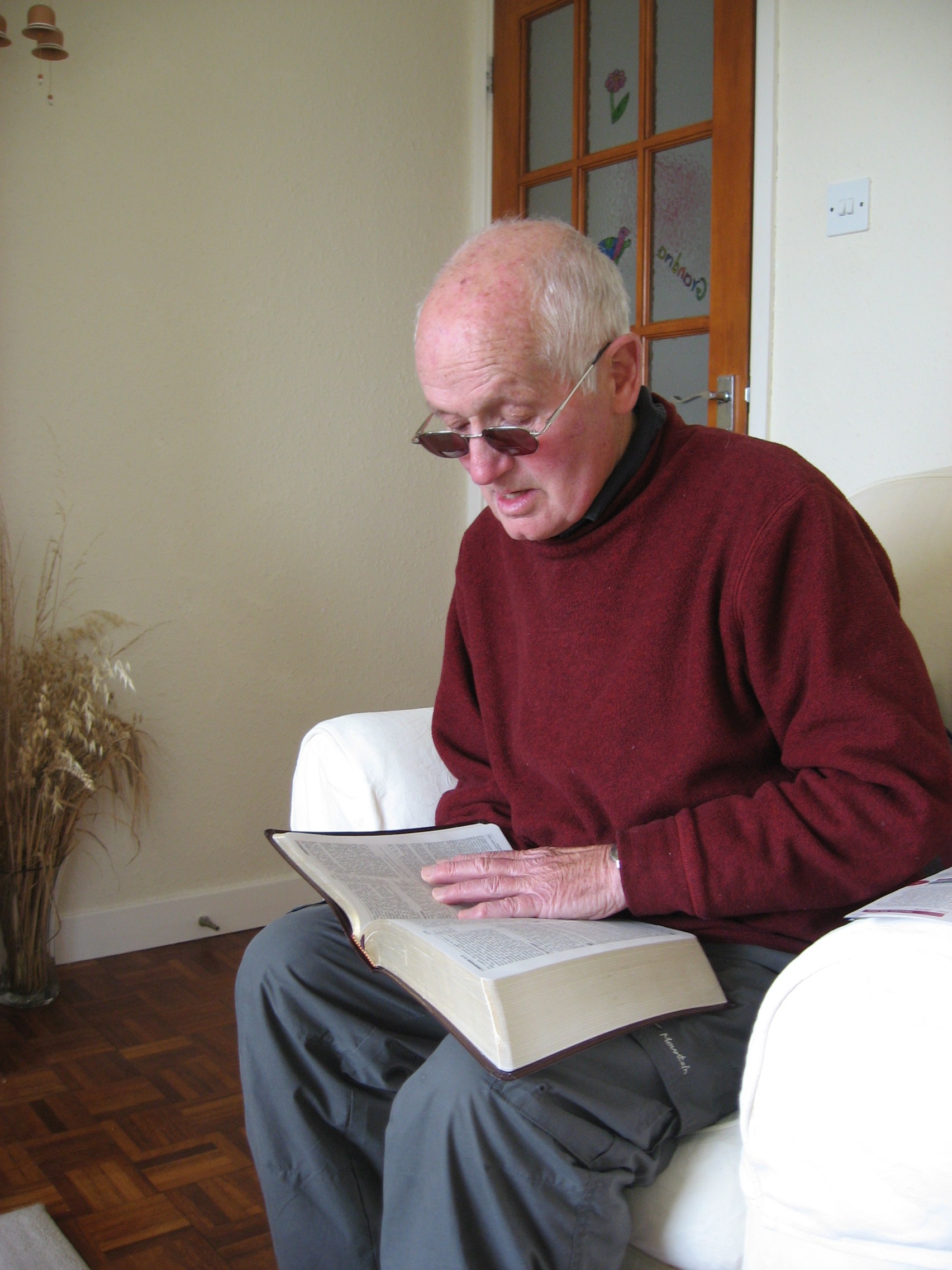
New Beginning: Why Read Psalms?

I have decided to read the book of Psalms.  Why?  Because I need an aid to my life of praise and worship.  I am stronger by far in my study of the Bible than I am in prayer, or worship/praise.

Before we get stuck into the book of Psalms, there are a couple of points to navigate.  Firstly, what is worship?  For many of us, “worship time” has become synonymous with “song time”.  In fact, at the Barrington campus I was trying to get Jr. Highers to realise that worship does not equal singing, but because their experience so strongly coloured their perspective the word worship was welded to the word singing for them.

Worship means ascribing due worth to something or someone.  In my wedding ceremony I promised to ‘worship’ my wife.  I neither made her an idol, nor promised to sing to her forever.  I agreed to value her as a God-created woman, made in the image of God.  I agreed never to devalue her.

The highest object of worship is our highest object of value.  If we value money above all else, if we spend our time worrying about it, if we put a dollar value on everything, then we worship money in an unhealthy way.  If we place all of our energy, all of our time, all of our finances, and all of our thinking at God’s disposal then we are living lives of worship.

One aspect of ascribing value to God is to declare his worth in song.  This is the worship that we find in the Psalms.  The Psalms give us an idea of how to ascribe to God his proper worth.

Praise is a slightly different concept.  We all speak highly about things that we value.  We give praise where it is due.  If it is true that God created the world and sustains it moment by moment, I would say that is an act worthy of praise.  However, the psalmists know God to be intimately involved with all of Creation in a personal way.  Each day a right-minded person sees more acts that are performed by God.  Each day there is something new to praise God for.

Finally, psalms are songs that were originally written for large groups of people to sing at the temple.  These are not private prayers of personal reflection.  We are not breaking open David’s diary.  We are seeing songs that he and others wrote for the whole world to sing.  Of course, they have personal application.  However, they are also a model for modern song writers who want to glorify God with their craft.

Going Deeper

  1. How do you feel about poetry?
  2. Do you have some favourite poems?
  3. How are songs and poetry a comfort and a help to us?
  4. What is chiasmus?
  5. What is parallelism?
  6. How does technically understanding poetry help a person grow closer to God?
Posted in Daily Devotions | Leave a comment

Communitas not Community

In the book, The Forgotten Ways, that I have been reading as an applicatio of the book of Acts, Alan Hirsch advicates letting go of community in our churches and replacing it with communitas.  In community people are inward looking and seek to maintain and build the system that they have.  In communitas people rally around a cause and are outwardly focused to take it to those around them.

With community people are homogeneous and with communitas they are heterogeneous.  People will work with anyone to fulfill their call.

Studies released this week show that organized religion is on the decline.  People are predicting, using mathematical models, that religion will die out.

Going Deeper

Read the reports from CNN and the BBC and think what your response will be.

http://religion.blogs.cnn.com/2011/03/23/religion-to-go-extinct-in-9-countries-experts-predict/?hpt=C2

http://www.bbc.co.uk/news/science-environment-12811197

Posted in Daily Devotions | Leave a comment

Godfather: Tribute to Uncle Den

About an hour ago my godfather left earth.  He is in the presence of his Lord, who he served faithfully for many years.  My godfather was my Uncle Den.  My mother and father chose them to raise me if anything should happen to them.  My parents thought that my aunt and my uncle were people of character.  They always have been.

My Uncle was never one to sit on the sidelines and watch.  He wasn’t really one for sitting anywhere at all.  He wasn’t even one for traveling slow.  From age 33 he was a runner, he was a conoeist, he was an abseiler, and he was a walker (as long as the terrain was a challenge – like most men he hated walking in a shopping mall).  My grandmother would be whisked around with some velocity as he ran her up and down the hills of Plymouth in her wheelchair.  He was a good son-in-law.  My mother didn’t know whether he would turn up at her place of work or at her house jogging or cycling.  However, he would drop everything to go across town (sometimes even taking a car) and fix something that my mother needed help with.  He was a good brother-in-law.

As my Uncle and godfather I got to know him as an authority on trains and as a very active youth leader.  He would encourage the children in his care to overcome all kinds of fears and accomplish amazing feats, all for the sake of a Mars Bar.  He would bounce along energetically as he and his wife belted out songs with more umph! than most polished worship bands.  When I went to Caversham, in Reading, I had fun at church with my godparents.  I used to look forward to the vibrant faith and the chilly hall on a Christmas morning.  My Uncle’s faith was real.  He cared about injustice and he was nicknamed The Angry Old Man (AYM) because his faith told him that reaching out to people all over the world was essential, it made him angry when the world sat by and let injustice happen.  That influenced me.  He was also compassionate.  He cared for me, for his family, for Kenyans, and for his church in meaningful ways.  He didn’t distance himself from me when I became an obnoxious train-spotter.  He shared his knowledge of trains with me and he even arranged for me to drive a High Speed Train at 127 miles per hour between Reading and Swindon.  He gave me a chance to minister with him in his youth work.  Also, when I messed up he was willing to be my advocate in a difficult situation.

My uncle wrote to me a lot when I was traveling the world.  He would write his address using coordinates for the absolute location.  He would address the letters to AYM and sign them AOM.  I remember returning home and sitting together on the cliffs of Bovisand looking out to sea, thinking that our relationship had become mutually respectful.  He treated me as an adult, but still tested me with philosophical questions and physical challenges.

Last time I saw him he was weakened by the illness that took him.  He was struggling to make sense of the journey ahead.  He was bidding farewell to his beloved Dartmoor in poetry.  We were able to talk and look out over the sea together.  The most precious moment was when he suggested that we share communion.  Four of us prayed together and I felt deeply touched.  This faithful man overcame many challenges, but his goal was always to live for the ‘man from Galilee’.  Even in his weakness, he exhibited strength.

I run regularly because of the values that my godfather passed on to me.  However, I pursue God in a radical and uncompromising way because of what he modeled for me.  He has run the race well.  I pray that I will be the legacy on Earth that he would have hoped for.

Dennis Alfred Charles Batten d. March 21st 2011

Posted in 1 | 6 Comments

Passover Seder

I have decided to do a Passover Seder at my house this year.  We will be doing it on Palm Sunday, the week before Easter.  I thought that I had to bight the bullet and just do one.  As an attender at past Seders I have found them to be inspirational and really set the context for the Breaking of Bread.

Also, I am challenged that each person in the small group become as active as possible.  To that end I have challenged Kelli to look over our communications with each other and see if there is anything else we could be doing.

1 Comment

Application of Acts to Church Organization

In the next section of Alan Hirsch’s book The Forgotten Ways he explains what he terms organic systems.  He starts by showing that Jesus talked in mostly organic terms about organisation using imagery of fields or vines.  He insists that this was not just a surface illustration but a deeper one.

Organic systems have embedded within each cell the information we would call DNA.  In the same way an active church in the mode of the book of Acts needs to develop its members into people who understand what their calling is and are ‘living it’.  These people (who see God in all of their lives because God is one and is everywhere) will communicate the gospel of God through their social networking.  They will then need to train up the contacts that they make by forming new cells which then are well enough trained and living spiritually disciplined lives that they reproduce.

The leadership and inspiration for this kind of organization does not come from on high through an hierarchy.  It comes from the individuals in the group seeing their calling and communicating their enthusiasm for Christ life-on-life in smaller groups.

Posted in Daily Devotions | Leave a comment

Application of Acts to Church Leadership

In his book Forgotten Ways, Alan Hirsch advocates the setting up of an Apostolic Environment.  To create this environment requires leaders with vision.  They must be led by the Holy Spirit to want to break new ground in the local community.  This means that they will influence others to see it as their mission to reach others and encourage them to live a life transformed by the spiritual disciplines.  This looks a lot like the apostles in the Book of Acts.  Secondly, these inspirational leaders should keep the church forward looking and also make sure that the theology in the church is sound.  Lastly, the leaders must create the kind of fertile environment that births new ministries.

The ministers in the movement that Alan Hirsch envisions will have five primary teaching roles.  Those roles are apostle, prophet, evangelist, pastor and teacher.  In the modern church, says, Hirsch, the function of ministers is mostly in the pastor or teacher role.  These two roles maintain, but they do not cast vision and adapt ministry to the postmodern world.  The church needs leaders who are not respected because of their position, but gain position because of respect.  The respect is generated as they express clearly the fresh, god-given vision that God has given their church.

Posted in Daily Devotions | Leave a comment

The Problem With Change

Going from reading passages of the Bible to reading a book that applies that book has been problematic.  I was in a system and that system needed to change to make me see more of the relevance.

The problem with change is that it is messy.  I found that I had set myself the goal of going from reading a whole chapter within a book of the Bible to reading a whole book of possibly 200 to 300 pages as a devotional task.

Because of the overwhelming nature of this, I found that I was reading less biblical and devotional material and not more.  Even over a week or two, not reading the Bible negatively changes the way one sees the world.

I am therefore setting myself the goal of reading one chapter a day in devotional/applicational books after I have read a book of the Bible.  this seems sustainable.

Posted in Daily Devotions | Leave a comment

Applying the Book of Acts Today

As a follow up to reading the entire book of Acts, I read the book Transformational Church http://www.transformationalchurch.com/ .  In this book, the authors lay out an assessment that they did of North American churches to find out what the most healthy churches are doing.

What we find is that the healthy churches have really taken the core principles from the book of Acts and are running with them.  The churches are focused on mission.  They see themselves as situated in a geographical location to reach that location in particular.  The church is intentionally relational and makes friendships that last with people in the local community.  These are not the shallow connections of “How are you doing?” without really listening for an authentic answer.  These relationships are a basis to build into friends’ and neighbours lives with spiritual growth.  Vibrant leadership, leadership that equips and enables their congregations, by modeling the best practices of spiritual growth needs to lead the way in forming relationships.  However, the church, in general has become very passive in allowing their leaders to do ministry for them rather than motivate the church members to be missionaries to those they live around.

There are a lot more principles outlined in the book, but I recommend that you get a copy and read the research.  We all know that the church in general is in decline in the West.  This book outlines the activities of churches that are not in decline, and is therefore a breath of fresh air.  I am on a team at my church that is evaluating how we may apply this book’s findings.  Maybe you should read it and form a group with a mission yourself  http://www.transformationalchurch.com/.

Next, I will be reading a book called The Forgotten Ways by Alan Hirsch.  It is generally seen as emergent, and although at Moody, where I work, the emergent church is very controversial, they are trying to apply the principles of the book of Acts.  I will post an overview when I have read the book.

Posted in Daily Devotions | 1 Comment

Worldview Evangelism

Ajith Fernando concludes his commentary on Acts by reminding us how Paul contextualized his message and taught with worldview in mind:

“If we are truly to identify with those whom we are trying to reach, we must open our lives to them as Paul did.

In such situations, Paul preached and taught (v. 31).  Preaching (kerysso) refers to a proclamation of the message that appeals primarily to the will of the individual.  In eaching (didasko) the emphasis is more on challenging the mind.  Often in Acts evangelism is described as teaching (5:21, 25, 28).  Especially when evangelizing people who do not have a Christian worldview, teaching is important to understand what Christians are saying and thus make an intelligent decision.  however, impressed they may be by the oratory in preaching, they will interpret our message by sending its words through the grid of their own worldview.  they may make a decision in response to our invitation, but they have not understood the gospel.

The evangelistic discussions that Paul had with his audiences undoubtedly helped the truth of the gospel sink into their minds.  Two days before writing this I spoke at a YFC evangelistic camp.  About 70% of the youth in the audience were Buddhist, Hindu, or Muslim.  I spoke on who Jesus is, explaining things that the Gospels say about him.  The speakers before me had spoken on creation, the Fall, and the efects of sin on personal life and relationships.  After my talk we had a seventy-five minute discussion about what Christians believe.  Much of what happened up to that time had ben teaching the truths about Christianity through talks and discussions.  When an evangelist spoke the night after I had spoken, many people were ready to commit their lives to Christ.  though this was an evangelistic camp, the teaching was as critical as the preaching.

Since the majority of the people in the West today have rejected Christianity, their worldview too is not Christian.  therefore witnesses in the post-Christian West face the same challenge that we in so-called  non-Christian countries do.  A key to effective evangelism in both these environments is teaching people what Christians believe and being sensitive to their reactions.  Teaching does not have to be boring!  I have heard people say of some Christian communicators that they are teachers, not preachers.  But what they really meant is that they were boring speakers.  Teachers must use a variety of means to attarct and keep the attention of the audience.”

(The NIV Application Commentary: Acts pp.631,632)

Acts 28:16-31

16 When we got to Rome, Paul was allowed to live by himself, with a soldier to guard him.

 17 Three days later he called together the local Jewish leaders. When they had assembled, Paul said to them: “My brothers, although I have done nothing against our people or against the customs of our ancestors, I was arrested in Jerusalem and handed over to the Romans. 18 They examined me and wanted to release me, because I was not guilty of any crime deserving death. 19 The Jews objected, so I was compelled to make an appeal to Caesar. I certainly did not intend to bring any charge against my own people. 20 For this reason I have asked to see you and talk with you. It is because of the hope of Israel that I am bound with this chain.”

 21 They replied, “We have not received any letters from Judea concerning you, and none of our people who have come from there has reported or said anything bad about you. 22 But we want to hear what your views are, for we know that people everywhere are talking against this sect.”

 23 They arranged to meet Paul on a certain day, and came in even larger numbers to the place where he was staying. He witnessed to them from morning till evening, explaining about the kingdom of God, and from the Law of Moses and from the Prophets he tried to persuade them about Jesus. 24 Some were convinced by what he said, but others would not believe. 25 They disagreed among themselves and began to leave after Paul had made this final statement: “The Holy Spirit spoke the truth to your ancestors when he said through Isaiah the prophet:

 26 “‘Go to this people and say,
“You will be ever hearing but never understanding;
   you will be ever seeing but never perceiving.”
27 For this people’s heart has become calloused;
   they hardly hear with their ears,
   and they have closed their eyes.
Otherwise they might see with their eyes,
   hear with their ears,
   understand with their hearts
and turn, and I would heal them.’[a]

 28 “Therefore I want you to know that God’s salvation has been sent to the Gentiles, and they will listen!” [29] [b]

 30 For two whole years Paul stayed there in his own rented house and welcomed all who came to see him. 31 He proclaimed the kingdom of God and taught about the Lord Jesus Christ—with all boldness and without hindrance!

Questions

  1. To whom was Paul chained?
  2. To whom did Paul preach?
  3. How does this passage reveal the methods that Paul has used throughout Acts?
  4. Why do you think the book ends abruptly?
  5. How are you living as Acts 29?
Posted in Daily Devotions | Leave a comment

God’s Sovereignty Over The Seas

When I grew up in England I remember seeing a man in a storm.  We were on a cliff in North Cornwall and the man was weaving masterfully over the waves before they shattered on the rocks.  The raging seas continued for the rest of the day, but in the papers the day after we read that the man we had seen was dead.

Sailors are renowned for superstition and faith.  It is a comfort to believe that there is a force greater than the forces of the oceans.  Of course, the God of the oceans and the seas can shape their actions.  We are sometimes left to wonder why God allows death at sea, but God is allowed to show grace and save whomever he chooses.

In the case of Paul’s shipwreck on Malta God saves Paul for his own purposes. God wishes Paul to go to Rome, and all the other passengers share in the grace that God shows Paul.

Acts 27:1-28:15

1 When it was decided that we would sail for Italy, Paul and some other prisoners were handed over to a centurion named Julius, who belonged to the Imperial Regiment. 2 We boarded a ship from Adramyttium about to sail for ports along the coast of the province of Asia, and we put out to sea. Aristarchus, a Macedonian from Thessalonica, was with us.

 3 The next day we landed at Sidon; and Julius, in kindness to Paul, allowed him to go to his friends so they might provide for his needs. 4 From there we put out to sea again and passed to the lee of Cyprus because the winds were against us. 5 When we had sailed across the open sea off the coast of Cilicia and Pamphylia, we landed at Myra in Lycia. 6 There the centurion found an Alexandrian ship sailing for Italy and put us on board. 7 We made slow headway for many days and had difficulty arriving off Cnidus. When the wind did not allow us to hold our course, we sailed to the lee of Crete, opposite Salmone. 8 We moved along the coast with difficulty and came to a place called Fair Havens, near the town of Lasea.

 9 Much time had been lost, and sailing had already become dangerous because by now it was after the Day of Atonement.[a] So Paul warned them, 10 “Men, I can see that our voyage is going to be disastrous and bring great loss to ship and cargo, and to our own lives also.” 11 But the centurion, instead of listening to what Paul said, followed the advice of the pilot and of the owner of the ship. 12 Since the harbor was unsuitable to winter in, the majority decided that we should sail on, hoping to reach Phoenix and winter there. This was a harbor in Crete, facing both southwest and northwest.

The Storm

 13 When a gentle south wind began to blow, they saw their opportunity; so they weighed anchor and sailed along the shore of Crete. 14 Before very long, a wind of hurricane force, called the Northeaster, swept down from the island. 15 The ship was caught by the storm and could not head into the wind; so we gave way to it and were driven along. 16 As we passed to the lee of a small island called Cauda, we were hardly able to make the lifeboat secure, 17 so the men hoisted it aboard. Then they passed ropes under the ship itself to hold it together. Because they were afraid they would run aground on the sandbars of Syrtis, they lowered the sea anchor[b] and let the ship be driven along. 18 We took such a violent battering from the storm that the next day they began to throw the cargo overboard. 19 On the third day, they threw the ship’s tackle overboard with their own hands. 20 When neither sun nor stars appeared for many days and the storm continued raging, we finally gave up all hope of being saved.

 21 After they had gone a long time without food, Paul stood up before them and said: “Men, you should have taken my advice not to sail from Crete; then you would have spared yourselves this damage and loss. 22 But now I urge you to keep up your courage, because not one of you will be lost; only the ship will be destroyed. 23 Last night an angel of the God to whom I belong and whom I serve stood beside me 24 and said, ‘Do not be afraid, Paul. You must stand trial before Caesar; and God has graciously given you the lives of all who sail with you.’ 25 So keep up your courage, men, for I have faith in God that it will happen just as he told me. 26 Nevertheless, we must run aground on some island.”

The Shipwreck

 27 On the fourteenth night we were still being driven across the Adriatic[c] Sea, when about midnight the sailors sensed they were approaching land. 28 They took soundings and found that the water was a hundred and twenty feet[d] deep. A short time later they took soundings again and found it was ninety feet[e] deep. 29 Fearing that we would be dashed against the rocks, they dropped four anchors from the stern and prayed for daylight. 30 In an attempt to escape from the ship, the sailors let the lifeboat down into the sea, pretending they were going to lower some anchors from the bow. 31 Then Paul said to the centurion and the soldiers, “Unless these men stay with the ship, you cannot be saved.” 32 So the soldiers cut the ropes that held the lifeboat and let it drift away.

 33 Just before dawn Paul urged them all to eat. “For the last fourteen days,” he said, “you have been in constant suspense and have gone without food—you haven’t eaten anything. 34 Now I urge you to take some food. You need it to survive. Not one of you will lose a single hair from his head.” 35 After he said this, he took some bread and gave thanks to God in front of them all. Then he broke it and began to eat. 36 They were all encouraged and ate some food themselves. 37 Altogether there were 276 of us on board. 38 When they had eaten as much as they wanted, they lightened the ship by throwing the grain into the sea.

 39 When daylight came, they did not recognize the land, but they saw a bay with a sandy beach, where they decided to run the ship aground if they could. 40 Cutting loose the anchors, they left them in the sea and at the same time untied the ropes that held the rudders. Then they hoisted the foresail to the wind and made for the beach. 41 But the ship struck a sandbar and ran aground. The bow stuck fast and would not move, and the stern was broken to pieces by the pounding of the surf.

 42 The soldiers planned to kill the prisoners to prevent any of them from swimming away and escaping. 43 But the centurion wanted to spare Paul’s life and kept them from carrying out their plan. He ordered those who could swim to jump overboard first and get to land. 44 The rest were to get there on planks or on other pieces of the ship. In this way everyone reached land safely.

1 Once safely on shore, we found out that the island was called Malta. 2 The islanders showed us unusual kindness. They built a fire and welcomed us all because it was raining and cold. 3 Paul gathered a pile of brushwood and, as he put it on the fire, a viper, driven out by the heat, fastened itself on his hand. 4 When the islanders saw the snake hanging from his hand, they said to each other, “This man must be a murderer; for though he escaped from the sea, the goddess Justice has not allowed him to live.” 5 But Paul shook the snake off into the fire and suffered no ill effects. 6 The people expected him to swell up or suddenly fall dead; but after waiting a long time and seeing nothing unusual happen to him, they changed their minds and said he was a god.

 7 There was an estate nearby that belonged to Publius, the chief official of the island. He welcomed us to his home and showed us generous hospitality for three days. 8 His father was sick in bed, suffering from fever and dysentery. Paul went in to see him and, after prayer, placed his hands on him and healed him. 9 When this had happened, the rest of the sick on the island came and were cured. 10 They honored us in many ways; and when we were ready to sail, they furnished us with the supplies we needed.

Paul’s Arrival at Rome

 11 After three months we put out to sea in a ship that had wintered in the island—it was an Alexandrian ship with the figurehead of the twin gods Castor and Pollux. 12 We put in at Syracuse and stayed there three days. 13 From there we set sail and arrived at Rhegium. The next day the south wind came up, and on the following day we reached Puteoli. 14 There we found some brothers and sisters who invited us to spend a week with them. And so we came to Rome. 15 The brothers and sisters there had heard that we were coming, and they traveled as far as the Forum of Appius and the Three Taverns to meet us. At the sight of these people Paul thanked God and was encouraged.1 Once safely on shore, we found out that the island was called Malta. 2 The islanders showed us unusual kindness. They built a fire and welcomed us all because it was raining and cold. 3 Paul gathered a pile of brushwood and, as he put it on the fire, a viper, driven out by the heat, fastened itself on his hand. 4 When the islanders saw the snake hanging from his hand, they said to each other, “This man must be a murderer; for though he escaped from the sea, the goddess Justice has not allowed him to live.” 5 But Paul shook the snake off into the fire and suffered no ill effects. 6 The people expected him to swell up or suddenly fall dead; but after waiting a long time and seeing nothing unusual happen to him, they changed their minds and said he was a god.

 7 There was an estate nearby that belonged to Publius, the chief official of the island. He welcomed us to his home and showed us generous hospitality for three days. 8 His father was sick in bed, suffering from fever and dysentery. Paul went in to see him and, after prayer, placed his hands on him and healed him. 9 When this had happened, the rest of the sick on the island came and were cured. 10 They honored us in many ways; and when we were ready to sail, they furnished us with the supplies we needed.

Paul’s Arrival at Rome

 11 After three months we put out to sea in a ship that had wintered in the island—it was an Alexandrian ship with the figurehead of the twin gods Castor and Pollux. 12 We put in at Syracuse and stayed there three days. 13 From there we set sail and arrived at Rhegium. The next day the south wind came up, and on the following day we reached Puteoli. 14 There we found some brothers and sisters who invited us to spend a week with them. And so we came to Rome. 15 The brothers and sisters there had heard that we were coming, and they traveled as far as the Forum of Appius and the Three Taverns to meet us. At the sight of these people Paul thanked God and was encouraged.

Questions

  1. Why is Paul’s journey important?
  2. Who is with Paul and writes the account of the journey?
  3. Why does God show grace to Paul and the travelers?
  4. How is God’s sovereignty revealed?
  5. Why does God control the elements to do what he wants to do and not to do the good that we think he should do?
Posted in Daily Devotions | Leave a comment